

Plant-Wide Time Synchronization: NTP, PTP, and GPS Strategies for Yokogawa CENTUM VP and Bently Nevada 3500 Systems
Why Do Timestamps Make or Break Trip Investigations?
Every serious trip investigation starts with a sequence of events. However, that sequence means nothing when the clocks disagree. I investigated a steam turbine trip where three systems disagreed by eleven seconds. The Yokogawa CENTUM VP historian logged one order of events. The Bently Nevada machinery monitoring system told another story. The electrical protection relay told a third. We spent two days arguing about cause and effect before anyone checked the clocks. Therefore, treat time synchronization as a safety-critical service, not an IT afterthought. Small clock offsets between devices make event logs misleading. Worse, they poison trust in the whole historian.
What Are the Operating Principles and Limits of NTP and SNTP?
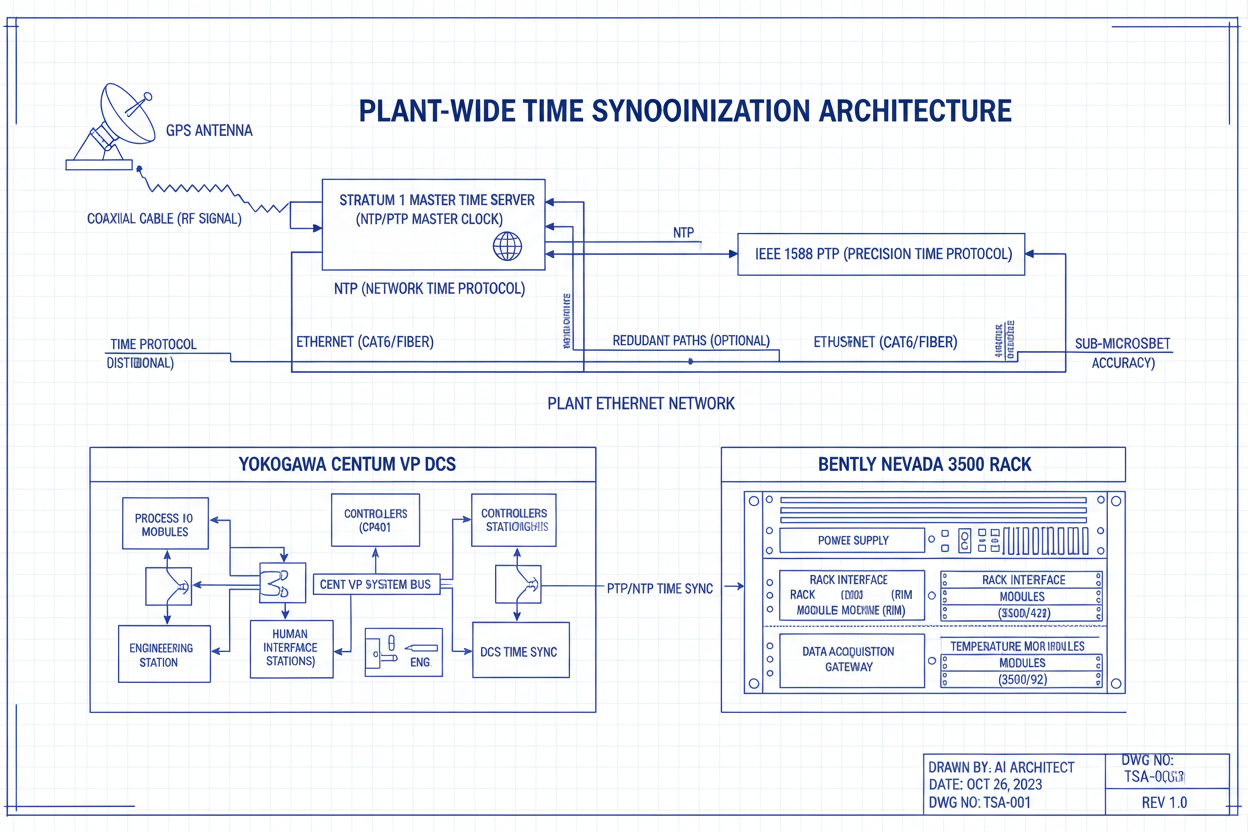
Network Time Protocol is the simplest and most common sync method. A master server holds the reference time, and client devices ask for updates at regular intervals. The server can pull its time from GPS satellites or internet sources. NTP accuracy reaches about 10 milliseconds on a good plant network. SNTP, the simplified version, skips the network delay calculations. It achieves only around 50 milliseconds and suits small, uncritical applications. The stratum level describes distance from the reference. A GPS receiver is stratum 0 hardware feeding a stratum 1 server. Your plant hierarchy should follow the same cascade. Moreover, keep the hierarchy shallow. Every additional stratum layer adds error. However, never sync a control system to an internet time server directly. That path crosses your security boundary and introduces jitter you cannot control.
- Step 1: Install a GPS time receiver with antenna as the stratum 0 source.
- Step 2: Dedicate one server as the internal stratum 1 NTP master.
- Step 3: Configure all DCS servers, PLCs, and HMIs as clients of that master only.
- Step 4: Document the stratum hierarchy and forbid direct internet time sources.
How Does PTP Deliver Sub-Millisecond Accuracy for Critical Applications?
Precision Time Protocol, IEEE 1588, delivers accuracy near one millisecond and often far better. The master pushes timestamps to slaves at continuous intervals instead of waiting for requests. Slaves account for network delay and adjust their clocks with negligible offset. However, that accuracy has a price. You need PTP-capable Ethernet switches with hardware timestamping. Ordinary switches add unpredictable queuing delay that destroys PTP accuracy. In the automation world, several profiles build on this foundation. EtherNet/IP networks use CIP Sync, an IEEE 1588 profile, to align controller clocks. Yokogawa systems synchronize their domains and fieldbus communication modules with disciplined GPS-referenced masters. Therefore, choose PTP when sequence-of-events accuracy below 10 milliseconds matters. Choose NTP for general SCADA and historian tagging. Finally, match the protocol to the application, never to marketing claims.
- Step 1: Identify devices that genuinely need sub-10 ms event resolution.
- Step 2: Deploy PTP-capable switches with hardware timestamping in those segments.
- Step 3: Elect one grandmaster clock, referenced to GPS, for the whole PTP domain.
- Step 4: Verify slave offsets against the grandmaster after every network change.
How Do You Synchronize CENTUM VP and Bently Nevada 3500 to One Clock?
Here is a practical architecture that works. A GPS receiver feeds a dedicated time server, creating the stratum 1 master. The Yokogawa CENTUM VP domain syncs to this master and distributes time across its stations. The Bently Nevada 3500 racks and their proximitor monitors accept NTP time from the same source through rack interface modules. First, configure the time server IP address in each 3500 rack setup. Second, verify the rack clock offset from System 1 or the rack configuration software. Moreover, check the CENTUM VP station clocks weekly through the system status display. I recommend a tolerance policy: keep all devices within one second of the master, and within 10 milliseconds for machinery protection systems. Finally, add a time-drift alarm. A device that silently stops syncing deserves an alarm, because its timestamps will rot slowly until the next trip investigation.
- Step 1: Point the CENTUM VP time master and each 3500 rack to the same NTP server.
- Step 2: Set polling intervals to a few minutes and keep them consistent across devices.
- Step 3: Log the offset of every device weekly and trend it like a process variable.
- Step 4: Alarm on any device whose offset exceeds 1 second for 24 hours.
- Step 5: After every trip, export all event logs in UTC before local conversion.
Conclusion & Action Advice
Time synchronization is cheap insurance for expensive investigations. First, anchor the whole plant to one GPS-referenced master and build a documented stratum hierarchy. Second, use NTP for general tagging and PTP where sub-10 millisecond sequence resolution is real. Moreover, align your Yokogawa CENTUM VP stations and Bently Nevada 3500 racks to the identical source, never to separate servers. However, remember that hardware alone guarantees nothing. Verify offsets after every network change and every switch replacement. Therefore, trend clock offsets like any other critical measurement. Finally, run a quarterly time audit. Pull the plug on the GPS antenna during a planned test and watch how your systems react. The day a turbine trips, your event logs will tell one story, and it will be the true one.
Author: Zhou Yiming is an industrial automation engineer with over 10 years of experience in PLC, DCS, and control systems.


