

Legacy DCS Modernization: Why Plants Should Review Before They Migrate
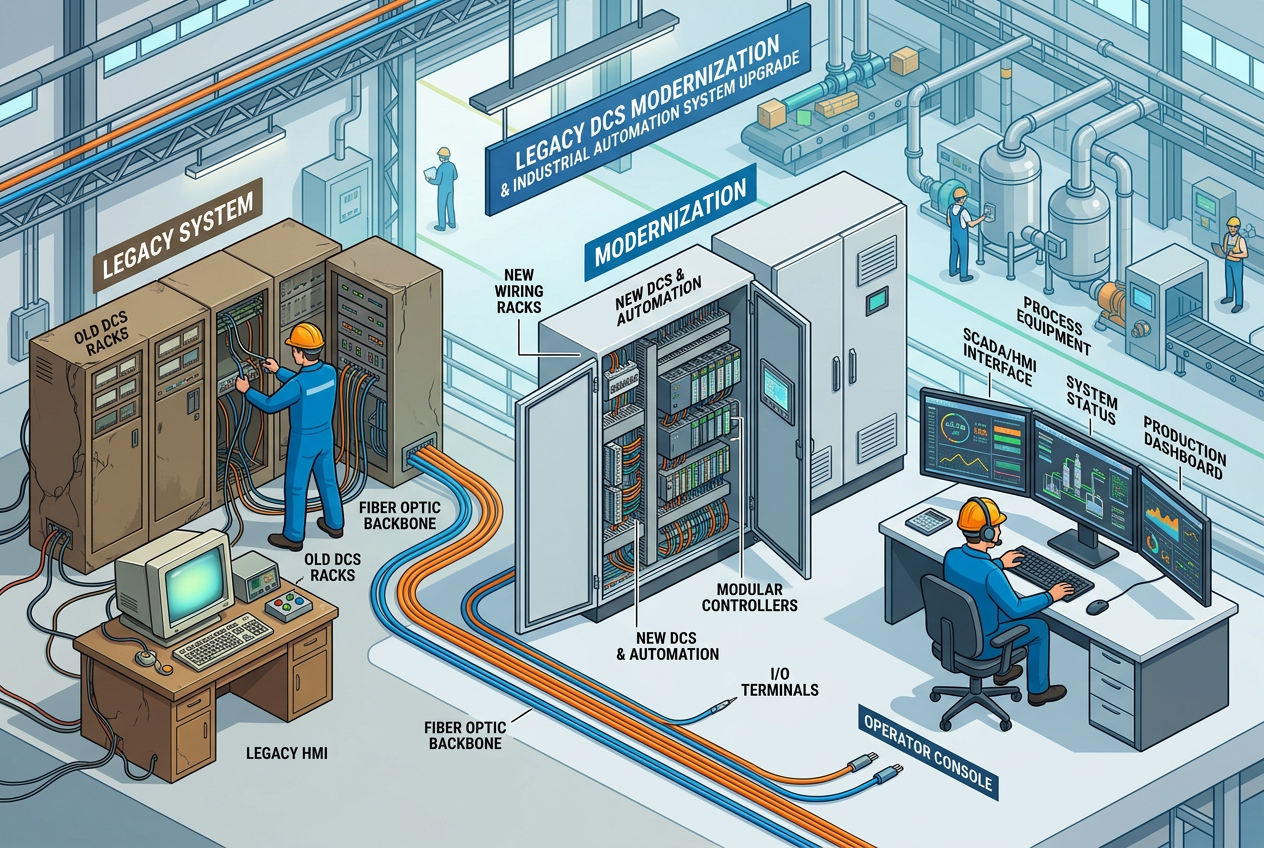
Legacy DCS Modernization: Why Plants Should Review Before They Migrate
A structured engineering approach to replacing aging distributed control systems without reproducing decades of configuration problems.
Why Can a Like-for-Like DCS Migration Create Costly New Problems?
Many industrial plants operate distributed control systems that have been running for decades. While these legacy systems continue to manage baseline production, aging electronics, scarce spare parts, and outdated engineering environments make long-term maintenance increasingly hazardous.
A frequent mistake during upgrades is blindly executing a "1-to-1" or like-for-like configuration conversion. On the surface, copying existing logic seems fast and low-risk because it preserves familiar loop behaviors. However, decades of plant modifications inevitably leave behind unused points, obsolete logic rungs, duplicated alarm thresholds, and undocumented temporary workarounds.
Directly porting legacy code transfers historical technical debt into the new platform. Plant teams invest heavily in state-of-the-art controllers such as the Emerson DeltaV CPU Module, yet end up saddled with the exact same engineering bloat. A successful modernization begins with a thorough audit: engineers must clarify what process functions are actually active before deciding what to convert, re-engineer, or retire.
How Do Engineers Build a Reliable Baseline Before Conversion?
You cannot migrate what you do not fully understand. The first priority is compiling a comprehensive, verified inventory of the current control system:
- Hardware Audit: Catalog every rack, controller, and backplane, including legacy processor cards like the Yokogawa CP401-10 Processor Module and system power infrastructure like the Honeywell 51198947-200 DCS Power Supply Module.
- Database & I/O Cross-Check: Compare original engineering loop sheets and P&IDs against live controller exports. Discrepancies are common: decommissioned transmitters often remain configured as ghost channels, while field jumper wires may bypass unrecorded interlocks.
- Interface Documentation: Map out all third-party PLC communication gateways, historians, safety instrumented systems (SIS), and OPC servers.
Every unexplained point or orphaned software tag should be logged with an assigned engineer and a clear disposition status, establishing a verified project baseline across operations, maintenance, and EPC teams.
What Are the Essential Engineering Phases for DCS Modernization?
Rather than treating migration as an abrupt hardware swap, top engineering teams follow a phased approach:
- Phase 1: Architecture & Hardware Assessment: Map the physical network topology, control bus limitations, and unsupported legacy hardware cards to pinpoint immediate reliability vulnerabilities.
- Phase 2: Configuration Gap Analysis: Interrogate control modules against actual operational requirements. Clean out inactive alarm tags, resolve redundant sequences, and document undocumented bypasses.
- Phase 3: Standardizing Conversion Rules: Establish strict implementation guidelines on the target DCS platform, covering tag naming conventions, engineering unit scaling, alarm rationalization (ISA-18.2), and modular function block templates.
- Phase 4: Automated Database Comparison: Utilize automated verification utilities to scan exported tag databases against converted targets, catching missing parameters, attribute shifts, and incomplete mapping before checkout.
- Phase 5: Cutover Strategy & Contingency Planning: Detail step-by-step turnaround windows, loop-by-loop hot cutover feasibility, equipment interdependencies, and unambiguous rollback triggers with defined authority.
- Phase 6: Post-Migration Tuning & Validation: Carry out loop response verification, operator feedback reviews, and baseline energy/throughput comparisons against pre-migration metrics.
Why Is Rigorous I/O and Logic Validation Critical?
Migrating physical and software I/O requires much more than matching screw terminal numbers. Field instrument impedance, 2-wire vs. 4-wire power loops, HART pass-through, and fail-safe trip states must be verified channel by channel.
For example, when transitioning legacy analog/discrete channels to modern I/O architectures—such as replacing older racks with high-density field interface assemblies or a dedicated Emerson DeltaV KJ3101X1-BB1 DI Module or legacy Foxboro I/A Series FBM211 Differential Input Module—proper channel isolation, grounding, and wiring polarity must be confirmed before energizing.
Crucially, protective interlocks and emergency shutdown (ESD) interfaces must undergo strict Management of Change (MOC) reviews. A logic sequence that worked in the past may rely on undocumented timing delays that behave differently on faster modern scan cycles.
What Should Be Covered During FAT, SAT, and Operational Readiness?
Simulation and testing are the only safety net protecting live production during a plant turnaround:
- Factory Acceptance Testing (FAT): Conduct full software loop simulation, dynamic graphics checkout, alarm priority verification, and communication failover tests on the assembled target cabinets before shipping to site.
- Site Acceptance Testing (SAT): Validate field wiring integrity, end-to-end transmitter calibration, valve stroke feedback, and emergency trip interlocks in the actual plant environment.
- Operator Transition & HMI Training: Modern High-Performance HMI (ISA-101) layouts look and respond differently from legacy character-based or 2D graphic consoles. Operators need hands-on simulation practice to react instinctively during abnormal operating conditions.
Engineering Takeaway: How Should Plants Start Their DCS Upgrade?
A DCS migration is an opportunity to revitalize your facility's operational agility, not just a hardware refresh. By investing time upfront in baseline verification, logic clean-up, and conversion rule standardization, control engineers can eliminate decades of accumulated configuration errors and ensure a flawless cutover.
Begin with a comprehensive cabinet audit, identify unsupported components early, and follow formal acceptance testing protocols to protect uptime and plant safety.


