

From Production Dashboards to Action: Closing the Improvement Loop in Food Manufacturing
From Production Dashboards to Action: Closing the Improvement Loop in Food Manufacturing
How connected production information and structured follow-up help food plants turn operational visibility into measurable results.
Why Is Real-Time Visibility Only the Starting Point in Food Plants?
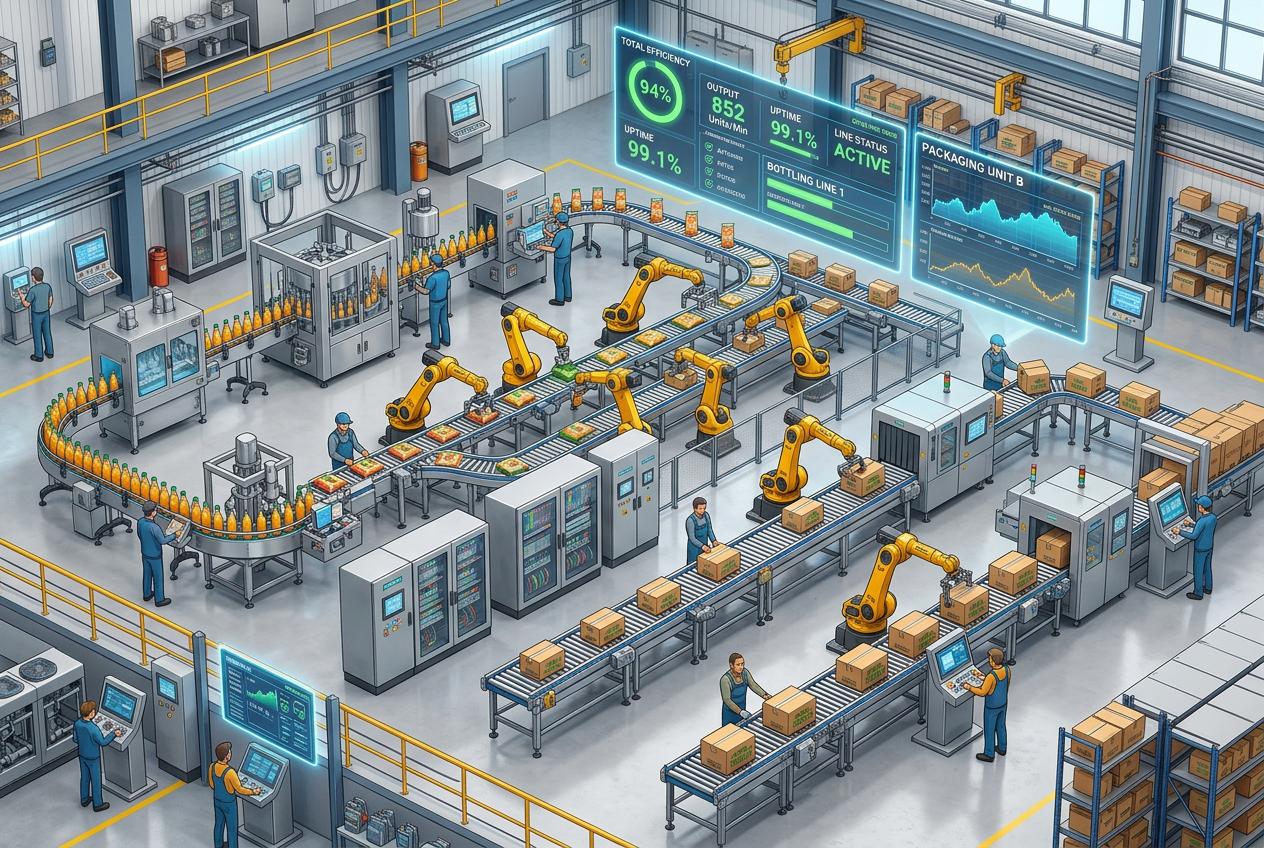
Modern food manufacturing plants generate continuous streams of operational data. Programmable logic controllers, field sensors, servo drives, operator interfaces like the Siemens KTP700 Basic HMI, and SCADA platforms continuously feed metrics on equipment status, throughput rates, and micro-downtime.
These monitoring tools empower shift supervisors to spot production deviations quickly. An interactive dashboard might highlight that a primary pouch packaging line is dropping efficiency or that a blending batch cycle is lagging behind schedule.
However, simply visualizing a red alarm indicator on a monitor does not fix the root cause. Without a formal accountability mechanism, alerts get acknowledged and forgotten, and unresolved performance dips inevitably spill over across shift handovers.
Where Does Critical Operational Data Get Lost Between Shifts?
Food processing plants frequently operate with segregated software systems dedicated to production scheduling, maintenance management, quality assurance, and sanitation compliance.
When an interruption strikes, operational clues end up scattered across isolated silos:
- The line operator terminal, such as an Allen-Bradley PanelView Plus 700 HMI, registers repeated mechanical jam alarms.
- The computerized maintenance management system (CMMS) stores past work orders and lubrication schedules.
- The quality management system logs temperature deviations or weight rejections, while handwritten operator logs capture anecdotal machine vibrations.
When these platforms cannot communicate, technicians lose critical time chasing data rather than troubleshooting the physical equipment, increasing mean time to repair (MTTR).
How Can Plants Connect Machine Signals to Structured Corrective Actions?
An intelligent operations layer bridges the gap between automation hardware and personnel workflows without requiring the replacement of existing PLC, SCADA, or MES architectures. By capturing event triggers directly from main line controllers like the Allen Bradley 1756-L1 ControlLogix Controller, teams can automatically structure problem resolution:
- Contextualized Capture: Log equipment faults with exact shift, recipe, and operator context.
- Automated Task Assignment: Route corrective maintenance or calibration work directly to assigned technicians.
- Clear Timelines: Define resolution windows and automated escalation triggers for time-sensitive tasks.
- Action Auditing: Maintain centralized logs of diagnostic observations, part replacements, and root-cause findings.
- Impact Tracking: Verify through real-time telemetry whether completed tasks permanently eliminated recurring faults.
How Do You Solve Packaging Line Short Stops Using Closed-Loop Data?
Consider a continuous carton packaging machine driven by dedicated motion hardware, such as the Schneider PacDrive MC-4 Servo Drive, that experiences intermittent 30-second stoppages. Standard OEE reports may hide these micro-stops inside overall availability numbers.
Here is how a closed-loop engineering approach resolves the root cause:
- Analyze Frequency Patterns: Match PLC fault timestamps against drive torque spikes and operator shift logs to pinpoint whether stoppages correlate with specific packaging roll splices or carton flap misalignments.
- Assign Targeted Inspections: Issue a targeted inspection task to inspect feed belt tension, vacuum cup wear, and drive synchronization.
- Post-Maintenance Telemetry Validation: After adjustments, monitor the line for consecutive shifts. If short stops fall to zero, standardize the revised PM interval into routine standard operating procedures (SOPs).
How Can Digital Workflows Streamline Sanitation and Quality Verification?
Food and beverage manufacturing mandates uncompromising sanitation standards and allergen controls. Digital workflows tightly coordinate clean-in-place (CIP) and changeover milestones with production schedules:
During an allergen changeover, intuitive shop-floor interfaces such as the Schneider HMIGXU5512 Touchscreen can enforce multi-point inspection checklists before permitting the line PLC to resume cycle start. If swabbing or ATP bioluminescence results are delayed, interlocks prevent product release until certified by quality staff.
How Do Food Plants Measure Whether Corrective Actions Truly Deliver Results?
Real improvement requires tracking verified key performance indicators before and after an engineering intervention:
- Micro-Downtime Frequency: Track the total count and cumulative duration of sub-minute stoppages per shift.
- True OEE Alignment: Ensure availability, performance, and quality metrics reflect actual automated counter readings rather than manual end-of-shift estimates.
- Sustainability Across Shifts: Confirm whether performance gains persist across night shifts, alternate recipes, and seasonal ambient temperature shifts.
Engineering Takeaway: How Should Food Plants Close the Loop?
Real-time visibility only delivers ROI when connected directly to human action and verified follow-up. Food manufacturers should start small: select one bottleneck packaging line or troublesome filling station, connect its PLC alarms to clear task ownership, and measure the reduction in downtime.


