

Industrial Acoustic Imaging: Finding Hidden Faults Before They Cause Downtime
Industrial Acoustic Imaging: Finding Hidden Faults Before They Cause Downtime
How sound visualization helps maintenance teams locate leaks, identify electrical discharge, and improve inspection efficiency.
Why Are Critical Industrial Faults So Difficult to Detect Early?
Many industrial equipment failures develop without obvious visual signs. A small compressed-air leak in an overhead manifold may remain unnoticed for months, steadily driving up compressor electricity costs. Similarly, partial discharge inside high-voltage switchgear can quietly degrade insulation long before catastrophic flashover occurs, and rotating mechanical assemblies frequently emit abnormal high-frequency acoustic patterns well before bearing seizure halts production.
Traditional inspection methods typically require technicians to walk through facilities investigating one potential problem spot at a time. In complex industrial plants spanning miles of pneumatic piping, motor control centers (MCC), and rotating machinery, spot-checking every valve and fitting is both labor-intensive and prone to missed anomalies.
Acoustic imaging fundamentally changes this workflow. Rather than relying solely on listening or physical contact probes, an acoustic camera visualizes ultrasonic sound waves directly over an optical image. Technicians can scan broad areas in seconds, seeing exactly where sound energy originates and pinpointing emerging issues before unplanned downtime strikes.
How Do Modern Acoustic Imagers Like the Fluke ii1050 and ii1030 Work?
On November 2, 2026, Fluke introduced its next-generation ii1050 and ii1030 acoustic imagers, demonstrating how rapidly sound visualization technology is evolving for frontline plant teams. Both models combine sensitive acoustic sensor arrays, optical cameras, and on-device analytics into lightweight handheld instruments designed for harsh plant environments.
Key technical advancements in this generation include:
- High-Density Microphone Arrays: The sensor array has expanded from 64 to 202 MEMS microphones, allowing technicians to capture much fainter acoustic signals and separate target leaks from background industrial plant noise.
- Compact Handheld Form Factor: Engineered to be roughly 40 percent smaller than previous designs and weighing approximately 1.2 kg, making one-handed operation practical in tight spaces, cable vaults, and elevated pipe racks.
- Multimodal Inspection: Equipped with a 13-megapixel optical camera, integrated LED illumination, and an IP54-rated industrial enclosure. Support for the TC03A plug-in thermal camera adds instant thermal context alongside sound heatmaps.
These capabilities allow maintenance technicians to quickly scan large production areas without shutting down active production lines or exposing personnel to hazardous proximity.
Where Does Acoustic Imaging Deliver the Greatest Value in Plant Maintenance?
Acoustic inspection delivers immediate return on investment across three critical operational areas:
1. Compressed Air and Gas Leak Detection
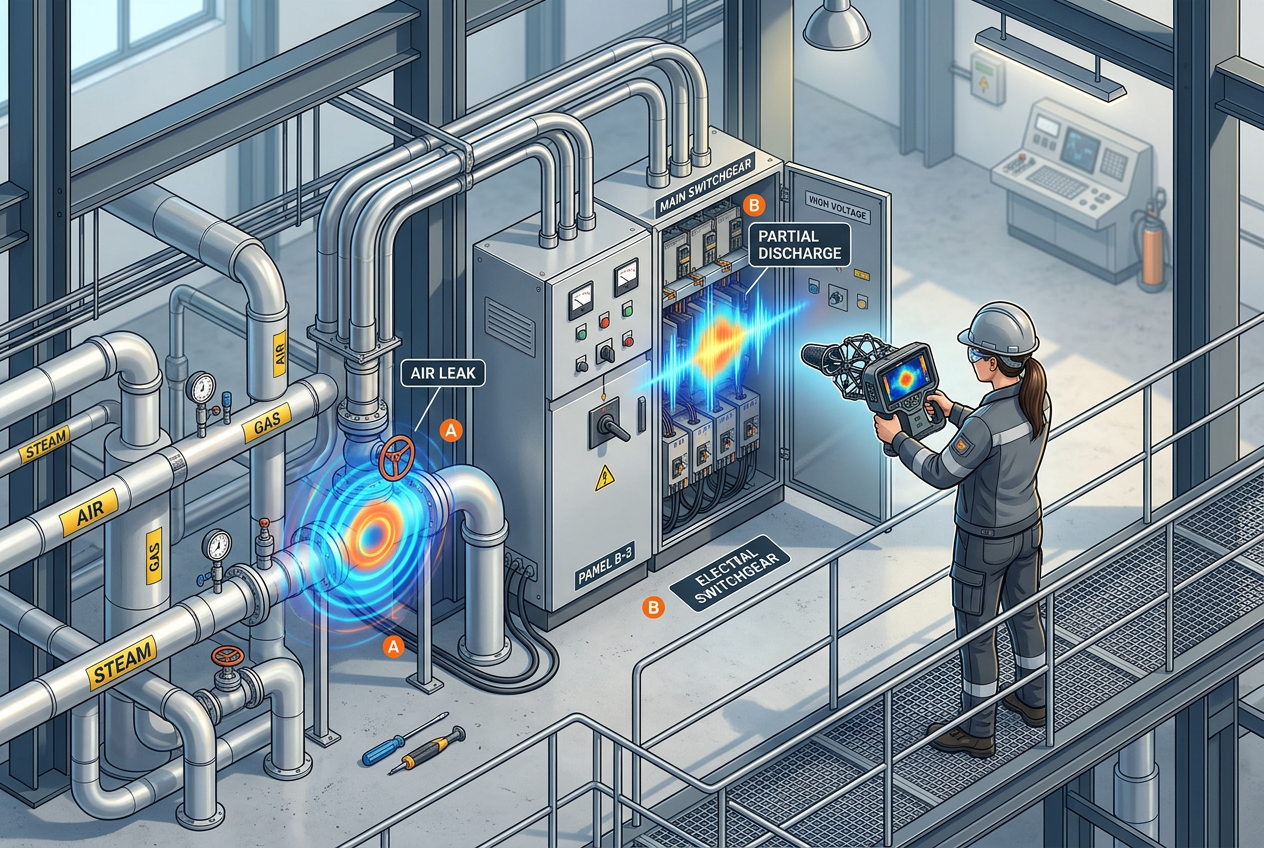
Compressed air is often called the fourth utility, and it is frequently the most expensive. In typical industrial distribution systems, 20% to 30% of compressor output is lost to piping leaks, worn couplings, and leaking valves. Acoustic cameras pinpoint air and gas leaks from distances up to 70 meters, allowing maintenance teams to tag leaks, estimate CFM loss, and schedule repairs without taking the pneumatic system offline. For comprehensive system health, pairing acoustic surveys with calibrated in-line transmitters such as the Yokogawa DPharp EJA Series Pressure Transmitter provides precise line-pressure verification across headers and branch lines.
2. Electrical Partial Discharge (PD) Inspection
Partial discharge is a localized electrical breakdown that occurs across insulation voids or surface contamination in medium- and high-voltage gear. Left unaddressed, PD tracks across insulation surfaces, generating ozone and corrosive nitric acid that inevitably leads to arc-flash events and catastrophic equipment destruction. Acoustic imaging detects the characteristic ultrasonic crackle emitted by tracking, arcing, and corona discharge from safe working distances, providing an early warning layer that complements periodic offline dielectric testing.
3. Mechanical Anomaly and Rotating Equipment Monitoring
Failing roller bearings, cavitation in centrifugal pumps, and leaking internal steam trap valves generate high-frequency frictional sound long before noticeable temperature rises or low-frequency vibration spikes occur. While acoustic imaging excels at locating these acoustic hot spots from across a room, comprehensive machine protection relies on integrating field findings with dedicated vibration instrumentation. For deep diagnostic analysis, engineers deploy portable analyzers like the Bently Nevada SCOUT100-EX Vibration Data Collector and Analyzer, while critical continuous machinery can be continuously safeguarded using the Bently Nevada 3500/16 Dual Vibration Monitor or rugged field transmitters like the Bently Nevada 177230 Seismic Transmitter.
How Should Teams Turn Acoustic Findings into Corrective Action?
Detecting an abnormal sound signature is valuable only if it leads directly to an effective maintenance response. An inspection workflow should follow a structured lifecycle:
- Tag and Geotag Assets: Correlate every acoustic image and audio recording with exact equipment asset IDs in your CMMS/EAM system.
- Capture Baseline Operating Parameters: Document machine load, ambient temperature, pressure levels, and process states at the moment of inspection.
- Quantify Severity and Financial Impact: Categorize findings by safety risk, energy cost, and potential downtime severity. Modern acoustic imagers calculate leak rate estimates directly on screen.
- Close the Maintenance Loop: Generate work orders for piping seals, lubrication, or insulation cleaning, and re-inspect the repaired component during the next inspection round to verify baseline restoration.
What Are the Best Practices for Deploying an Acoustic Program?
To maximize success when rolling out acoustic imaging in an operating plant:
- Focus on High-Impact Assets First: Start with critical compressor headers, primary substation switchgear, and bottleneck rotating equipment where downtime carries the highest financial penalty.
- Train Technicians on Environmental Interference: Acoustic reflection off metal walls, echoing ductwork, and steady background process noise can occasionally distort sound localization. Understanding frequency filtering and distance compensation prevents false positives.
- Correlate Multimodal Sensor Data: Treat acoustic imaging as an agile scout that directs deeper diagnostic tools—such as thermal imaging, oil analysis, and vibration spectrometry—to the exact spot where degradation is underway.
Summary: Moving from Reactive Repairs to Acoustic Reliability
Acoustic imaging bridges the gap between periodic manual inspections and fixed continuous monitoring. By visualizing airborne and structure-borne sound in real time, maintenance teams can identify compressed air leaks, electrical tracking, and early mechanical degradation before costly failures occur.
Combining visual acoustic surveys with established plant instrumentation and online condition monitoring creates a robust defense against unscheduled outages.
Author: Lin Wei, Senior Reliability & Field Instrumentation Engineer


