

Digital Load Cells: Bringing Vessel Weighing Data Directly into the PLC
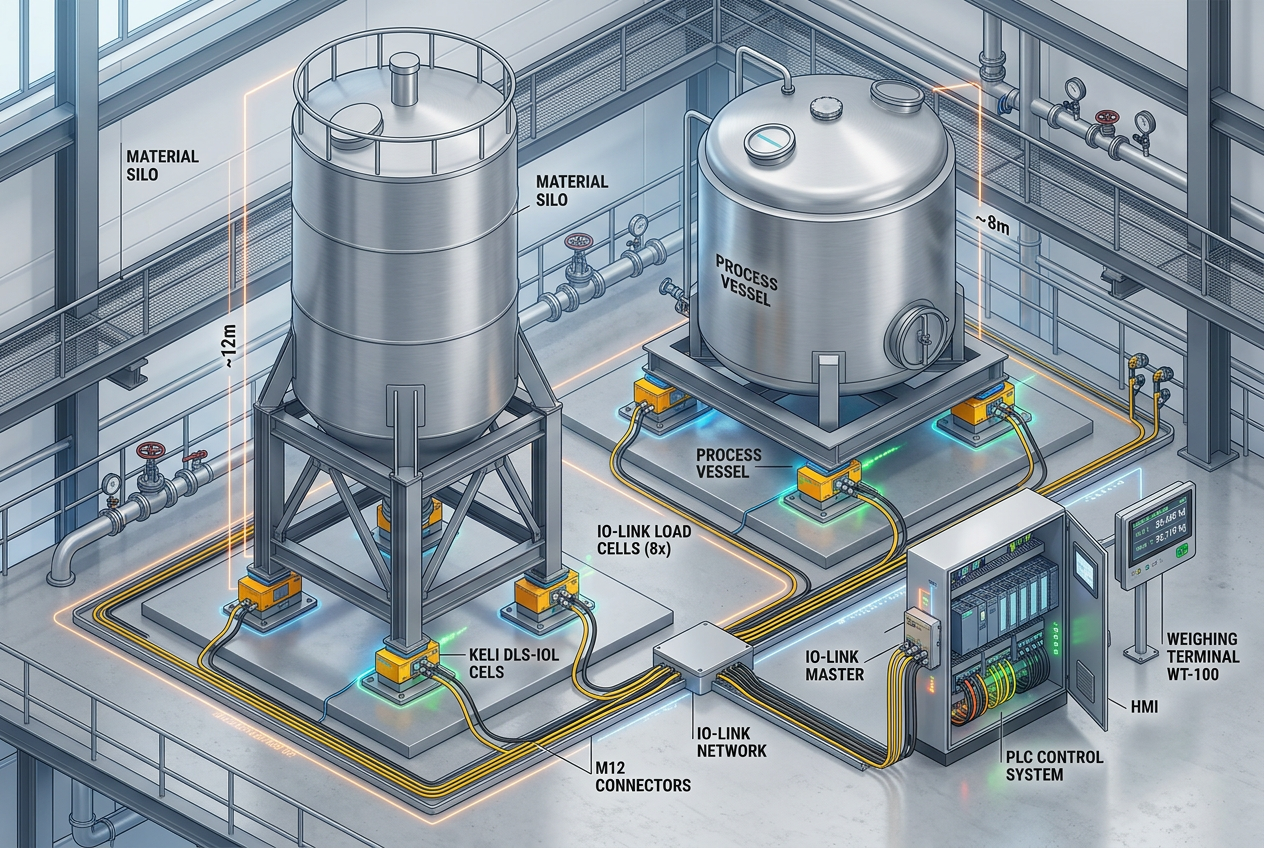
How digital weighing technology can simplify tank, silo, and hopper installations while giving operators more detailed load information.
Why do industrial vessels need individual support weighing visibility?
Industrial storage tanks, silos, and bulk hoppers rely extensively on load cells to monitor material inventory and maintain precise batching, dosing, and recipe management. In conventional installations, multiple load cells are placed beneath a vessel, routing low-voltage millivolt signals through a summing junction box and an external analog amplifier before reaching the PLC via an analog input module.
While this analog architecture is widespread, it creates an operational blind spot: operators only see the summed gross vessel weight. If material bridges unevenly, or if structural shifting forces one support leg to carry 80% of the load, the summed signal looks normal even as a mechanical failure or tipping hazard develops. Digital load cells eliminate this blind spot by providing dedicated, continuous weight feedback from every individual support point.
How does IO-Link transform traditional vessel weighing architectures?
Recent advances in digital weighing instruments—such as octogon's LBOA shear beam load cell range—integrate the signal amplifier and digital transceiver directly inside a rugged, hermetically sealed IP67 stainless steel housing. By communicating natively over IO-Link or 4–20 mA, these sensors connect directly to standard industrial network master ports.
This architectural shift removes the need for traditional summing junction boxes, potentiometer balancing, and noise-sensitive millivolt field wiring. Instead, the central PLC receives both high-resolution individual support measurements and the computed vessel total over digital communication, providing rich diagnostic data for predictive maintenance and structural condition monitoring.
What diagnostic insights do individual support loads reveal to engineers?
Monitoring each vessel support independently unlocks critical process insights that total weight alone conceals:
- Detecting Material Clumping and Bridging: In silos holding powders or hygroscopic bulk solids, rat-holing or eccentric material hang-ups skew center-of-gravity calculations, placing extreme lateral loads on tank walls and support legs.
- Identifying Mechanical Binding and Piping Strain: Thermal expansion on connected process piping or rigid conduit connections often introduces artificial forces. Individual support trends instantly show when an external pipe is pushing or lifting a vessel corner.
- Configurable Local Thresholds: Smart load cells frequently include integrated switching channels with programmable setpoints, hysteresis, and teach-in features, enabling immediate hardware interlocks for overfill prevention and low-level dry-run protection.
How should you integrate digital load cells into your PLC control system?
Integrating digital weighing into plant automation follows a structured control engineering workflow:
1. Define Weighing Hardware Requirements: Confirm total gross capacity, number of vessel legs, tare weight, dynamic material impact factors, and required weighing accuracy.
2. Select the Control Interface: Digital IO-Link masters provide seamless integration into fieldbus networks. For legacy architectures or retrofit projects, dedicated weighing processors such as the Allen-Bradley 1769-2WS Dual-Channel Weigh Scale Module or Schneider TSXISPY101 Weighing Module provide high-speed onboard filtering. Standard analog loops can also be read using precision I/O like the Siemens 6ES7134-4GD00-0AB0 or Siemens 6ES7331-7KB02-0AB0 Analog Input Module.
3. Configure PLC Data Tags and Units: Map real-time weights, individual support percentages, calibration constants, tare commands, and sensor health flags directly into your controller memory tags.
4. Establish Imbalance and Safety Interlocks: Program alarm logic to flag severe load imbalances across support legs, protecting structural steel from fatigue and alerting operators before mechanical binding damages the vessel.
5. Perform Full Calibration and Span Testing: Conduct zero-point calibration, test-weight verification across the working range, and dynamic agitation tests to confirm digital filter settings.
Why is mechanical mounting still critical for digital load cells?
Digital connectivity cannot compensate for flawed mechanical installation. High-accuracy weighing demands rigid, level base plates, precise axial alignment, and dedicated stay-rods or check-rods to neutralize wind loads and pipe vibration.
Thermal expansion and seismic considerations must also be addressed through proper mounting kits with lift-off protection and side-load arrestors. Calibration records and serial numbers should always be documented against each specific vessel leg for complete maintenance traceability.
Conclusion: How can facilities upgrade their weighing systems?
Digital load cells provide higher visibility and richer diagnostic insights for vessel weighing applications, but successful operation hinges on combining smart sensor communication with rigorous mechanical mounting and proper PLC configuration. Verify your structural constraints, select the appropriate communication interface, and integrate diagnostic alarming early in the engineering phase.
Article contributed by Lin Wei, Senior Process Instrumentation & Control Engineer.


