

Designing Multi-Axis Motion Control Systems with EtherCAT
Designing Multi-Axis Motion Control Systems with EtherCAT
How synchronized industrial Ethernet networks help machine builders coordinate multiple axes while maintaining predictable, deterministic machine behavior.
Why Is Multi-Axis Coordination Critical in Modern Packaging and Robotics?
Modern packaging machines, high-speed robotics, printing equipment, and material-handling systems frequently require several servo motors to operate as a single coordinated mechanism. Each axis may execute an independent trajectory, but overall machine throughput and product quality rely on microsecond-level timing and phase alignment.
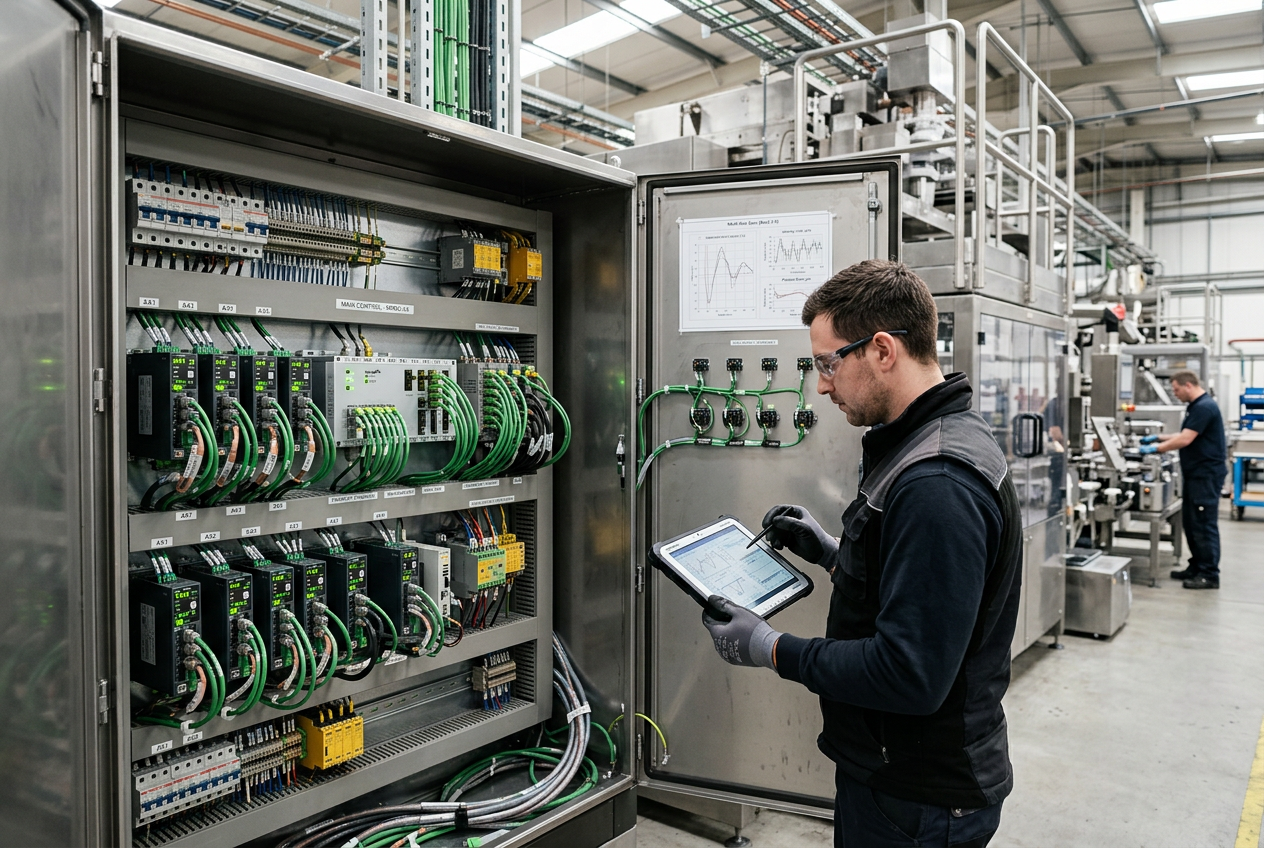
Traditional legacy architectures often struggle with complex wiring, analog velocity commands, and non-deterministic fieldbuses when scaling up axis counts. EtherCAT solves this through deterministic on-the-fly Ethernet frame processing and distributed clock synchronization. In high-speed automated packaging cells, deploying dedicated drives like the Schneider PacDrive MC-4 Servo Drive ensures tightly synchronized multi-axis motion while reducing cabinet footprint and cabling overhead.
Recent developments in multi-axis motion drivers reflect a clear industry transition: machine builders require modular, compact architectures that maintain deterministic performance without inflating cabinet costs.
What Are the Core Architectural Components of an EtherCAT Motion Network?
A deterministic motion control topology consists of five interconnected layers: the motion controller/master, the EtherCAT physical communication ring or line, digital servo drives, feedback transducers, and mechanical actuators.
The motion controller computes interpolated trajectories, electronic camming tables, and virtual gear ratios. Controllers such as the ABB PM5670-MC-KIT Motion Controller Kit deliver the necessary CPU bandwidth to calculate complex multi-axis motion profiles in real time while managing background diagnostic tasks.
However, field performance does not depend solely on bus speed. Mechanical resonance, drive tuning loops (current, velocity, position), encoder resolution, and task timing jitter directly dictate path accuracy.
How Do You Accurately Calculate and Plan Axis Capacity for Motion Controllers?
When engineering a multi-axis motion system, avoid selecting a controller solely by its headline axis count. Use this structured approach:
1. Classify axis functional tiers: Distinguish between non-critical auxiliary axes (simple speed-regulated conveyors) and tightly synchronized process axes (flying shears, rotary knives, electronic cams, and delta robot kinematics).
2. Profile controller cycle-time headroom: A controller rated for 16 axes at 1 ms cycle rates may face cycle slippage if it simultaneously handles extensive safety logic, HMI polling, recipe management, and vision inspection data.
3. Validate drive and motor compatibility: Confirm that servo drives support standard motion profiles such as CiA 402 (CANopen over EtherCAT / CoE), including Cyclic Synchronous Position (CSP), Cyclic Synchronous Velocity (CSV), and Cyclic Synchronous Torque (CST) operating modes.
How Does EtherCAT Distributed Clock (DC) Achieve Deterministic Multi-Axis Synchronization?
Multi-axis synchronization requires all participating servo nodes to latch feedback positions and update PWM inverter cycles at the exact same physical instant. Standard Ethernet cannot guarantee this due to packet collision and transit jitter.
EtherCAT addresses this challenge using hardware-based Distributed Clocks (DC). The first DC-capable slave node typically acts as the reference clock. During bus initialization, the master sends propagation delay measurement frames to calculate transit times between each node. Clocks on all slave devices are dynamically adjusted so synchronization jitter remains well below 1 microsecond across hundreds of nodes.
In mixed or evolving automation plants, inter-drive communication and high-speed data exchange have long been critical. Dedicated drive communication solutions like the ABB SDCS-DSL-4 DCSLink Communication Board and established industrial network controllers such as the Allen-Bradley 1785-L20E Ethernet Controller illustrate how deterministic timing has continuously evolved from dedicated point-to-point links to unified real-time Ethernet.
What Key Steps Should Be Verified on Your Motion Commissioning Checklist?
Before commissioning high-speed coordinated motion on live machinery, systematically verify each operational layer:
- Hardware & Wiring: Verify shielded twisted-pair cabling (Cat5e/Cat6 industrial Ethernet), single-point earthing, and proper separation between servo motor power cables and encoder lines.
- Distributed Clock Validation: Confirm DC mode is enabled on all synchronized axes, check synchronization jitter counters in the master diagnostics, and verify that the sync cycle matches the controller task period.
- Control Loop Tuning: Auto-tune or manually tune current, velocity, and position loops for each individual axis prior to enabling multi-axis master-slave gearing or camming.
- Homing & Safe Limits: Validate positive and negative software and hardware overtravel limits, torque limits, and absolute encoder homing offsets.
- Network Fault Behavior: Simulate communication loss by pulling an intermediate network cable; ensure drives immediately transition to safe torque off (STO) or controlled emergency deceleration.
- Configuration Backup: Export and archive drive parameter sets, controller XML network configuration files (ENI), and source programs.
How Do Compact Multi-Axis Servo Drives Optimize Enclosure Space and Thermal Management?
Modern machine builders face continuous pressure to shrink electrical enclosures. Dual-axis and multi-axis servo drives consolidate multiple inverter power stages into a single chassis sharing a common DC bus and rectifier.
Shared DC bus designs allow regenerating decelerating motors to supply energy directly to accelerating motors, cutting overall mains power demand and reducing braking resistor heat dissipation. However, higher power density requires rigorous thermal calculation, adequate panel ventilation, and strict adherence to minimum side-clearance spacing specified in manufacturer installation manuals.
Summary & Field Recommendations: How Should Engineers Proceed?
EtherCAT provides machine builders with a deterministic, scalable backbone for high-performance multi-axis automation. Successful implementation requires balancing high bus speeds with proper mechanical rigidity, meticulous drive loop tuning, and robust distributed clock configuration. By pairing reliable industrial controllers, certified multi-axis servo drives, and validated network configurations, engineering teams can build high-throughput machines that run smoothly and predictably for years to come.
Article contributed by Lin Wei, Senior Industrial Automation & Motion Systems Specialist at PLC DCS Pro Ltd.


