

AI-Enabled Cyber Threats to Industrial Control Systems: A Defensive Engineering Guide
AI-Enabled Cyber Threats to Industrial Control Systems: A Defensive Engineering Guide
Protect PLCs, SCADA systems, and industrial networks against increasingly automated cyber threats.
How Is AI Reshaping the OT and ICS Cybersecurity Threat Landscape?
Industrial control systems (ICS) tightly integrate digital software, communication networks, and heavy physical machinery. A cybersecurity compromise in operational technology (OT) is never merely a data breach—it directly endangers physical plant availability, mechanical integrity, and worker safety.
Adversaries are now leveraging automated AI tools to rapidly analyze network topology, decipher proprietary firmware, discover zero-day vulnerabilities, and script automated reconnaissance. Recent industry benchmarks demonstrate that automated penetration frameworks can compress vulnerability scanning cycles from weeks to hours.
However, simulated exploits in laboratory settings do not mean every industrial plant is uniformly vulnerable. The most pragmatic engineering response is not panic, but disciplined defense-in-depth: eliminating exposed ingress pathways, enforcing micro-segmentation, securing PLC engineering access, and maintaining validated offline recovery procedures.
Which Critical Industrial Assets Must Automation Teams Identify and Prioritize First?
Effective defense begins with an exhaustive, living inventory of all operational assets across the Purdue Model levels. Automation and IT teams must collaborate to catalogue:
- Core Controllers: Programmable Logic Controllers (PLCs), Remote Terminal Units (RTUs), and Distributed Control System (DCS) controller nodes.
- Supervisory Infrastructure: SCADA servers, human-machine interfaces (HMIs), historian databases, and engineering workstations.
- Networking Hardware: Managed switches, protocol converters, fieldbus couplers, and industrial firewalls.
- Access Pathways: Cellular modems, remote vendor maintenance tunnels, and dual-homed engineering laptops.
Pay meticulous attention to bridge devices that span multiple subnets. A single dual-homed engineering workstation or unmanaged protocol gateway can inadvertently become an unmonitored pivot point into safety-critical control loops.
How Do You Implement Robust Industrial Network Segmentation Across OT Zones?
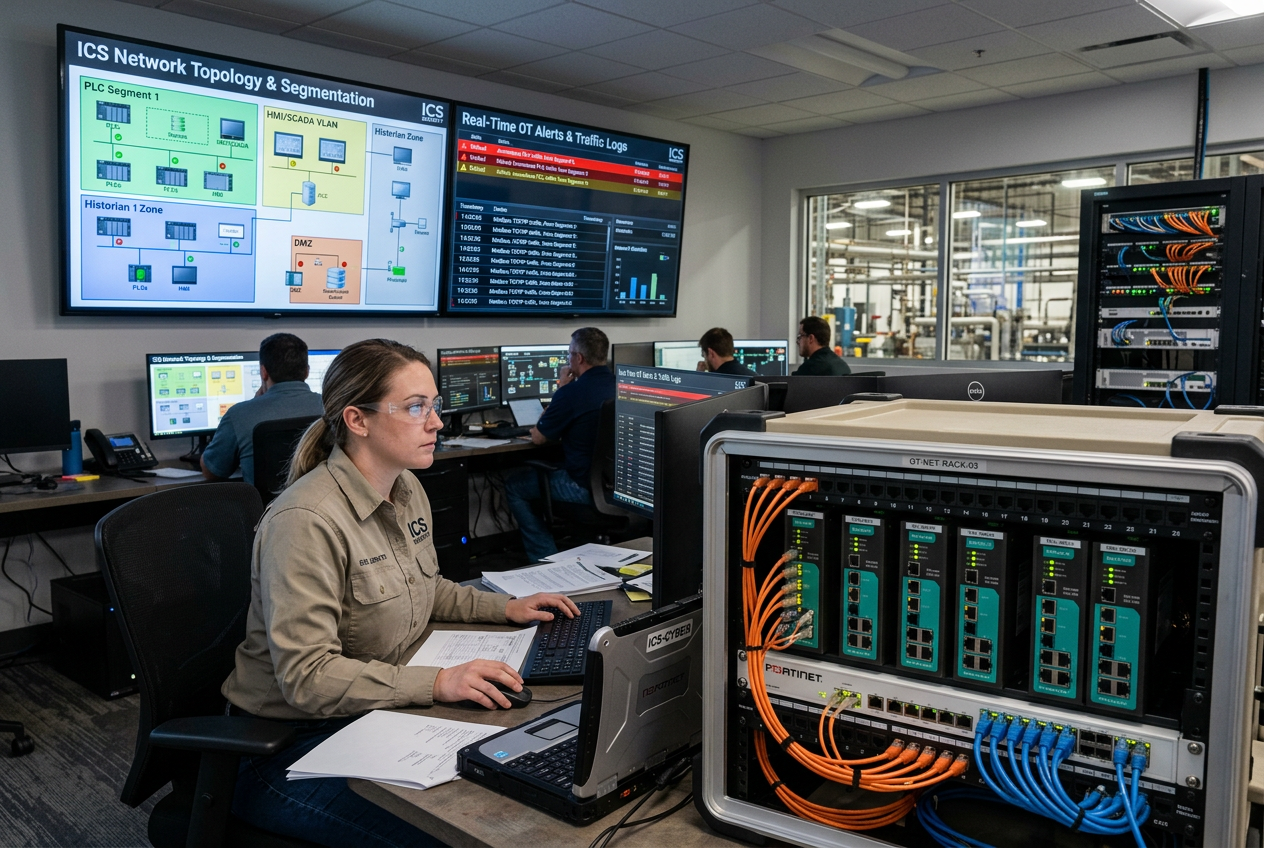
Complete convergence of enterprise IT and plant OT without strict demarcation is an open invitation to lateral malware propagation. Follow the ISA/IEC 62443 standard to compartmentalize systems into dedicated security zones and conduits.
Industrial networks should rely on hardware-enforced boundaries. Deploying ruggedized, managed infrastructure like Allen-Bradley Stratix 5700 managed Ethernet switches allows plants to isolate automation cells via VLANs, enforce port-level access control lists (ACLs), and restrict non-essential broadcast traffic.
Remote maintenance connections must terminate at dedicated industrial DMZ gateways rather than routing directly into controller racks. If wireless maintenance is necessary, use dedicated, secured appliances such as the Prosoft industrial hotspot configured with enterprise encryption and strict time-window timeouts.
Multi-protocol interfaces—such as Schneider EtherNet/IP Modbus TCP modules or Allen-Bradley EtherNet/IP adapter modules—should have granular routing rules applied so they only pass explicitly authorized industrial command frames.
How Can Plants Strictly Protect PLC Logic, Engineering Workstations, and Configuration Changes?
Because PLC logic controls physical actuators, valves, and heaters, unauthorized modifications can cause catastrophic equipment damage. Hardening the engineering lifecycle requires disciplined change management:
- Enforce Role-Based Access Control (RBAC): Eliminate generic admin logins; assign individual named accounts with cryptographic authentication.
- Implement CPU Key Switch Discipline: Keep PLC physical key switches in RUN mode rather than REMOTE RUN during normal operation to prevent unauthorized remote logic overwrites.
- Isolate Engineering Laptops: Restrict maintenance laptops from accessing general internet browsing or unvetted external USB drives.
- Verify AI-Assisted Code: Never permit AI-generated PLC ladder logic, structured text, or script configurations to be downloaded to live controllers without thorough simulation and peer review.
- Maintain Immutable Golden Backups: Store cryptographically signed, timestamped baseline copies of all PLC firmware, logic files, and safety parameters in an offline repository.
What Are the Best Practices for Continuous Industrial Network Monitoring and Anomaly Detection?
Active network scanning can inadvertently crash legacy serial-to-Ethernet converters or overload sensitive PLC communication stacks. OT monitoring must prioritize passive network tapping and deep packet inspection (DPI).
Establish baseline communication profiles during normal manufacturing operations. Alert immediately on anomalies such as unexpected controller firmware download commands, new MAC addresses on critical switch ports, or abnormal polling frequency.
Ensure that Syslog and event logs from SCADA servers, managed switches, and controller diagnostic buffers are mirrored to a write-protected, central security log server with standardized NTP synchronization.
How Should You Structure and Execute an Effective OT Incident Response Plan?
Unlike enterprise IT, where isolating a server simply pauses an application, abruptly severing an industrial network can trigger dangerous physical process trips. A mature OT incident response plan follows five rigorous steps:
1. Define Clear Escalation & Authority: Designate who holds the authority to halt production or isolate a control skid, balancing cyber containment against process safety hazards.
2. Rapid Forensic Capture: Collect volatile network PCAPs, PLC diagnostic fault logs, and SCADA alarm dumps without altering controller operating memory.
3. Safe Controlled Containment: Execute pre-engineered failover or segmented isolation steps that allow physical processes to ramp down safely without creating pressure surges or runaway thermal reactions.
4. Rapid Hardware Restoration: Validate physical logic integrity against golden baselines and maintain cold-standby spares, such as Emerson redundant Ethernet I/O card assemblies, for swift, verified hardware swap-outs.
5. Root-Cause Post-Mortem: Analyze the specific conduit or credential failure that allowed ingress, updating firewall rules and firmware patching schedules accordingly.
Where Does AI Fit Into Modern Defensive Industrial Cybersecurity?
While adversaries weaponize AI, defensive teams can utilize machine learning to parse millions of telemetry events, detect subtle baseline drifts, and correlate disparate alarms across complex plant topologies.
However, AI-driven defense must remain advisory. Automated containment logic should never be allowed to trip safety interlocks or shut down critical compressors based solely on probabilistic models. High-consequence containment actions must always retain human-in-the-loop authorization.
Key Takeaways & Engineering Defense Checklist
Defending industrial control systems in the era of AI requires relentless commitment to cyber-physical fundamentals. By establishing complete asset visibility, enforcing hardware-based network segmentation, locking down PLC engineering access, and practicing safe, safety-first incident recovery, automation engineers can build resilient, highly defensible operational environments that withstand evolving automated threats.


