

What Can a Multi-Gas Detector Detect? Here’s What You Need to Know ⚠️
🔧 What Is a Multi-Gas Detector?
A multi-gas detector is a single device that monitors multiple gases at the same time. 🎯 Whether portable or fixed, it helps keep industrial and confined environments safe. It’s much more efficient than using several single-gas detectors.
These units detect harmful gas concentrations by pulling in air (actively or passively) and analyzing it using built-in sensor technologies like:
-
Electrochemical reaction
-
Catalytic bead
-
Infrared detection
-
Photoionization
Each sensor type reacts differently depending on the gas it is built to detect.
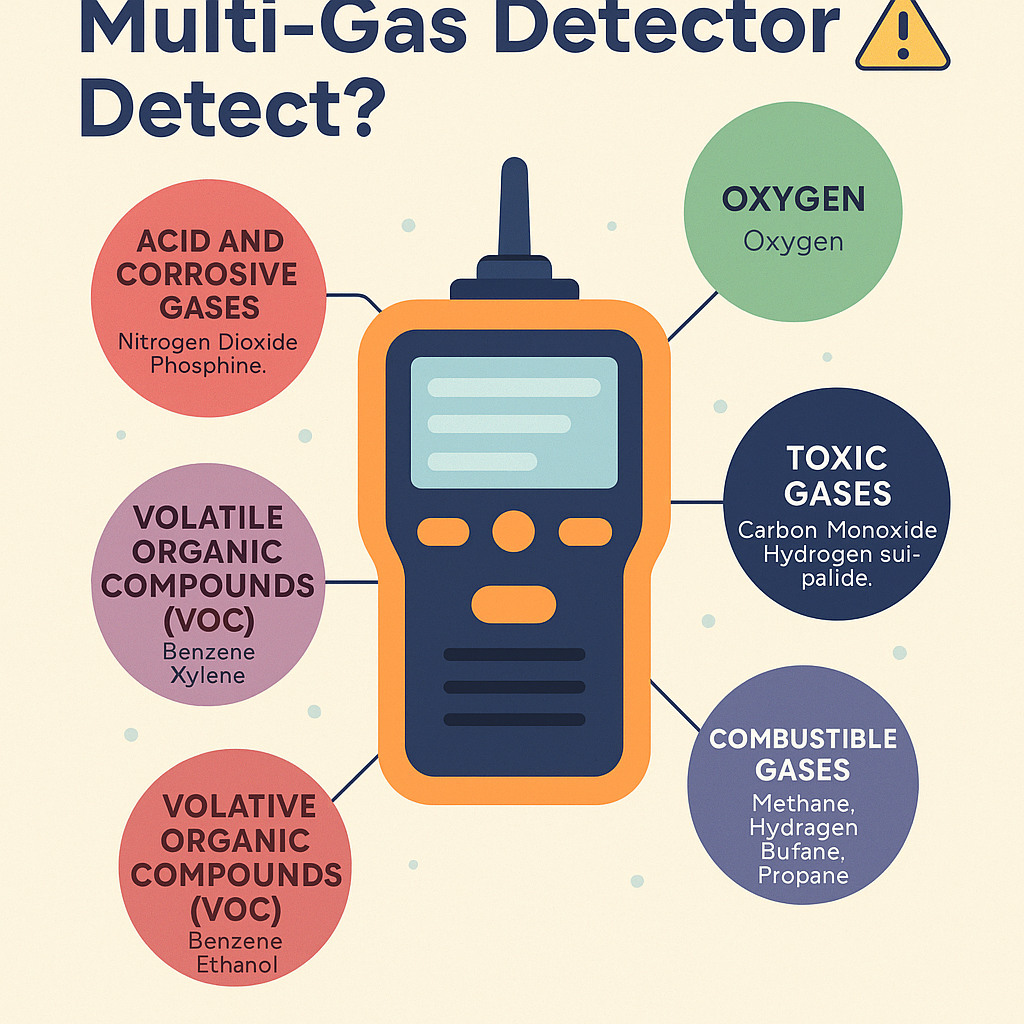
🧪 Categories of Gases Detected
1️⃣ Acid and Corrosive Gases
-
Gases: Nitrogen Dioxide (NO₂), Phosphine (PH₃), Hydrogen Chloride (HCl)
-
Sensor Type: Electrochemical
-
Use Case: Labs, chemical plants, semiconductor facilities
2️⃣ VOC (Volatile Organic Compounds)
-
Gases: Benzene, Xylene, Ethanol
-
Sensor Type: Photoionization Detector (PID)
-
Use Case: Paints, coatings, refineries
3️⃣ Oxygen Level Monitoring
-
Gas: Oxygen (O₂)
-
Sensor Type: Electrochemical
-
Use Case: Confined spaces, HVAC, tanks
-
📉 Both low and high O₂ levels can be dangerous!
4️⃣ Toxic Gases
-
Gases: Carbon Monoxide (CO), Hydrogen Sulphide (H₂S), Ammonia (NH₃), Sulphur Dioxide (SO₂), Chlorine (Cl₂)
-
Sensor Type: Electrochemical
-
Use Case: Mining, oil & gas, water treatment
5️⃣ Combustible Gases
-
Gases: Methane (CH₄), Hydrogen (H₂), Butane (C₄H₁₀), Propane (C₃H₈)
-
Sensor Type: Catalytic Bead or Infrared
-
Use Case: Gas pipelines, LNG facilities, chemical plants
📊 Things to Check Before Buying
When selecting a multi-gas detector, consider:
✅ How many gases it can detect
✅ Sensor types used
✅ Compliance with safety standards
✅ IP rating and durability
✅ Connectivity options (Bluetooth, Modbus, PLC interface)
⚖️ Pros and Cons of Multi-Gas Detectors
| ✅ Pros | ⚠️ Cons |
|---|---|
| Detects up to 5–6 gases at once | If it fails, full system downtime |
| Saves cost over multiple detectors | May require frequent calibration |
| Compact and easy to carry | Sensor replacement can be costly |
| Can integrate with PLC systems | Customization limits if not modular |
💼 In Industrial Automation?
If you're working in a DCS or PLC-controlled plant, a multi-gas detector with Modbus or 4-20 mA output can seamlessly integrate into your monitoring system.
🔗 Need Automation Parts Too?
We at PLCDCSPRO stock a wide range of industrial automation spares—including sensors, PLC modules, and control system parts.


