

Topology Failures in EtherNet/IP and PROFIBUS DP: An Allen-Bradley and Schneider Field Guide
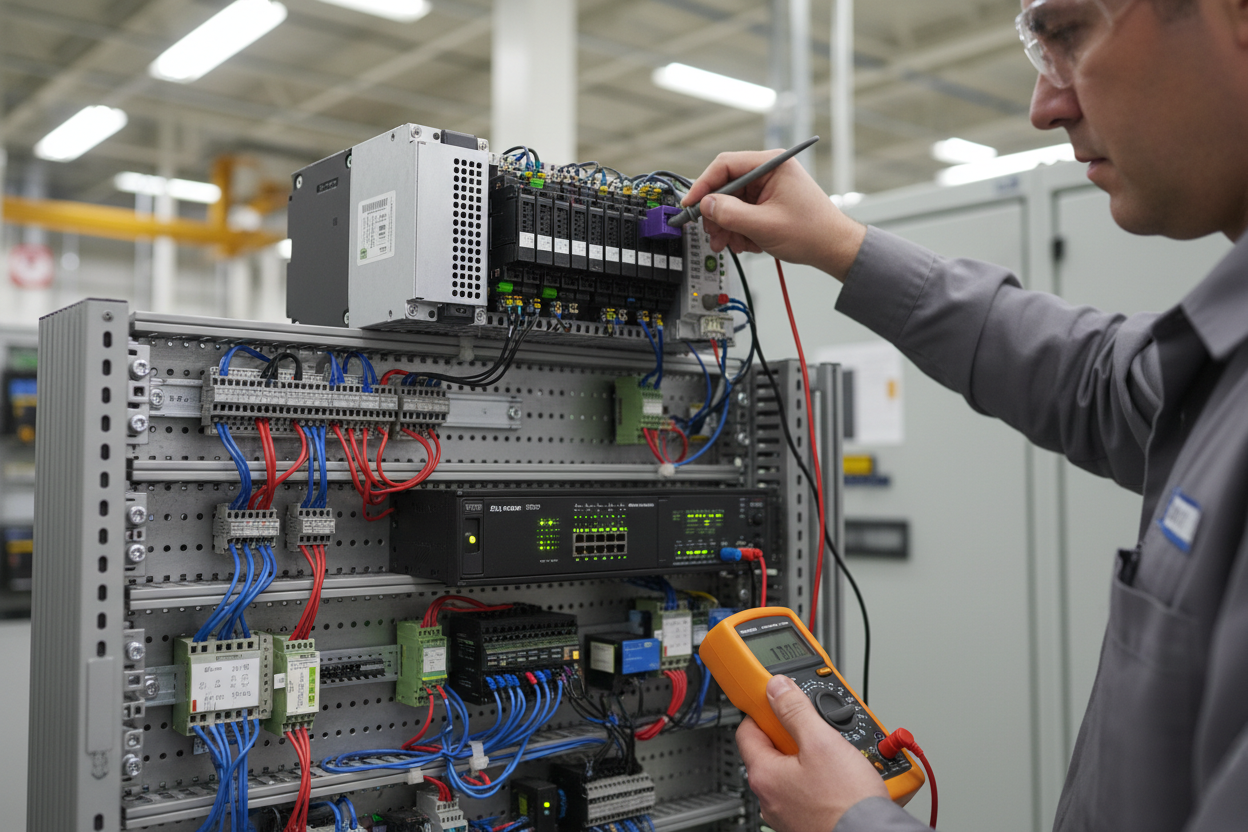
Why Topology Knowledge Saves Uptime
Every programmer should know how their network fails. A single weak link hurts reliability, uptime, and stability. Modern plants also push data to cloud IoT gateways. Therefore, topology faults now ripple farther. Let us map the four classic shapes — tied to real Allen-Bradley and Schneider gear — with parameters you can measure today.
Q: How Does a Line (Bus) Topology Fail?
In a line, devices sit in one straight chain. It needs minimal cable and suits small, non-critical loops. However, one broken cable kills the whole run. A loose terminal or a powered-down device also breaks it downstream.
On PROFIBUS DP, wrong termination is the silent killer. On Modbus RTU with a Schneider Modicon Quantum, missing bias resistors cause intermittent faults that are hard to trace.
Use a ProSoft Ethernet/PROFIBUS Gateway to bridge segments and isolate faults without rewiring the whole bus.
- Step 1 — Fit a 390 Ω terminator on the first and last PROFIBUS DP nodes only.
- Step 2 — Measure between A and B lines. Expect ~220 Ω across the loaded bus.
- Step 3 — For Modbus RTU, add 120 Ω end terminators plus bias resistors.
- Step 4 — Keep segment length under 1200 m at 9.6 kbps; derate as baud rate rises.
Q: What Causes Star Topology Failures on EtherNet/IP?
A star routes every device to one central switch. Expansion is easy and troubleshooting is simple. Yet the central switch is the single point of failure — if it dies, the whole network dies.
On EtherNet/IP, one noisy device can flood multicast or broadcast packets, stalling control traffic across the star. A Allen-Bradley ControlLogix 1756-L62 processor sitting behind a misconfigured VLAN will drop implicit messaging silently.
- Step 1 — Enable IGMP snooping so multicast stays on subscribed ports only.
- Step 2 — Cap EtherNet/IP RPI to realistic values: typically 500 ms–2000 ms.
- Step 3 — Configure QoS and Class of Service to prioritize implicit messaging.
- Step 4 — Segment CIP Motion or CIP Sync traffic onto a dedicated VLAN.
Q: How Do Ring Topologies Fail — and How Is DLR Different?
The ring removes the single-cable weakness by wrapping devices into a closed loop, providing two paths to every node. A fiber cut no longer stops the plant. Allen-Bradley uses Device Level Ring (DLR); Schneider and others use RSTP-based Ethernet ring protocols.
However, rings can fail twice simultaneously. A break at two nodes splits the ring into a line segment — and if blocking is not re-enabled correctly, a broadcast storm follows instantly. The ProSoft PLX51-PBS gateway supports ring-aware topologies for mixed PROFIBUS/EtherNet/IP plants.
- Step 1 — Enable DLR on adapter modules and set ring recovery time near 200 ms.
- Step 2 — Tune RSTP forward delay to match controller fault tolerance.
- Step 3 — Alarm on any single ring break so crews fix it before a second fault occurs.
Q: What Are the Hidden Risks in Tree Topologies?
A tree nests stars into branches and scales well, but root switch faults cascade widely. Long Ethernet runs cause packet fragmentation — small control frames then time out. On an Allen-Bradley rack, MTU mismatches silently drop CIP packets.
The Allen-Bradley ProSoft MVI56E-MCM Modbus module is sensitive to MTU and framing errors when deployed at tree branch ends. Confirm MTU at 1500 bytes across the entire path and check CRC error counters on each port. Rising counters point to bad terminators or electrical noise.
For hot-standby redundancy at the root, the Schneider 140CPU67160 Hot Standby Processor provides multimode Ethernet failover to protect the tree root.
- Step 1 — Confirm MTU = 1500 bytes across all switches in the tree path.
- Step 2 — Check CRC error counters per port; replace suspect connectors first.
- Step 3 — Protect the root with a redundant processor or dual uplinks.
Conclusion & Action Advice
Match the fix to the topology shape:
- Bus/Line — Verify termination resistance and segment length first.
- Star — Protect the central switch; block multicast storms with IGMP snooping.
- Ring — Alarm on the first break before a second fault creates a storm.
- Tree — Guard the root switch and confirm MTU end-to-end.
Keep measured baselines on record: PROFIBUS resistance, Modbus bias values, and EtherNet/IP RPI per node. This turns guesswork into a repeatable diagnostic routine — ready for your next Allen-Bradley or Schneider outage.
Author: Liang Junhao is an industrial automation engineer with over 10 years of experience in PLC, DCS, and control systems.


