

The Rise of the Smart Factory: How Embedded Systems, AI, and Robotics Are Redefining Industrial Automation
Introduction: From Automated Lines to Intelligent Production
The modern smart factory represents a major shift in industrial automation.Unlike earlier digital waves, today’s transformation tightly connects software intelligence with physical production.As a result, factory automation now integrates embedded systems, AI, robotics, and real-time data into one adaptive ecosystem.
A New Industrial Revolution Driven by AI and Machines
Over the past 20 years, several technology revolutions reshaped global industries.However, the current AI-driven transformation differs fundamentally from the dot-com era.AI today directly controls machines, sensors, and control systems, making it a production asset rather than a digital abstraction.
In my experience working with automation projects, this physical integration is what delivers measurable productivity gains.Therefore, AI adoption in manufacturing has lasting economic value.
Industrial Embedded Systems as the Backbone of Automation
Industrial embedded systems form the foundation of modern automation architectures.
They combine specialized hardware and software to execute control tasks with high precision.Examples include PLCs, industrial PCs, microcontrollers, and embedded controllers inside DCS platforms.
These systems manage motor control, line speed, safety logic, and network communication.According to industry research firms, the embedded systems market continues steady long-term growth.This trend reflects their critical role in industrial automation.
Data Collection: The Hidden Engine of Factory Automation
Data collection remains a core benefit of connected embedded systems.Previously, operators relied heavily on manual intervention and isolated monitoring tools.Today, integrated data pipelines provide real-time visibility across production lines.
Moreover, continuous data enables predictive maintenance and energy optimization.Closed-loop control systems detect deviations instantly and correct them automatically.As a result, manufacturers reduce scrap, downtime, and operating costs.
Industrial IoT Enables System-Wide Connectivity
The rise of industrial IoT (IIoT) has dramatically improved factory connectivity.Sensors, machines, and software platforms now exchange data in real time.This integration supports faster decision-making and tighter process control.
However, higher connectivity increases design complexity.Engineers must ensure electrical safety, protocol compatibility, and cybersecurity.Standards from organizations like IEC and IEEE help guide reliable IIoT deployment.
Edge Computing Brings Intelligence Closer to Machines
Traditional cloud computing cannot meet all industrial timing requirements.Therefore, edge computing has become essential in factory automation.By processing data near machines, edge systems reduce latency and improve reliability.
In robotics and vision inspection, milliseconds matter.Local control also keeps production running during network outages.From my perspective, edge computing is now a default design choice for mission-critical automation.
Heterogeneous Embedded Platforms Power the Smart Factory
Modern edge platforms often combine CPUs, GPUs, and AI accelerators.This heterogeneous architecture supports control logic, signal processing, and AI inference simultaneously.For example, robotic welding and SMT placement systems rely on such platforms.
However, complexity increases significantly.Engineers must balance real-time operating systems, containers, and hardware constraints.Hardware-assisted virtualization increasingly helps isolate workloads safely.
Running AI on Embedded Industrial Platforms
Deploying AI on embedded systems presents unique challenges.Limited power, thermal constraints, and real-time requirements restrict model size.Therefore, engineers apply techniques such as quantization and pruning.
In practice, AI complements rather than replaces traditional control algorithms.For instance, ML handles anomaly detection, while PLC logic maintains deterministic control.This hybrid approach preserves safety and predictability.
Robotics Highlights System-Level Embedded Complexity
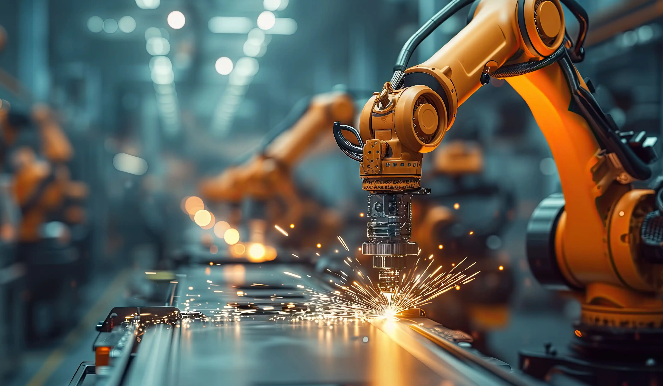
Industrial robots integrate motion control, vision, networking, and safety subsystems.Each function operates under different timing constraints.Nevertheless, seamless coordination remains essential.
Recent advances move perception and localization directly onto robot controllers.This reduces latency but increases software complexity.Careful workload allocation ensures compliance with functional safety standards like IEC 61508.
Determinism and Safety in AI-Enabled Control Systems
AI introduces uncertainty into traditionally deterministic environments.Unlike rule-based logic, ML models behave probabilistically.This complicates validation and certification.
To manage risk, designers isolate AI from safety-critical loops.They also implement runtime monitoring and fallback strategies.In my view, this layered safety approach will define future certified AI systems.
Lifecycle Challenges in Long-Term Industrial Deployments
Industrial embedded systems often operate for 30 years or more.However, software frameworks evolve far faster.AI models may require frequent retraining as data patterns change.
Hardware obsolescence adds another challenge.Processors and communication chips rarely match industrial lifespans.Therefore, maintainability and cybersecurity demand proactive planning.
Evolutionary Resilience as a Design Philosophy
To address lifecycle mismatches, manufacturers adopt evolutionary resilience.This strategy emphasizes modular software and standardized interfaces.Hardware abstraction layers help future-proof control systems.
Secure over-the-air updates also play a key role.They allow safe remote maintenance without disrupting production.In my experience, resilience now matters as much as initial performance.
Practical Application Scenarios in Smart Factories
In automotive plants, edge AI optimizes robotic welding quality in real time.Food processing facilities use embedded vision to enforce hygiene compliance.Electronics manufacturers rely on high-speed inspection for defect detection.
These examples show how industrial automation delivers real operational value.The smart factory succeeds not through hype, but through reliable execution.
Conclusion: Intelligence That Evolves with Production
The future factory combines embedded systems, AI, robotics, and data into one adaptive whole.Success depends on determinism, safety, and long-term maintainability.A truly smart factory evolves continuously without sacrificing reliability.


