

Multilin™ D25: Transforming Substation Automation with Integrated Control Solutions
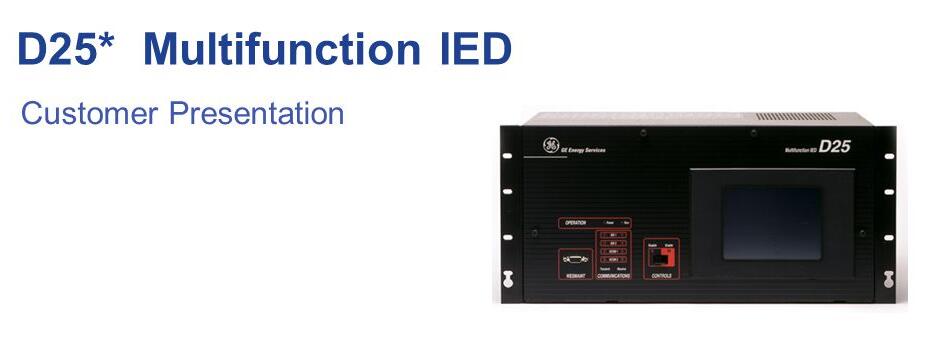
The Multilin™ D25: Revolutionizing Substation Automation
GE's Multilin™ D25 Substation Controller represents a significant leap forward in substation automation and control. This advanced device is engineered to meet the demanding needs of both large and small substation projects, whether new or retrofit. With its modular design, scalability, and upgradability, the D25 offers a comprehensive solution that consolidates multiple functions into a single, unified unit, making it an indispensable tool for modern substations.
A Comprehensive Automation Solution
The D25 controller replaces multiple standalone devices, streamlining the entire automation process. This consolidation not only reduces wiring and maintenance costs but also simplifies overall system management. By integrating communications, data concentration, automation control, metering, and fault recording into one unit, the D25 minimizes the need for additional hardware. Moreover, its ability to retrieve data from legacy and third-party devices makes it a versatile choice for substations with diverse equipment.
Enhancing Operational Efficiency
One of the standout features of the D25 is its ability to measure and record total harmonic distortion, harmonic spectrum, RMS trending, and voltage disturbances. These capabilities enable operators and analysts to monitor the quality of power flowing through the system, ensuring consistency and reliability. By pinpointing problem areas, the D25 helps prevent potential issues before they escalate, ultimately enhancing the operational efficiency of the substation.
Advanced Display Options
The D25 offers two built-in screen options to suit different operational needs. The Data Display Panel provides a straightforward interface for displaying the status of various digital or analog points, making it easy for operators to monitor system conditions. Alternatively, the Graphical Display Panel (GDP) offers a more advanced interface with a touch screen monochrome LCD. This panel allows users to configure dynamic displays with one-line diagrams and alarm screens, transforming the GDP into a full-fledged local HMI. This flexibility in display options ensures that the D25 can meet the specific needs of any substation environment.
Seamless Fault Management
Fault management is a critical aspect of substation operations, and the D25 excels in this area. It automatically transfers fault records via LAN to the substation computer or directly to a remote PC through email. This capability ensures that utility engineers can quickly analyze recordings and verify that relay settings are correct, reducing the likelihood of equipment damage or system downtime. The D25's proactive fault management features contribute to a more reliable and resilient power grid.
Versatile Metering Capabilities
The D25's software modules provide versatile metering options, supporting 1, 2, 2½, and 3 element metering configurations. These modules can meter up to six feeders on the same bus in a three-wire configuration or up to four feeders in a four-wire configuration. With revenue-class metering accuracy, the D25 ensures precise measurement and billing, making it an essential tool for substations that require accurate and reliable metering solutions.
LogicLinx®: A Game-Changer in Automation
LogicLinx® is another key feature of the D25, offering a soft logic automation tool that revolutionizes how substations approach automation schemes. By eliminating the need for hardwiring, LogicLinx® reduces costs and simplifies the creation of automation applications. This software allows engineers to link components accurately and logically, ensuring seamless operation and integration across the substation.
Conclusion: The Future of Substation Control
In conclusion, the Multilin™ D25 Substation Controller is more than just a piece of hardware; it's a comprehensive solution that addresses the complex needs of modern substations. By combining multiple functions into a single, modular unit, the D25 reduces costs, enhances operational efficiency, and provides the flexibility needed for future expansion. Whether used in transmission, distribution, or generator substations, the D25 stands out as a cutting-edge tool that brings substation automation and control into a new era.


