

DCS Redundant Controller Bumpless Transfer Validation and SIS Interlock Integration: ABB Symphony Plus AC800M and HIMA HIMatrix F30
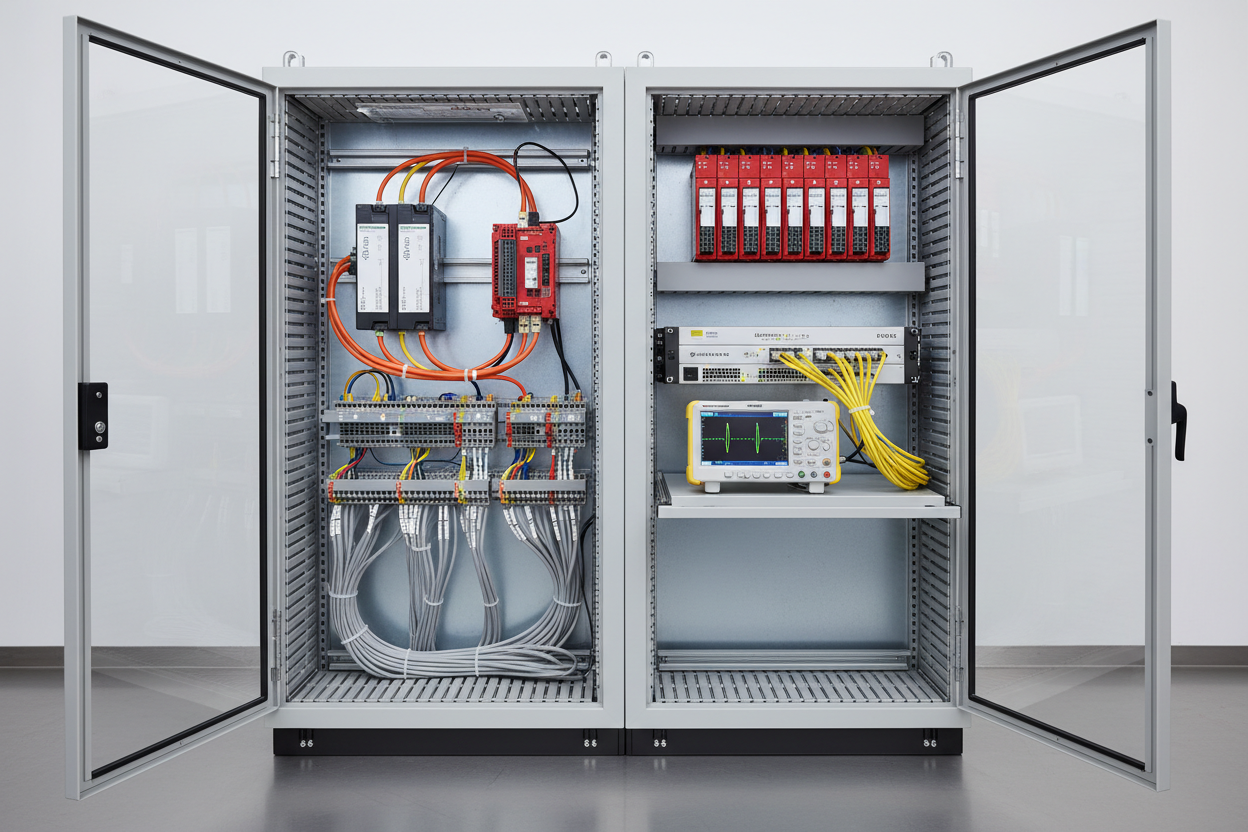
Redundant DCS Architecture and Switchover Requirements
ABB Symphony Plus uses the AC800M PM866 controller in redundant configuration with a CEX-Bus hot-standby link. The primary and redundant controllers synchronize internal memory every 20 ms via the CEX-Bus. When a switchover occurs, the backup controller must assume control without measurable output bump on analog outputs or digital command states. ABB defines bumpless transfer as an output deviation of less than 0.1% of span during the switchover transient.
The HIMA HIMatrix F30 safety controllers operate independently from the ABB Symphony Plus BPCS layer. However, both systems share hardwired safety interlocks and exchange status data via EtherNet/IP. The integration architecture requires that a Symphony Plus controller switchover does not create a false EtherNet/IP connection loss that triggers a HIMatrix F30 safety function. Engineers must validate both bumpless transfer timing and EtherNet/IP connection recovery time as part of the Factory Acceptance Test and Site Acceptance Test protocols.
Bumpless Transfer Timing Measurement Procedure
Validate bumpless transfer performance with instrumented measurement — never rely on operator observation. The AC800M PM866 redundancy switchover takes approximately 80–150 ms depending on controller loading. During this period, output modules hold their last value.
- Step 1: Connect an oscilloscope or high-speed data logger to the 4–20 mA output of an AO890 analog output module. Set the sample rate to 1 kHz minimum. Configure a trigger on the CEX-Bus fault indicator LED or the REDUNDANCY STATUS OPC tag in Symphony Plus Operations.
- Step 2: In ABB Control Builder M, set the active controller output to a stable value — 12.000 mA (50% setpoint). Initiate a manual switchover using the Control Builder M redundancy management panel. Record the AO890 output deviation peak and recovery time on the oscilloscope.
- Step 3: Acceptable result: output deviation less than 0.5 mA (±3% span for a 0–100% range), recovery within 200 ms. If output bumps by more than 1.0 mA, the controller program contains a re-initialization sequence that resets output values on startup. Identify and remove all unconditional output write instructions in the first scan cycle of the program.
- Step 4: Repeat the test under 80% CPU loading. High CPU utilization at switchover increases output hold time to 200–300 ms on some PM866 firmware versions. Document the maximum observed bump at target CPU loading and compare against process requirements.
EtherNet/IP Connection Recovery During Switchover
The HIMA HIMatrix F30 communicates with ABB Symphony Plus via EtherNet/IP Class 1 (implicit messaging). The HIMatrix F30 operates as the EtherNet/IP adapter; the Symphony Plus Control Builder M EtherNet/IP scanner initiates the connection. During a Symphony Plus controller switchover, the EtherNet/IP scanner session terminates and re-establishes on the backup controller.
Default HIMatrix F30 EtherNet/IP connection timeout is 500 ms (5× RPI at 100 ms default). If the Symphony Plus switchover exceeds 500 ms, the HIMatrix F30 connection times out and transitions the associated safety input data to a SAFE state. This can trigger a spurious safety function on any SIF that uses EtherNet/IP data as a permissive input.
Mitigation strategy: increase the HIMatrix F30 EtherNet/IP connection timeout to 2000 ms in the SILworx configuration (Adapter → EIP Connection → Timeout Multiplier = 20× RPI). Verify this change is documented in the SIL validation record — IEC 61511 Clause 11.9.3 requires that all changes to safety-related software parameters are formally assessed. Reduce Symphony Plus controller CPU utilization below 50% at steady state so switchover completes within 300 ms, providing a 6× safety margin against the 2000 ms timeout.
Hardwired Safety Interlock Wiring Between Systems
The HIMatrix F30 F-DI (Fail-safe Digital Input) modules use a 24 VDC dual-channel input with internal pulse testing at 1 Hz. Each input channel connects to a separate field device terminal. Both channels must agree within 200 ms for the input to register as TRUE.
Common wiring error: engineers connect both F-DI channels to the same field terminal instead of separate relay contacts. This single-channel configuration defeats the dual-channel integrity of the HIMatrix F30 and invalidates the SIL 2 claim. HIMA SILworx diagnostics flag this as a CH1/CH2 discrepancy fault only when the single point of failure opens. Therefore, verify dual-channel wiring continuity with a tug test on each cable core at commissioning.
For the ABB Symphony Plus DI820 digital input module receiving hardwired trip status from the HIMatrix F30 F-DO (Fail-safe Digital Output), configure the DI820 input filter time to 10 ms. This prevents the HIMatrix F30 internal pulse test signal (1 Hz, 5 ms OFF pulse) from registering as a false trip in the Symphony Plus event log.
SIL 2 Proof Test Integration with DCS Maintenance Mode
- Step 1: Activate Symphony Plus Maintenance Mode for the affected control loops. This switches BPCS PID controllers to Manual with last-value hold.
- Step 2: Send an EtherNet/IP test-mode command from Symphony Plus to the HIMatrix F30 (SILworx parameter: PROOF_TEST_MODE = 1).
- Step 3: Execute the proof test sequence per the HIMA SILworx Proof Test Report template (section 6.3): verify trip relay opens within 150 ms of simulated demand, verify reset logic clears correctly, verify discrepancy detection between redundant sensors. The HIMatrix F3 DIO module response time must be confirmed against the SIL 2 requirement specification.
- Step 4: Exit PROOF_TEST_MODE and confirm HIMatrix F30 returns to normal monitoring.
- Step 5: Release Symphony Plus Maintenance Mode and verify PID controllers transfer back to Auto without output bump. Document all as-found response times and compare against SIL 2 requirements (PFDavg must remain within the defined safety requirement specification boundary).
Conclusion and Action Advice
Integrating ABB Symphony Plus AC800M redundant controllers with HIMA HIMatrix F30 safety systems requires validation at three levels: bumpless transfer performance, EtherNet/IP connection recovery timing, and dual-channel safety input wiring integrity. Measure bumpless transfer with a 1 kHz data logger — visual inspection is insufficient. Set the HIMatrix F30 EtherNet/IP connection timeout to 2000 ms to survive controller switchovers under load. Verify dual-channel F-DI wiring physically — discrepancy faults hide until a single-channel failure occurs in service.
Coordinate proof test procedures with Symphony Plus Maintenance Mode to maintain process control continuity during IEC 61511 safety function testing. Document every parameter change in the SIL validation record. A 2000 ms connection timeout setting that is not documented and assessed is a compliance gap that auditors will find — and that could invalidate the SIL 2 claim for the entire safety loop.
Author: Jiang Bolun is an industrial automation engineer with over 10 years of experience in PLC, DCS, and control systems.


