

Advancements in Industrial Control: Enhancing Digital Input Modules for PLCs and DCSs
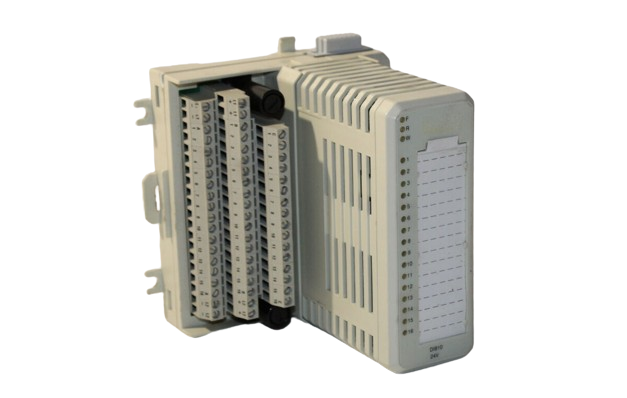
I/O modules are fundamental to industrial control systems, including PLCs (Programmable Logic Controllers), PACs (Programmable Automation Controllers), and DCSs (Distributed Control Systems). Digital input modules play a vital role in capturing and interpreting signals from various sensors like proximity switches, limit switches, and push buttons. These modules typically handle inputs ranging from 0 to 24 volts, with tolerances up to 30 volts.

ABB 3BSE008508R1 DI810 Digital Input 24V 16 ch
Signal Chain
DC sensors often emit higher-voltage signals, necessitating isolation via opto-couplers before serialization in a shift register. Alternatively, digital input serializers consolidate inputs, enhancing channel density and offering features such as adjustable current limits and programmable debounce times. Some models integrate temperature sensing and voltage regulation.
Processor
Development platforms, software tools, and support expedite time-to-market. Connectivity options include Ethernet, UARTs, and SPI ports, facilitating integration with enterprise networks. Cost-effective PLCs with abundant digital I/O and integrated functionalities like fault diagnostics and low-power operation are common. For advanced applications requiring higher loop rates and complex control algorithms, high-performance MPUs are essential.
Interface
Field bus options, serial (RS-485, DeviceNet, Profibus, CAN) and Ethernet-based, support various industrial needs. Enhanced cable reach and diagnostics aid troubleshooting. Integrated digital isolation in interface transceivers conserves space and ensures robustness. Opto-couplers or TI isolators digitally isolate input interfaces.
Microcontroller
Hercules™ Safety MCUs, based on ARM Cortex-R4F, are certified for use in systems adhering to IEC61508 SIL-3 safety standards. These MCUs feature integrated floating-point units, 12-bit ADCs, motor-control-specific PWMs, and encoder inputs via the HET Timer co-processor.
Power
To protect against transients and ground loops, electrical isolation is crucial between the field side and the control side. Designs may incorporate DC-DC converters with discrete components or pre-built isolated modules. Considerations include efficiency, integration, and compactness, with wide input range converters guarding against supply transients effectively.


