

Steam Flow Measurement: Orifice Plates vs Vortex Meters — Commissioning Guide for Emerson Rosemount 8800DF and Honeywell SmartLine STF
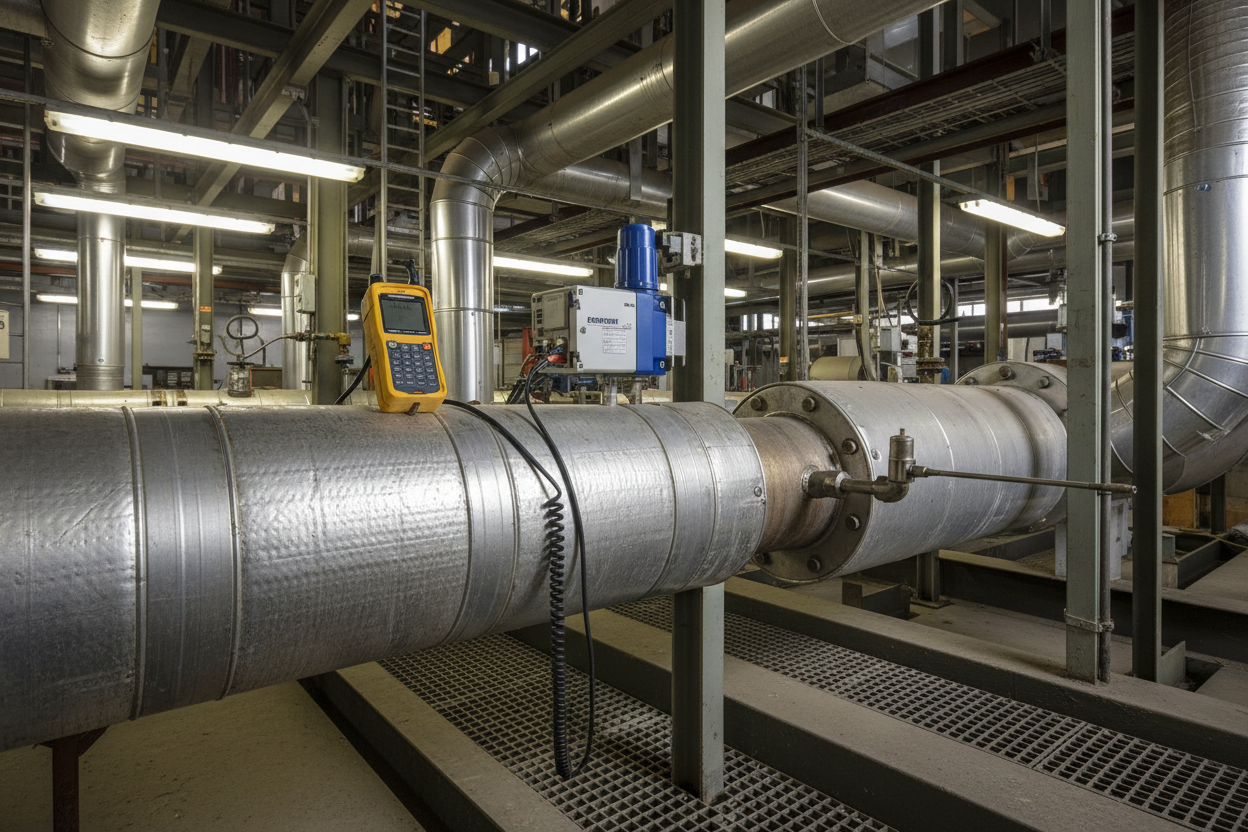
Technology Selection: Orifice Plate vs Vortex Meter for Steam
Orifice plates are inexpensive and reference ISO 5167. However, they require condensate pots, two impulse taps, and a DP transmitter with temperature compensation. A beta = 0.6 orifice plate delivers only a 3:1 turndown at acceptable uncertainty. Vortex meters measure shedding frequency directly proportional to fluid velocity. The Emerson Rosemount 8800DF integrates temperature sensing for density compensation on saturated steam without an external transmitter, eliminating impulse line freeze risk in cold climates.
Vortex meters have a low-flow cutoff — below 2 to 3 m/s, shedding becomes irregular. Select orifice plate technology for steam lines that regularly operate below 30% of design flow. Select vortex meters for lines with steady flow above 1 m/s and 10:1 turndown requirements — the standard specification for both 8800DF and Honeywell SmartLine STF models. For conductive liquid flow measurement as an alternative technology, the ABB FSM4000 Electromagnetic Flowmeter provides high-accuracy inline measurement without moving parts.
Emerson Rosemount 8800DF Commissioning
The 8800DF integrates a vortex sensor with a dual-function temperature element and outputs compensated mass flow on a 4–20 mA HART signal. Correct configuration requires accurate steam property data entry.
- Step 1: Enter the pipe inside diameter with 0.1 mm resolution. Use the actual bore dimension from the pipe schedule certificate. A 1 mm error on a 100 mm pipe shifts the K-factor and introduces a 2% volumetric flow error.
- Step 2: Select fluid type. Navigate to Configuration → Fluid Type and select Saturated Steam or Superheated Steam. For saturated steam, the meter uses pressure input to look up density from the IAPWS-IF97 steam table.
- Step 3: Configure pressure compensation. For a constant 10 bar saturated steam line, entering a fixed pressure value introduces less than 0.5% density error if operating pressure stays within ±0.3 bar of the set value.
- Step 4: Set the low-flow cutoff to 1.5 m/s during the first 30 minutes of steam admission to prevent condensate slug damage to the sensor. Restore to the default 0.5 m/s after line temperature stabilises.
- Step 5: Verify K-factor output using HART Command 1. The K-factor for a 100 mm 8800DF is typically 1.8 to 2.1 pulses per litre depending on the shedder bar size.
- Step 6: Document as-found signal output at zero flow. A correctly installed vortex meter reads 4.00 mA ± 0.02 mA at zero flow. Values outside this range indicate electrical noise or sensor damage from condensate slug flow during startup.
Honeywell SmartLine STF Vibration Filter and Modbus TCP
The SmartLine STF uses HART revision 7 and integrates with Honeywell Experion PKS through a HART Multiplexer or AI cards. It includes a built-in vibration filter to prevent low-frequency mechanical vibration from mimicking vortex shedding. A 100 mm pipe at 3 to 20 m/s produces shedding at 20 to 130 Hz. Configure the STF filter to pass 15 to 150 Hz and reject signals below 10 Hz. This blocks pump vibration at 25 Hz without attenuating real flow signals.
For Modbus TCP, map mass flow (kg/h) to register 40001, process temperature to 40003, and process pressure to 40005. Use port 502 with a 500 ms timeout in Experion PKS to detect STF communication loss promptly.
Five Common Fault Patterns in Steam Vortex Applications
- Fault 1 — Noise reading at zero flow: Indicates condensate slug impact damage — inspect the shedder bar for mechanical deformation.
- Fault 2 — Flow reading 15 to 20% low after long operation: Suggests shedder bar fouling from scale deposits — clean the throat or replace the insert.
- Fault 3 — HART communication loss after line heating: Indicates connector corrosion at the field junction box — check for moisture ingress and clean terminals.
- Fault 4 — Erratic readings during plant startup: Points to two-phase wet steam flow — wet steam above 5% moisture content causes shedding instability. Add a steam separator upstream or increase trap loading.
- Fault 5 — Mass flow error of 3 to 5% after several months: Traces to pressure compensation drift — recalibrate the upstream pressure transmitter and verify the compensation value matches the actual operating pressure in both 8800DF and STF configuration.
Conclusion and Action Advice
Select vortex meters for steam lines with steady flow above 1 m/s and 10:1 turndown requirements. Use orifice plates where flow regularly falls below 30% of design capacity. For saturated steam service, the Emerson Rosemount 8800DF with integrated density compensation eliminates condensate pots and simplifies installation. For Honeywell Experion PKS plants, the SmartLine STF maps directly to Modbus register 40001 with minimal configuration. In both cases, set low-flow cutoff to 1.5 m/s during the first 30 minutes of steam admission. This prevents shedder bar damage from condensate slugs and is the single most effective protection measure for vortex meter service life.
Author: Zhang Hua is an industrial automation engineer with over 10 years of experience in PLC, DCS, and control systems.


