

Hydraulic System Pressure Instability: Root Causes and Field Troubleshooting Guide
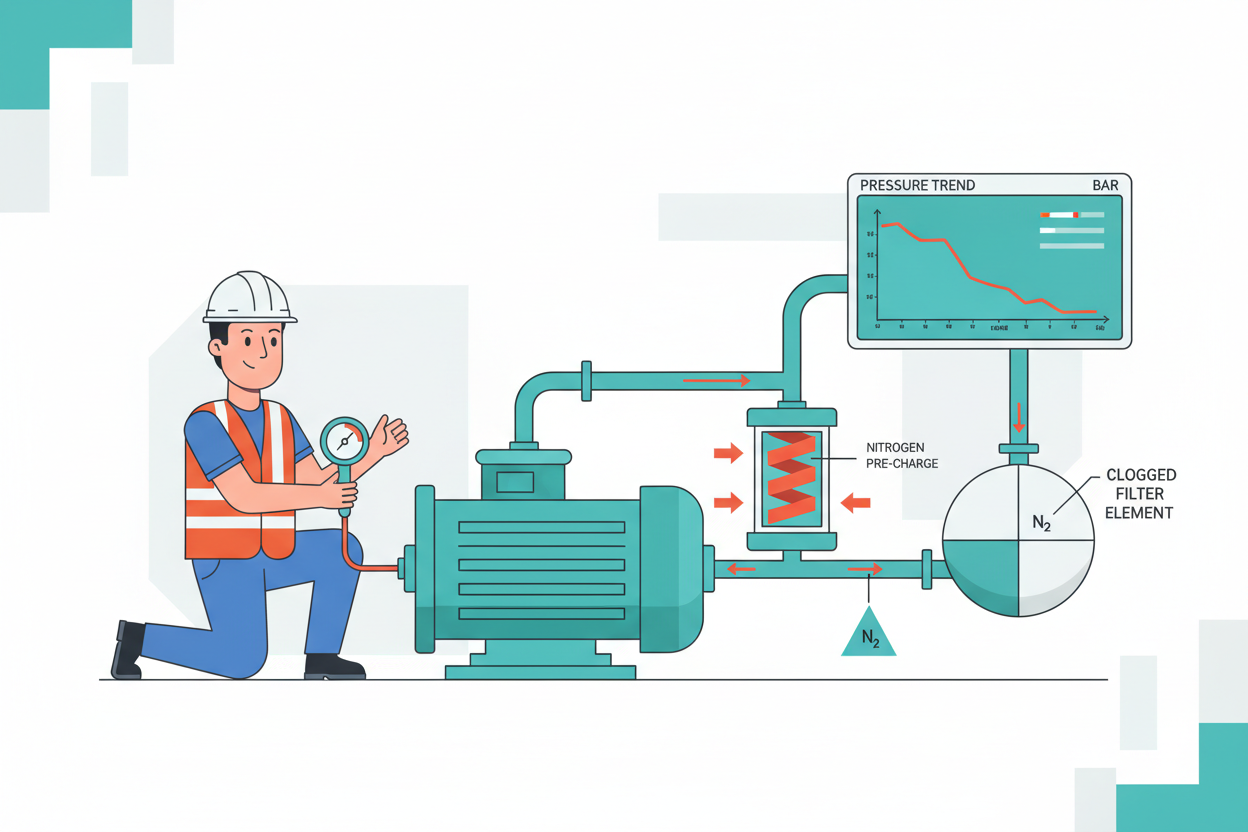
Why Does Hydraulic System Pressure Change Unexpectedly?
Industrial fluid systems use pressurized oil or gas to move actuators and drive loads. The amplification factor that makes hydraulic systems efficient for heavy-duty applications also means small faults produce large pressure swings.
Q: What is the most common cause of unexplained pressure drops?
Contaminated fluid. Particles as small as 15 microns damage pump surfaces and valve seats, creating internal leakage paths over time. Pressure drops without any external load change. Always verify fluid cleanliness with an ISO 4406 particle count before blaming other components.
Q: What is the second most common cause?
Device failure. A pump with worn gears or a cracked piston ring cannot maintain rated discharge pressure. A relief valve set too low bleeds off pressure before the actuator reaches full stroke. Emerson Fisher regulators and pilot valves are often inspected first because they directly govern system pressure limits.
How Do I Diagnose a Pressure Drop?
Follow this structured approach to isolate the fault quickly:
- Isolate the circuit: Close the manual shut-off valve at the actuator and measure pump discharge pressure. If pressure remains low, the pump or relief valve is suspect. If pressure recovers, the fault is downstream.
- Check the relief valve setting: Use a calibrated pressure gauge at the relief valve test port. The set point should match the original commissioning data on the Yokogawa loop diagram.
- Sample the fluid: Pull a 100 mL sample from the return line and submit it for particle count analysis. An ISO cleanliness level worse than 17/15/12 indicates contamination damage.
- Inspect internal cylinder seals: Attach a transparent drain line to the cylinder rod end. Observe for continuous oil flow when the cylinder is under static load. Seal bypass confirms internal leakage.
- Review DCS trend data: Yokogawa CENTUM VP historians log pressure every second. A gradual decline points to progressive wear. A sudden step drop indicates a valve or seal failure. The Yokogawa DPharp EJA Series Pressure Transmitter with 0.04% accuracy provides the reliable high-resolution data needed for meaningful trend analysis in hydraulic pressure monitoring applications.
How Do I Diagnose High Pressure and Surges?
High pressure events stress hoses, fittings, and actuator housings beyond rated limits. Pressure surges accelerate fatigue cracking at pipe elbows and tee connections.
Q: What causes sudden high pressure?
A clogged filter element raises upstream pressure rapidly. Replace the filter element and monitor the pressure differential indicator. A differential greater than 5 bar on a return-line filter demands immediate element replacement.
Q: Why does pressure overshoot during ramp-up?
Low accumulator precharge or proportional valve hysteresis. A nitrogen-charged accumulator with low precharge cannot absorb pressure spikes — verify the precharge matches 60% of minimum working pressure. Emerson Fisher proportional control valves can develop hysteresis after years of operation, causing the valve to lag behind its command signal. Request a valve signature test using Emerson AMS Device Manager to quantify the hysteresis band.
How Do I Identify and Fix Cavitation?
Q: How do I know if my pump is cavitating?
Listen for a rattling or gravel-like noise from the pump housing — this confirms cavitation. Measure the pump inlet pressure. If it falls below 0.5 bar absolute, the pump is starved.
Q: What corrective actions fix cavitation?
Increase the reservoir height, shorten the suction line, or install a booster pump to correct the inlet condition. Use Yokogawa EJA-series differential pressure transmitters to monitor pressure across suction and discharge ports simultaneously. Trend the differential daily during seasonal temperature changes, since fluid viscosity affects vapor pressure margins.
What Preventive Maintenance Schedule Should I Follow?
- Every 500 hours: Change the hydraulic filter or when the differential pressure indicator reaches the red zone.
- Every 1,000 hours: Sample and test fluid quality using ISO 4406 particle counting and water content analysis.
- Quarterly: Check accumulator precharge. Log all readings in the maintenance management system with date and technician ID.
- Annually: Calibrate all pressure transmitters using a Yokogawa CA500 or equivalent reference standard traceable to national measurement institutes.
- Monthly: Review DCS alarm history. Address any pressure alarm that recurs more than three times in 30 days as a priority work order.
What Is the Key Takeaway?
Hydraulic pressure instability rarely has a single cause. Contamination, worn components, incorrect settings, and inadequate maintenance each contribute. A systematic stepwise diagnosis always outperforms guesswork. Start with fluid cleanliness, verify relief valve settings, and use DCS trend data to narrow the fault location. Teams using Yokogawa and Emerson platforms have access to powerful built-in trending and device health tools — use them actively rather than waiting for alarms.
Author: Liang Haocheng is an industrial automation engineer with over 10 years of experience in PLC, DCS, and control systems.


