

Sterile Filtration Technology: Extending Filter Life Without Compromising Process Integrity
Sterile Filtration Technology: Extending Filter Life Without Compromising Process Integrity
How advanced membrane architecture, differential pressure monitoring, and automated DCS/PLC process control safeguard sanitary manufacturing campaigns.
Why Is Sterile Filtration Critical in Modern Clean Manufacturing?
Sterile filtration plays an indispensable role in pharmaceutical production, food and beverage processing, healthcare manufacturing, and bioprocessing environments where absolute product integrity must be preserved. Filter elements are engineered to retain unwanted microorganisms and particulate contaminants while allowing the process fluid to pass through at an optimal, steady flow rate.
These stringent operational demands present a continuous engineering challenge: filtration efficiency, fluid resistance (differential pressure), and operational service life must be balanced simultaneously. As contaminants accumulate within the filter matrix over time, hydraulic resistance increases. This results in progressive pressure drops, reduced throughput, and accelerated filter replacement cycles. In critical sterile environments, an unplanned filter change not only incurs replacement hardware costs but can also interrupt an entire processing campaign.
What Is Donaldson Alpha-Pore Technology and How Does It Extend Operating Life?
On November 2, 2026, Donaldson introduced Alpha-Pore, a next-generation sterile filtration technology platform engineered within its LifeTec filter element portfolio. The technology addresses one of the most persistent bottlenecks in sterile processing: extending filter on-stream runtime while preserving strict microbiological retention and process integrity.
By optimizing the microporous membrane structure and cartridge architecture, Alpha-Pore significantly increases dirt-holding and contaminant-loading capacity throughout the filter lifecycle. Under controlled manufacturer laboratory testing, Donaldson reports up to 2.5 times longer run times compared with conventional single- and dual-layer polyethersulfone (PES) filter cartridges. Furthermore, the robust platform is rated to withstand up to 150 sterilization-in-place (SIP) steam cycles without compromising retention efficiency.
While these laboratory metrics demonstrate significant structural advancements, actual operating lifespan in commercial plants depends heavily on fluid viscosity, particulate loading, upstream prefiltration, and operating parameters.
What Are the Core Engineering Challenges in Sterile Filtration Systems?
How do you balance sterile retention with high fluid throughput?
A sterile-grade filter cartridge must guarantee validated microbial retention (typically 0.22 micron or tighter) without introducing excessive hydraulic drag into the fluid stream. A membrane optimized solely for high flow may compromise critical retention limits, while an overly restrictive design increases pumping energy requirements, generates frictional heat, and drives up operating costs.
Why is differential pressure (DP) monitoring crucial for filter health?
Differential pressure (ΔP)—the pressure delta between the upstream and downstream ports of the filter housing—is the most reliable operational health metric for any filtration system. Under steady flow rates, a gradual rise in differential pressure directly reflects particulate loading and membrane fouling. Tracking baseline ΔP and rate-of-rise allows plant engineers to predict remaining filter life and schedule changeouts during planned maintenance windows rather than suffering unexpected batch halts.
How can filter integrity be maintained during aggressive CIP/SIP cycles?
Sanitary processes frequently rely on Clean-in-Place (CIP) chemicals and Steam-in-Place (SIP) sterilization to sanitize process equipment without disassembling the piping skid. Thermal expansion, repeated steam temperature shocks, and chemical exposure place extreme stress on filter media, cage supports, and elastomeric seals. Engineers must verify total chemical and thermal compatibility across the entire filtration skid assembly.
Which Instrumentation and Control Modules Ensure Reliable Filter Monitoring?
High-integrity sterile filtration relies on precision instrumentation and robust process control hardware working in unison across the skid:
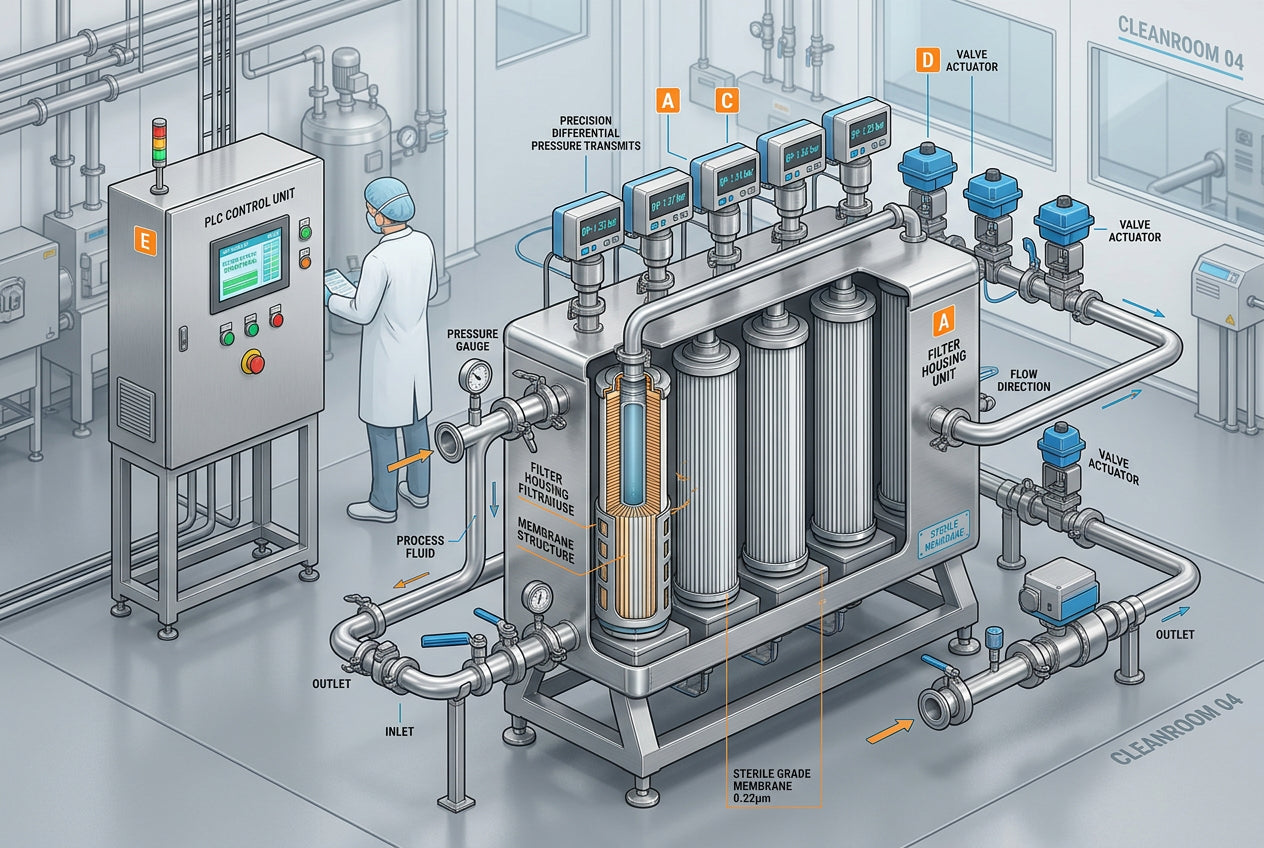
- Differential Pressure Transmitters: Continuous ΔP instruments like the Honeywell 51305829-400 Differential Pressure Transmitter and the high-accuracy Honeywell 51196814-200 Precision Differential Pressure Transmitter deliver direct, real-time feedback on membrane loading and clogging trends.
- Process Pressure Transmitters: Flange- and pipe-mounted units such as the Yokogawa DPharp EJA Series Pressure Transmitter measure upstream feed and downstream delivery pressures to protect membranes from pressure surges and cavitation.
- Sanitary Flow Meters: Electromagnetic or Coriolis mass flow meters track continuous throughput, enabling normalized ΔP calculations that account for variable flow rates.
- Sanitary RTD Temperature Sensors: Monitor temperatures during SIP cycles to ensure validated sterilization conditions are achieved without exceeding cartridge thermal limits.
- Automated Control Valves: Modulating sanitary control valves and digital positioners maintain smooth flow ramping to prevent hydraulic shock against fragile membranes.
- PLC / DCS Control Modules: Analog input channels such as the Yokogawa AAI135-S50 8-Channel Analog Input Module and the Emerson DeltaV KC3010X1-BK1 16-Channel HART Analog Input Module capture 4–20 mA HART telemetry, process trend data, manage alarm setpoints, and trigger interlocks.
For validated pharmaceutical processes, alarm limits should be configured based on the manufacturer's maximum allowable ΔP and validated integrity testing boundaries. Note that differential pressure alone does not replace regulatory post-batch bubble point or diffusion integrity testing.
How Can You Integrate Filtration Telemetry into Predictive Maintenance?
Traditionally, filter replacement intervals have followed rigid calendar hours, fixed batch counts, or high-pressure emergency alarms. Modern automated plants leverage historical telemetry from supervisory control and data acquisition (SCADA) systems to implement condition-based maintenance.
By logging normalized differential pressure, flow velocity, fluid temperature, and batch lot numbers, control engineers can compare membrane loading profiles across successive runs. Identifying abnormal pressure accumulation rates allows operators to catch upstream centrifuge or pre-filter degradation before expensive final sterile filters are compromised. Furthermore, logging installation timestamps, cumulative SIP cycle counts, and integrity test records ensures comprehensive regulatory batch compliance.
What Are Practical Steps for Upgrading a Sterile Filtration System?
- Evaluate Process Specifications: Review fluid viscosity, particulate distribution, bioburden levels, and chemical sanitization regimens.
- Establish Baseline Operating Curves: Record steady-state flow, upstream/downstream pressures, and temperature curves under standard operating recipes.
- Verify Instrumentation Accuracy: Calibrate differential pressure transmitters and inspect impulse lines or diaphragm seals for air entrapment.
- Check Skid Material Compatibility: Ensure housing alloys, O-ring elastomers (EPDM, PTFE, FKM), and cartridge components match SIP temperature and chemical parameters.
- Implement Automated Trend Alarming: Program warning and high ΔP trip points in your DCS/PLC to alert operators well before membrane blinding occurs.
- Perform In-Situ Validation: Conduct bacterial retention and post-use integrity testing (bubble point / forward flow) under actual production fluid conditions.
Summary: How to Maximize Sterile Filter Lifespan Safely?
Extending sterile filter life enhances production continuity, decreases expensive consumable turnover, and reduces maintenance overhead. However, longevity must never compromise final product sterility and regulatory compliance.
Advancements such as Donaldson Alpha-Pore highlight how optimized membrane architecture can balance high flow rates with greater contaminant loading. By pairing high-capacity sterile filters with precision differential pressure instrumentation and automated DCS/PLC monitoring, industrial manufacturers can achieve maximum filter lifespan alongside uncompromised process integrity.


