

Industrial Motion Control MCUs: What High-Performance Embedded Processing Enables
Industrial Motion Control MCUs: What High-Performance Embedded Processing Enables
How a new generation of microcontrollers supports compact servo drives, real-time communication and integrated industrial control.

Why Are Modern Industrial Controllers Facing Unprecedented Processing Demands?
Industrial controllers must process exponentially more sensor and feedback information while maintaining sub-millisecond, deterministic response times. Modern robotic joints, multi-axis machine tools, and compact servo drives frequently handle closed-loop motor feedback, multi-channel communication, active signal filtering, and complex kinematic algorithms—all within tightly constrained electronic footprints.
As automation architectures shift toward distributed, compact intelligence, the embedded microcontroller is no longer restricted to executing basic sequential control logic. It now routinely manages high-frequency encoder interfaces, executes digital filtering algorithms, coordinates fieldbus networking, and runs functional safety routines.
In legacy and modular machine layouts, dedicated standalone units such as the Schneider 141MMS53502 Quantum SERCOS Motion Controller coordinate multi-axis trajectory planning. However, the pressing challenge for equipment OEMs today is integrating similar computational power directly into motor drives and joint modules without adding prohibitive hardware costs or thermal complexity.
What Does the New GD32H7 High-Performance MCU Architecture Offer Automation Engineers?
On November 10, 2026, GigaDevice announced its new-generation GD32H7 high-performance MCU portfolio engineered specifically for demanding industrial automation applications.
The GD32H7 family is built upon Arm Cortex-M7 processing cores operating at clock frequencies of 600 MHz and 750 MHz, depending on the specific series. Rather than a one-size-fits-all silicon layout, the platform establishes a unified hardware foundation with application-targeted variants for industrial HMI, general automation, and robotic joint servo control.
From a memory and caching perspective, announced platform specifications include 640 KB of CPU-synchronous tightly coupled memory (TCM), 2 MB of zero-wait-state executable Flash, 8 MB of extended storage Flash, and 1.2 MB of high-speed SRAM, providing ample headroom for complex real-time firmware stacks.
How Does Embedded EtherCAT Integration Solve Real-Time Servo and Motion Communication Challenges?
Precision servo control relies fundamentally on deterministic feedback and ultra-low jitter communication. A motor controller must process position, velocity, and torque feedback rapidly enough to maintain tight trajectory tracking along the motion profile.
In traditional automation racks, synchronized deterministic fieldbus communication is typically handled by specialized modules, such as the ABB CM579-ETHCAT EtherCAT Master Module or decentralized field interfaces like the ABB CI511-ETHCAT Bus Interface Module. The GD32H7 brings this capability directly onto the controller silicon:
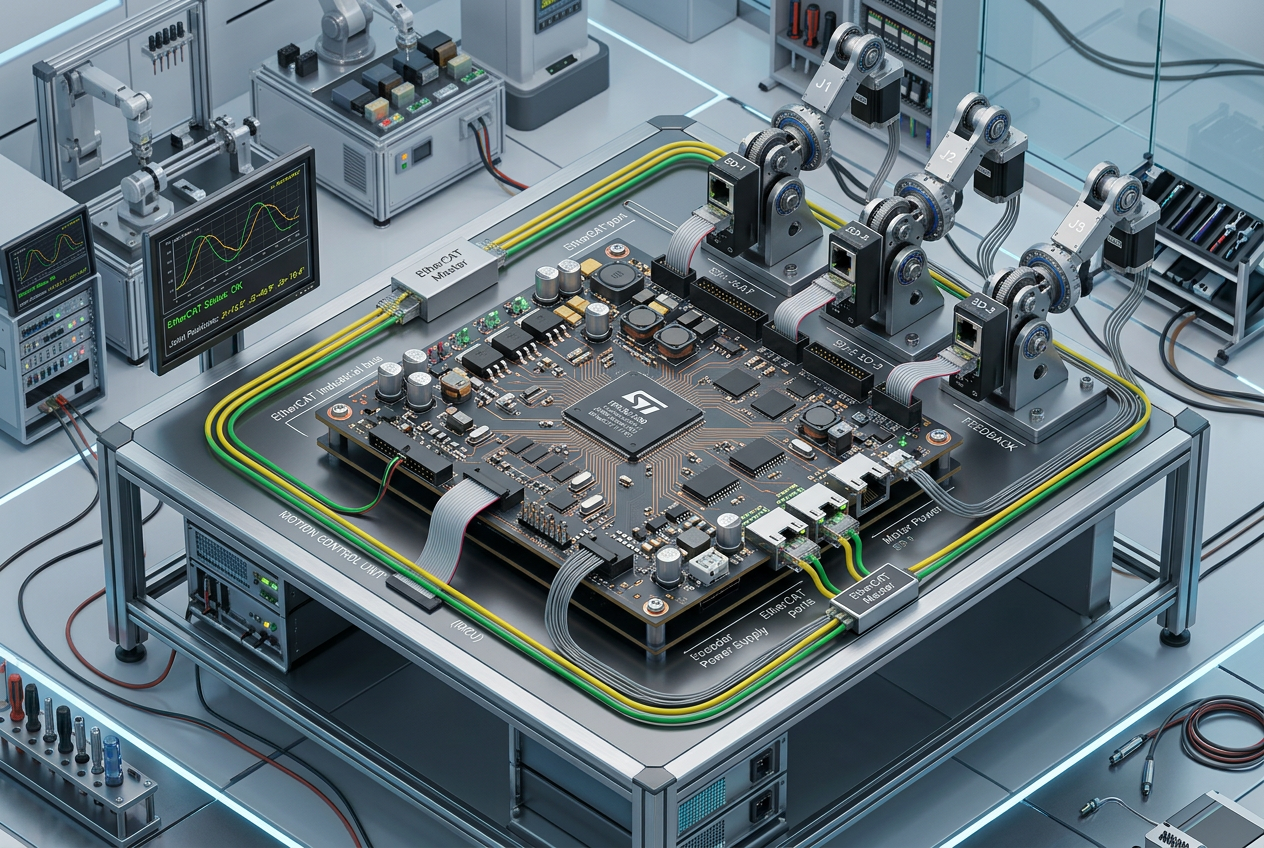
- GD32H7xR Series (Robotic Joint Servo Control): Integrates an on-chip EtherCAT slave controller alongside dual 100 Mbps Ethernet PHYs on a single silicon die. This design reports port-to-port transmission latency below 50 ns and natively supports the Fail Safe over EtherCAT (FSoE) protocol for functional safety.
- GD32H7xE Series (High-Precision Real-Time Motion Control): Incorporates a hardware-based EtherCAT slave controller with distributed clock (DC) synchronization accuracy reaching 62.5 μs, paired with native hardware interfaces for leading digital absolute encoders including EnDat, BiSS-C, Tamagawa, and HIPERFACE DSL.
These on-chip capabilities are highly relevant to compact drive architectures like the Schneider PacDrive MC-4 Servo Drive and specialized drive subsystems such as the Emerson Ovation Servo Driver Module, where tight PCB real estate and microsecond-level synchronization directly dictate system stability.
Beyond Motion Control, Where Does Integrated MCU Processing Deliver the Greatest Value?
While motion control is a primary beneficiary, high-throughput MCUs address several critical requirements across modern factory automation:
- Robotic Joint Servo Control: Ultra-compact processing and integrated multi-protocol PHYs streamline space-restricted joint modules and collaborative robotic arms.
- Industrial HMI & Operator Terminals: High-resolution display controllers and hardware 2D graphics acceleration provide responsive touchscreen interfaces without requiring high-power application processors.
- General Automation & Edge Gateways: 750 MHz processing enables local protocol translation, OPC UA pub/sub edge telemetry, and predictive maintenance diagnostics.
- Precision Analog Measurement: The general-purpose GD32H7x9 series integrates high-speed 14-bit ADCs and dedicated digital hardware filtering, ideal for process control loops, vibration monitoring, and fast signal acquisition.
What Functional Safety (SIL 2/3) and Firmware Security Measures Are Critical for Industrial MCUs?
Industrial electronic systems are expected to operate reliably over 10-to-20-year service lifecycles in electrically noisy, harsh environments. Functional safety integrity and secure firmware management are non-negotiable requirements.
The GD32H7 platform has attained IEC 61508 SC3 certification, supporting SIL 2 and SIL 3 safety integrity level architectures depending on system configuration. The hardware foundation features extensive security peripherals:
- Hardware-accelerated AES encryption and SHA-256 cryptographic verification.
- True Random Number Generator (TRNG) for secure industrial networking handshakes.
- Secure boot mechanisms and authenticated firmware update routines to prevent unauthorized code execution.
Engineering note: Component-level certification provides a robust foundation but does not automatically certify the complete machine or control cabinet. Equipment builders must complete the formal system-level hazard analysis (FMEA/FMEDA) and validation lifecycle.
What Key Factors Should Engineering Teams Evaluate Before Selecting an Industrial MCU?
Selecting an embedded processor for industrial machinery requires looking far beyond core clock speed. Key engineering criteria include:
- Deterministic Latency & Memory Bandwidth: Verify that tightly coupled memory (TCM) and cache configurations eliminate interrupt latency jitter during high-speed current loops.
- Feedback & Communication Compatibility: Ensure hardware-level support for existing factory fieldbus infrastructure and optical/magnetic encoder protocols.
- Thermal Dissipation & Operating Envelope: Assess power consumption in fully enclosed, IP67-rated robotic joints or miniature servo housings.
- Production Roadmap & Availability: GigaDevice targeted sample availability for the new portfolio in January 2027, with mass production scheduled for April 2027. Development teams should align their prototype cycles with verified commercial availability dates.
Engineering Summary & Practical Next Steps
High-performance embedded MCUs are fundamentally reshaping industrial control architectures by bringing multi-axis motion computation, dual-channel EtherCAT communication, and functional safety directly onto motor and joint hardware.
When planning your next-generation motion drive or embedded controller, benchmark real-time cycle requirements, verify hardware interface documentation, and ensure long-term industrial supply commitments across your complete control architecture.


