

Scaling Additive Manufacturing: How Industrial AI and Automation Unify Production
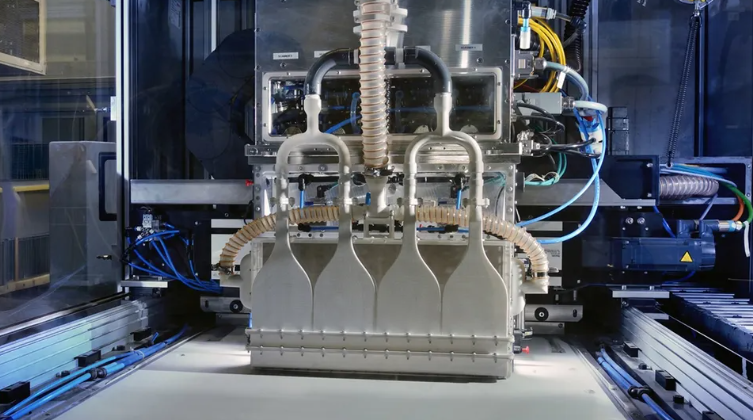
Additive Manufacturing (AM) has transitioned from a prototyping tool to a potential powerhouse for high-volume industrial production. However, reaching true "production scale" requires more than just faster 3D printers. According to insights from experts Tyler Bouchard and Tyler Modelski, the industry must converge AM with industrial automation and Artificial Intelligence (AI) to eliminate systemic bottlenecks. While AI offers predictive insights, its true value emerges only when it manages the entire process chain rather than isolated machines.
Breaking Down Silos in Factory Automation
Currently, many AM processes operate as "islands of automation." Machine learning models might optimize a single toolpath or detect build anomalies in real-time. However, these localized improvements do not address the fragmented nature of the broader production line. A typical AM workflow involves powder conditioning, printing, thermal processing, and CNC finishing. Often, these steps use different control systems and proprietary data formats. To scale effectively, manufacturers must integrate these disparate stages into a cohesive digital thread.
Building a Data Foundation for Industrial AI
AI thrives on high-quality, contextualized data from multiple sources across the factory floor. In many facilities, valuable data stays trapped within a specific PLC or a vendor-locked software environment. This lack of interoperability prevents AI from understanding the cause-and-effect relationships between different production stages. Consequently, factories need a software-defined infrastructure that connects every asset—from robotic arms to inspection sensors. This connectivity ensures that data flows seamlessly, allowing AI to identify root causes of defects across the entire lifecycle.
Transitioning to Closed-Loop Control Systems
The most significant leap for AM involves moving from simple monitoring to autonomous, closed-loop process control. Instead of merely alerting an operator to a fault, an intelligent system can adjust build parameters mid-print. It can also modify post-processing recipes based on real-time inspection feedback. For industries with high compliance standards, such as aerospace or medical, this adaptive intelligence ensures repeatable quality. However, achieving this requires real-time communication between the DCS (Distributed Control System) and the AI inference engine.
Orchestrating the Modern AM Production Cell
Scaling production usually leads to the creation of hybrid manufacturing cells. These cells combine 3D printers with robotic handling systems and automated finishing equipment. Without centralized orchestration, these diverse machines cannot synchronize their operations. Software-defined automation acts as the "brain" of the cell, managing sequences and balancing workloads. This prevents bottlenecks and ensures that the AI-driven optimization translates into actual throughput gains.
Author Insight: The Future of Software-Defined Manufacturing
In my view, the "bottleneck" in additive manufacturing is no longer the physics of printing, but the physics of the factory floor. Many companies focus too heavily on the printer itself while ignoring the manual "handoffs" between stages. The shift toward software-defined automation is not just a technical upgrade; it is a strategic necessity. By treating the entire AM cell as a single, programmable entity, manufacturers can finally treat 3D printing with the same rigor and predictability as traditional injection molding or CNC machining.


