

ABB System 800xA Modbus TCP Integration: Register Mapping, Unit IDs, and Timeout Troubleshooting
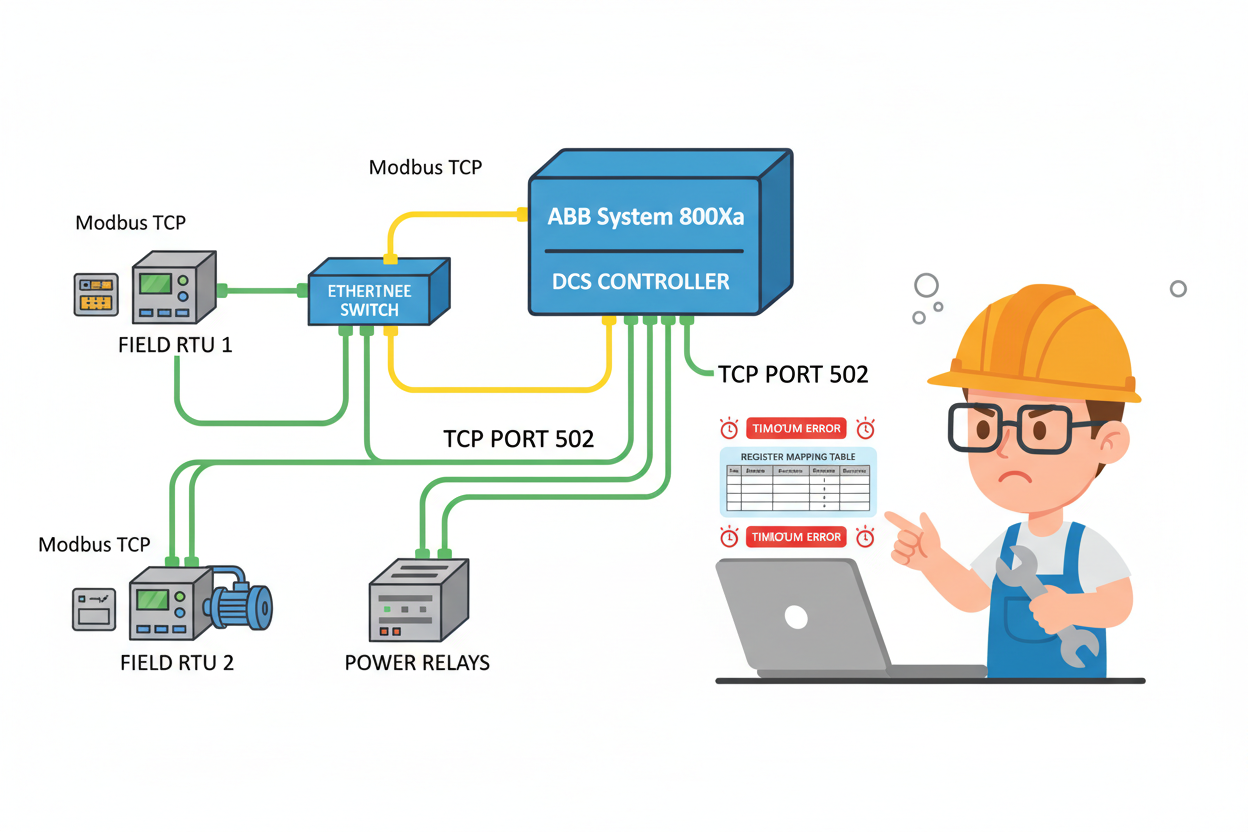
Modbus TCP on the ABB Control Network
Modbus TCP wraps the classic Modbus protocol inside standard Ethernet, running over TCP port 502. Unlike serial Modbus, there is no CRC or baud rate to match — the TCP stack handles integrity. This makes wiring simpler but shifts failure points into addressing and mapping.
The four Modbus data areas:
- Coils: Readable and writable bits (Function 1/5/15)
- Discrete Inputs: Read-only bits (Function 2)
- Holding Registers: Readable and writable 16-bit words (Function 3/16)
- Input Registers: Read-only 16-bit words (Function 4)
In ABB System 800xA, an AC 800M controller (PM861A) or a communication module acts as the Modbus TCP master. Field devices, RTUs, or power relays appear as slaves. The unit identifier (unit ID) routes requests to the correct slave when one IP address hosts multiple Modbus devices behind a gateway — always verify this in the device manual before assuming the unit ID is ignored.
Q: What Is the Base-Zero vs Base-One Offset Trap?
Modbus register addressing is a common source of confusion. Some tools show address 40001 as register zero; others show it as register one. This single off-by-one error produces wrong values or communication failures.
- Determine your slave’s convention by verifying against a known good reading. If a value appears shifted by one register, toggle the offset.
- Document the chosen convention in the 800xA point template for consistency.
- When a gateway fronts several slaves, confirm each slave’s offset independently — different vendors do not always agree.
Q: How Do You Handle Byte Order and Word Swap for 32-Bit Values?
Modbus registers are 16-bit words. A 32-bit value spans two registers, and the device defines both the high/low word order and the byte order inside each word. Getting this wrong makes integers look enormous, negative, or garbage when decoded as floating-point.
- Big-endian byte order is standard Modbus. Confirm whether your device follows this or uses little-endian.
- For 32-bit values, determine the word order (sometimes called word swap): high word first or low word first.
- Test with a known number — write a simple value, read it back, and inspect the bit pattern across all four permutations until the number decodes correctly.
- Lock the working order into the point documentation and share it with the team.
Q: How Do You Diagnose Modbus TCP Timeouts and Polling Overload?
A Modbus TCP timeout means a request went unanswered. The cause is rarely the network cable — start at the endpoints.
- Step 1: Confirm reachability with a ping, then test TCP port 502 directly. A closed port means the service or firewall is blocking you.
- Step 2: Verify the unit ID on gateway-connected slaves. A wrong unit ID yields an exception response or silence, not a link failure.
- Step 3: Reduce the polling rate on large scans. Aggressive requests overload a slow serial gateway behind the Ethernet port. Isolate one point and test at a calm rate first.
- Step 4: Read the exception code. “Illegal data address,” “Illegal function,” and “Slave device busy” each point to a different fix.
- Step 5: Capture traffic with a packet analyzer filtered to port 502. The raw frame reveals offset, function code, and timing faults clearly.
Group contiguous registers into a single multi-register read. Many small polls waste gateway bandwidth and trip timeouts on devices connected to redundant processor configurations.
Q: How Do You Bridge IEC 61850 Relays to 800xA SCADA?
Modern substations expose data through IEC 61850 rather than Modbus. An 800xA system typically reaches these relays through a protocol gateway that maps IEC 61850 logical nodes to Modbus TCP registers.
- Align the gateway’s point table with the 800xA mapping before commissioning.
- Watch for scaling factors on analog measurements — IEC 61850 and Modbus may use different engineering unit representations.
- Prefer reporting-based IEC 61850 reads where available for lower latency compared to polling.
- Diagnose from both the Modbus side and the IEC 61850 side — a gateway hides two protocol layers inside one box.
Conclusion & Action Advice
Clean Modbus TCP data in ABB System 800xA depends on precise mapping, not luck.
- All traffic uses TCP port 502; a unit ID selects the slave behind a gateway.
- Resolve the base-zero vs base-one offset against a known reading and document it.
- Confirm 32-bit byte and word order before trusting any value.
- When points go stale: check reachability → unit ID → poll rate → exception codes → port 502 packet capture.
- Group contiguous registers to reduce load.
- For substations, diagnose both sides of an IEC 61850 gateway independently.
Author: Ma Chenglong is an industrial automation engineer with over 10 years of experience in PLC, DCS, and control systems.


