

Seventy-Five Valves Stroking Erratically: The Rusted Positioner Spring Nobody Predicted
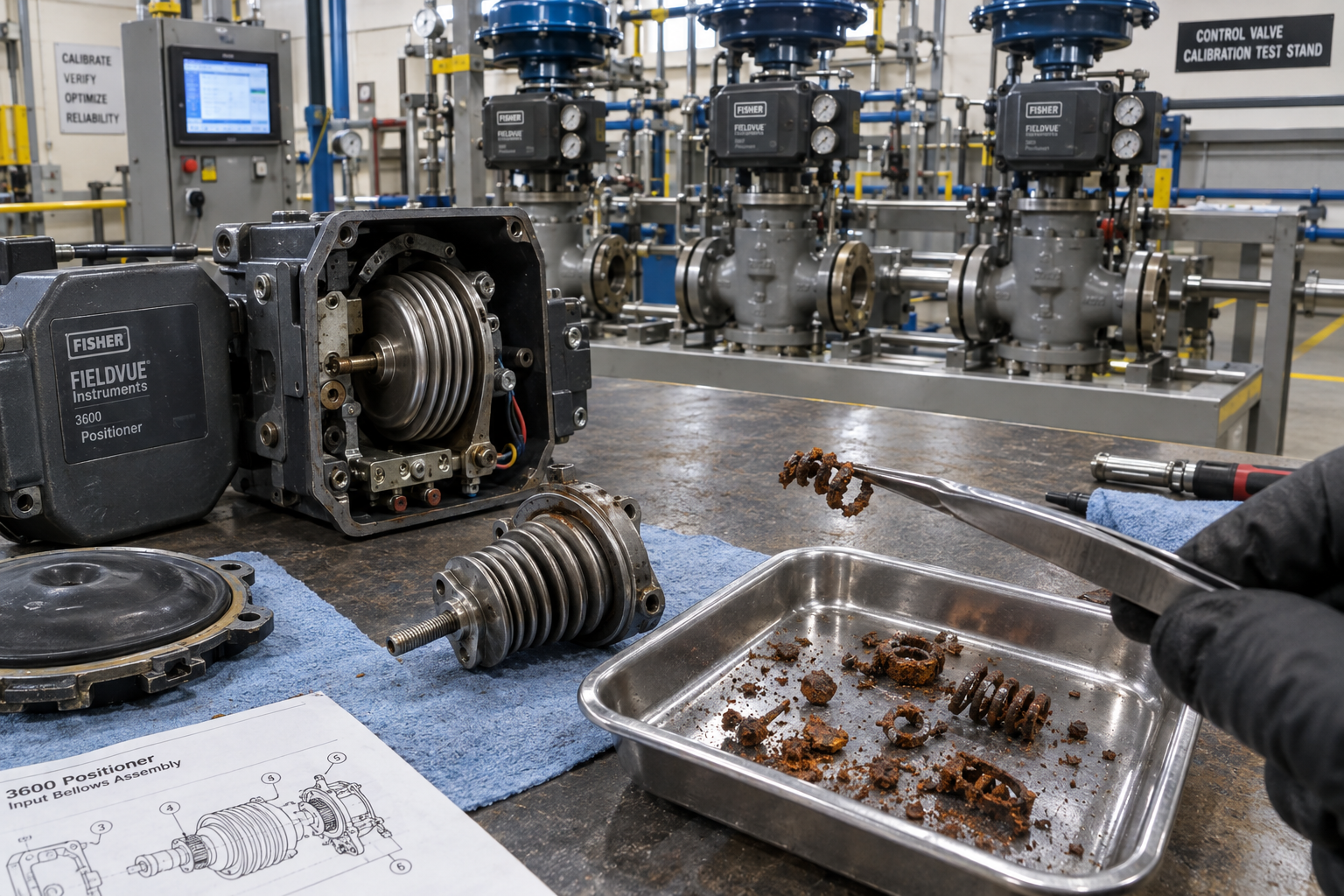
A control valve maintenance review, based on the instrumentationtools.com article "Erratic Stroking Control Valves Delaying the Shutdown Plant Restart".
Why Were 75 Control Valves Stroking Erratically During the Plant Restart?
Following a four-month water plant shutdown caused by severe drought, operations prepared to resume. As technicians stroked field equipment to verify readiness, approximately 75 control valves began stroking erratically. Despite the efforts of skilled instrument engineers and experienced maintenance crews, standard positioner adjustments failed to settle the loops.
Initial troubleshooting focused on the expected failure points, primarily damaged input or output bellows assemblies. However, plant telemetry reported clean, oil-free instrument air with a design dew point of -40°C, and external bellows components inspected on the bench looked brand new. When clean hardware exhibits unpredictable dynamic hunting, field diagnostic procedures must move beyond surface inspections and examine the internal mechanical balance of the valve positioner.
What Hidden Mechanical Fault Inside the Input Bellows Caused Valve Hunting?
Dismantling one recalcitrant positioner revealed the unexpected culprit: nestled inside the input bellows assembly was a small return spring. The spring had severely corroded and crumbled immediately under light finger pressure. Subsequent teardowns of three additional erratic positioners revealed identical spring disintegration.
In pneumatic and electro-pneumatic force-balance positioners, this internal spring provides the essential restoring force opposing the signal pressure. When the spring breaks, the mechanical balance collapses. Even when 4–20 mA control signals from an analog output module are stable and nozzle-flapper clearances appear correct, the valve stem hunts, overshoots, or binds. Because physical mechanics govern the positioner span, electronic re-zeroing cannot compensate for a missing mechanical counterforce.
How Did the Plant Overcome a Three-Month Vendor Lead Time for Bellows Assemblies?
When contacted, the overseas equipment vendor refused to supply individual replacement springs, quoting complete input bellows assemblies at high cost with a three-month shipping delay. Such a lead time would have paralyzed plant restart commitments.
The maintenance chief took an intact spring sample to a local precision spring manufacturer, commissioning an initial run of 25 matched units within hours. Because springs wound from identical diameter spring-grade wire reproduce original load-deflection characteristics within manufacturing tolerances, positioner stroke calibration easily absorbs minor spring-rate variations. Six test valves across different stroke lengths demonstrated immediate, repeatable calibration without hysteresis. Following this success, an order of 60 additional springs restored the remaining valves without operational delay.
What Is the Recommended Field Diagnostic and Repair Workflow for Erratic Positioners?
When confronting widespread valve stroking issues after a shutdown, execute the following systematic procedure:
- Verify point-of-use air quality: Measure dew point and oil content directly at field valve manifolds rather than relying solely on central compressor header readouts.
- Isolate electrical commands from mechanical feedback: Supply a known test signal directly to the positioner or compare against an intelligent valve controller to confirm whether hunting originates in loop tuning or mechanical feedback.
- Inspect internal mechanical components: Remove the input bellows and verify that return springs are free from corrosion, stress fractures, and loss of tension.
- Fabricate precision local replacements when justified: Replicate wire gauge, active coil count, and metallurgy, documenting vendor certifications for maintenance records.
- Apply anti-corrosion protection: Dip replacement springs in a protective anti-corrosive primer and allow them to fully dry before installation.
- Perform comprehensive stroke calibration: Carry out zero, span, and linearity checks across 0%, 25%, 50%, 75%, and 100% travel, logging baseline stroke signatures.
How Can Maintenance Teams Prevent Positioner Corrosion and Air System Outages?
Corrosion inside sealed bellows typically stems from unmonitored dew-point excursions during compressor upsets or desiccant regenerations. A single undetected moisture breakthrough can oxidize dozens of delicate springs across the facility.
To prevent recurrence, instrument teams should configure automated alarms on air dryer outlet temperatures and dew points, treating any excursion above specification as a plant-wide maintenance event. Additionally, plants utilizing Emerson Fisher or similar pilot-operated positioners should stock critical subassembly repair kits and identify qualified local fabrication partners before supply chain disruptions occur. Long-term follow-up at the facility confirmed that the locally manufactured springs operated reliably for more than fifteen years without failure.
What Are the Key Takeaways for Control System Reliability?
Erratic valve hunting following a turnaround is frequently mechanical rather than electronic. Always audit air quality at the valve, verify mechanical restoring forces inside positioner subassemblies, and utilize disciplined calibration to validate precision repairs.
Author: Yuan Tianyu is an industrial automation engineer with over 10 years of experience in PLC, DCS, and control systems.


