

Woodward 505E Gas Turbine Governor Hunting: Root Cause Analysis and Field Tuning Guide
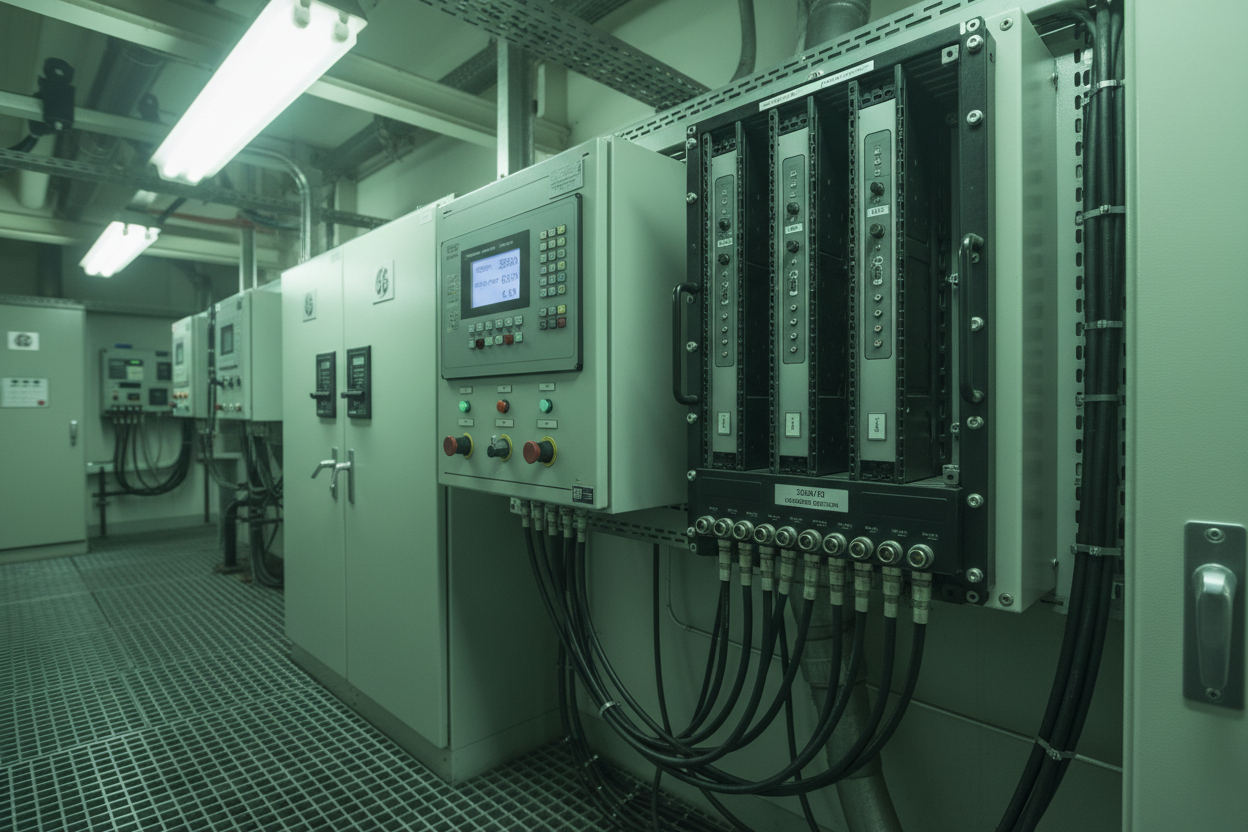
The Pain Point: Governor Hunting Costs You Money Every Hour
Speed hunting on a Woodward 505E digital governor causes compressor surge, excess fuel burn, and mechanical fatigue on the GE Frame 5 gas turbine drive train. First, operators see MW output oscillating ±2–4% around setpoint every 8–15 seconds. Second, the DCS historian shows fuel control valve position cycling continuously between 42% and 56% open. Moreover, the bearing temperature trends on the Bently Nevada 3500 system spike in synchrony with each speed oscillation cycle. Therefore, you must diagnose the hunting source before attempting any gain change.
Many engineers immediately reduce proportional gain P when hunting appears. However, this tactic often makes things worse when the actual cause is actuator deadband, not an over-tuned PID. A Woodward 505E operating on a GE Frame 5 at 3000 RPM setpoint with a droop of 4% and hunting ±60 RPM peak-to-peak needs systematic diagnosis, not blind gain reduction.
Five Root Causes of 505E Governor Hunting
Field experience on over 40 gas turbine governor commissioning jobs points to five recurring causes. Identify each one before touching any parameter.
- Step 1: Check actuator deadband. Connect Woodward Watch Window and monitor Actuator Output. If the output signal changes by less than 0.3 mA without any mechanical valve movement, deadband exceeds 0.5% and causes limit cycling. Tighten the actuator linkage or recalibrate the LVDT.
- Step 2: Verify MPU speed signal quality. A magnetic pickup unit gap wider than 0.64 mm (0.025 in) on the 60-tooth wheel produces noisy speed feedback. Use a Fluke 87V in frequency mode at idle: jitter above ±15 Hz indicates a gap problem, not a control problem.
- Step 3: Inspect the fuel gas pressure regulator upstream. Pressure fluctuations above ±0.15 bar at the skid inlet force the governor into constant corrective action. Log fuel supply pressure at 1-second intervals using the DCS historian for 30 minutes.
- Step 4: Review droop setting. On a 505E, droop parameter D_ROOP lives in Function Code 84. Default is 5%. For an isolated grid application, values below 3% cause excessive speed sensitivity. Set droop between 4% and 6% for grid-parallel operation.
- Step 5: Check Modbus RTU communication lag. If the DCS sends a new speed reference every 500 ms over Modbus RTU (19200 baud, 8N1, register 4096), the governor receives conflicting setpoints faster than its ramp rate allows. Increase the DCS write interval to 2000 ms minimum.
Step-by-Step PID Tuning on the Woodward 505E
First, put the turbine in Isochronous mode and disable Load Sharing. Second, open Watch Window and navigate to the Speed PID block. The factory default parameters on a GE Frame 5 at 3000 RPM are: Proportional Gain = 12.0, Integral Gain = 1.8, Derivative = 0.0. These values suit a well-maintained actuator with less than 0.2% deadband.
Follow this tuning sequence for a hunting governor:
- Step 1: Reduce Integral Gain to 0.5. Hold for 5 minutes. Observe if hunting amplitude decreases. If yes, the problem is integrator windup from a slow actuator.
- Step 2: Increase Integral Gain by increments of 0.2 until speed error stays within ±5 RPM during a 10% step load change.
- Step 3: Test Proportional Gain. Apply a 3% rated-load step. If speed undershoot exceeds 45 RPM (1.5% of 3000), increase P by 1.0. Limit P to 18.0 maximum on a Frame 5 to prevent resonance with the 6.2 Hz mechanical natural frequency.
- Step 4: Record final parameters in the Site Tuning Log. Include date, ambient temperature, turbine load, and fuel LHV. These four variables change optimal gains by up to 15%.
Moreover, always test the overspeed trip function after any governor change. Set a manual trip at 3300 RPM (110% of rated) and verify the 505E trips within 200 ms. The Bently Nevada 3500/53 overspeed detection module provides a hardware backup trip at 3330 RPM independent of the 505E software.
Actuator Output Calibration: The Most Overlooked Fix
A miscalibrated Woodward actuator is responsible for 40% of hunting cases in our field audits. The 505E Actuator Output signal ranges from 4 mA (minimum fuel) to 20 mA (maximum fuel). However, hydraulic actuator wear shifts the 4 mA zero point upward by 0.5–1.0 mA over 18 months of operation. Therefore, the governor pushes fuel flow above the intended minimum idle setting.
Perform this calibration during a planned maintenance window:
- Step 1: In Watch Window, navigate to Actuator Setup. Force Actuator Output to 4.00 mA manually.
- Step 2: Observe fuel control valve position on the DCS. It must read 0% open. If it shows 3–8% open, the actuator zero is drifted.
- Step 3: Adjust the Zero Offset parameter in 0.05 mA steps until valve reads 0%.
- Step 4: Repeat for 20.00 mA span calibration. Valve must reach 100% open at 20 mA.
- Step 5: Save configuration to EEPROM. Cycle power to the 505E and re-verify both endpoints before returning to automatic control.
Furthermore, document the calibration offsets on the turbine maintenance record. A Zero Offset exceeding 0.8 mA after calibration signals actuator coil degradation. Schedule a coil replacement within the next 1000 operating hours.
Emergency Overspeed Test Procedure
First, confirm the GE Frame 5 turbine is running at rated speed 3000 RPM with zero load. Second, notify the control room that an overspeed test is in progress. Third, disconnect the generator from the grid using the circuit breaker. The turbine will accelerate without load.
- Step 1: Monitor the 505E Watch Window speed display. Record acceleration rate in RPM per second.
- Step 2: Verify the 505E software trip fires at the programmed overspeed setpoint (3270 RPM for 9% overspeed on this unit).
- Step 3: Simultaneously confirm the Bently Nevada 3500/53 hardware trip fires independently at 3330 RPM. If only one system trips, investigate before returning to service.
- Step 4: Restart the turbine. Compare actual acceleration curve to baseline from commissioning. A change greater than 15% in acceleration rate indicates valve or actuator degradation.
However, never perform this test without a written permit and a clear shutdown procedure signed by the site safety officer. The 505E trip log in Watch Window retains the last 10 trip events with timestamps accurate to 1 ms. Export this log and attach it to the maintenance record.
Conclusion and Action Advice
Woodward 505E governor hunting on GE gas turbines always has a physical cause: actuator deadband, MPU signal noise, fuel pressure instability, wrong droop setting, or Modbus communication lag. Therefore, diagnose first and tune second. Set droop between 4–6% for grid-parallel operation. Calibrate actuator output endpoints during every annual maintenance. Verify both the 505E software trip (at 3270 RPM) and the Bently Nevada 3500/53 hardware trip (at 3330 RPM) after any parameter change. Finally, log all tuning changes with ambient temperature, load, and fuel LHV to build a site-specific performance baseline. A well-tuned 505E holds speed within ±5 RPM at rated load — no hunting, no surge, no wasted fuel.


