

Warehouse Automation Orchestration: Connecting Robots, Conveyors and Control Systems
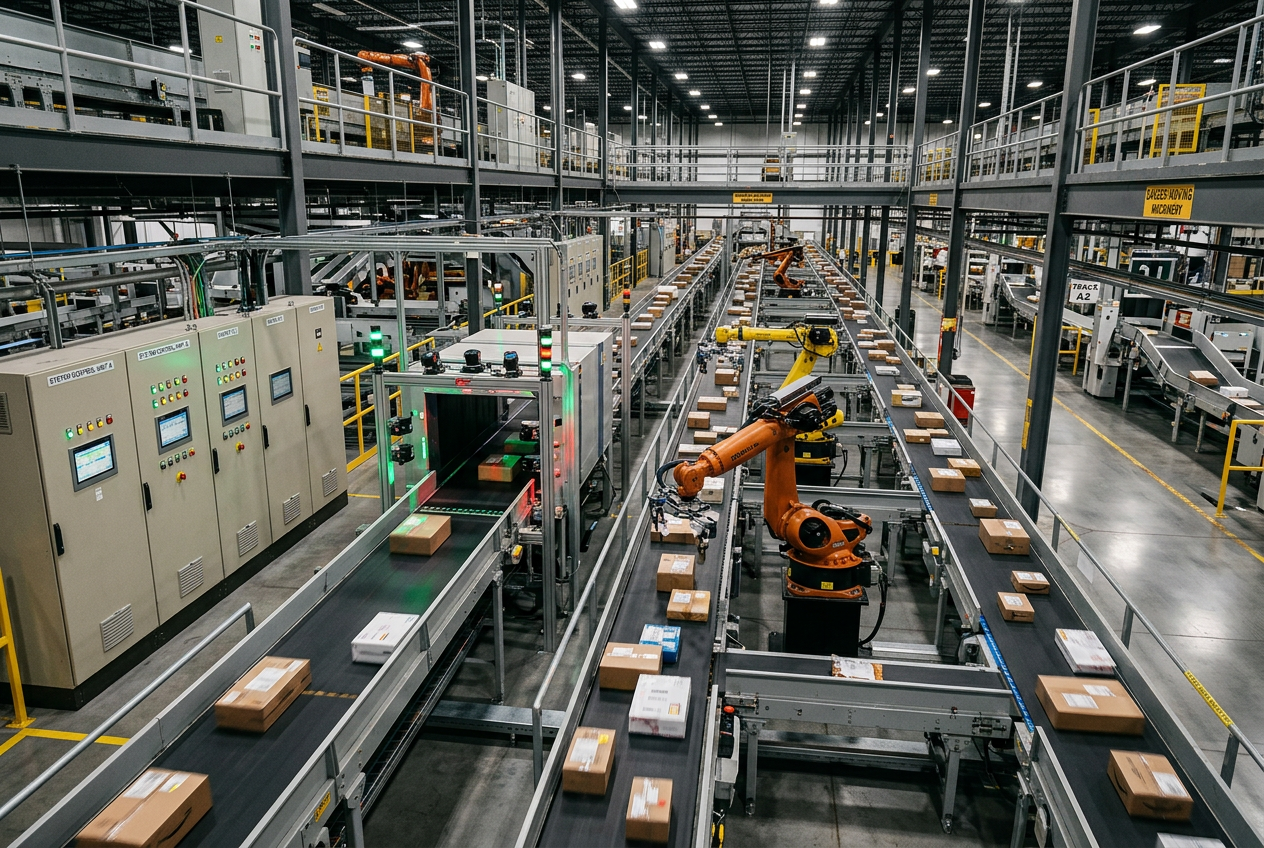
Warehouse Automation Orchestration: Connecting Robots, Conveyors and Control Systems
Why coordinating the entire material handling process matters more than optimizing individual machines.
Why Does Warehouse Automation Require System-Level Coordination Instead of Machine-Level Speed?
Modern distribution and fulfillment centers rely on diverse automated subsystems: robotic induction cells, modular belt conveyors, automated storage and retrieval systems (AS/RS), scanning tunnels, and manual packing workstations. While each subsystem may achieve peak nameplate velocity, total facility throughput is dictated by holistic material flow.
For instance, when a high-speed robotic parcel induction cell outpaces a downstream barcode scanning tunnel, accumulation buffers overflow and cause cascading line stoppages. The robot may operate at peak efficiency, yet the overall system underperforms. Warehouse automation orchestration solves this disconnect by harmonizing upstream release rates with downstream processing capacities to eliminate system-wide bottlenecks.
What Is the Difference Between Automation and Orchestration?
Traditional machine automation executes deterministic, low-latency control logic on dedicated equipment. A conveyor drive is governed by Allen-Bradley CompactLogix controllers, a robotic arm executes predefined kinematic trajectories, and high-throughput optical scanners read barcode information.
Orchestration operates at a higher supervisory tier. It continuously balances task routing, dynamic buffer allocations, equipment availability, and real-time order priorities across disparate automated lines. For example, if an orchestration layer detects a growing queue prior to a sortation loop, it dynamically modulates upstream release rates or reroutes eligible parcels through an alternate conveyor spur, bridging localized equipment performance with overall facility goals.
Why Does Optimizing Individual Machines Create New Bottlenecks?
Isolating optimization to individual stations often relocates bottlenecks rather than resolving them. Accelerating an induction robot can saturate transfer belts, overload downstream checkweighers, or overwhelm sorting chutes. Each automated unit operates within specific physical constraints and process dependencies.
Automation engineers must evaluate complete material flow dynamics, including queue lengths, cycle-time variations, buffer saturation thresholds, and equipment availability. True system performance should be quantified by end-to-end throughput and order completion latency rather than isolated machine cycle counts.
How Do You Combine Deterministic PLC Logic with Adaptive Orchestration?
Complete rip-and-replace retrofits carry prohibitive capital costs and operational downtime risks. The most practical architecture preserves ruggedized deterministic PLC hardware for safety-critical interlocks, high-speed sensor polling, and machine-level sequencing, while introducing a software-driven orchestration layer on top.
Supervisory platforms like high-performance Allen-Bradley ControlLogix 1756-L71 processors coordinate cell-to-cell communication, while distributed fieldbus modules such as a PROFIBUS DP remote I/O scanner module ensure synchronized conveyor telemetry. Where localized lines utilize compact controllers like a Siemens compact PLC module, standardized industrial Ethernet gateways bridge real-time operational technology (OT) to the orchestration system, ensuring adaptive logic remains within approved machine safety boundaries.
How Should Engineers Design and Deploy an Orchestration Strategy?
- Map Material Flow & Interlocks: Document every physical handoff, buffer capacity, conveyor divert, and equipment operational dependency.
- Pinpoint Dynamic Constraints: Collect cycle-time telemetry, queue lengths, and jam logs to identify baseline bottlenecks under peak load.
- Standardize Industrial Interfaces: Establish standardized communication protocols (such as EtherNet/IP, OPC UA, and MQTT) between PLCs, robot controllers, scanners, and warehouse management software.
- Implement Phased Coordination: Roll out orchestration logic in a single zone (such as induction to main sorter), validating that throttling and routing adjustments stabilize buffer levels without throughput loss.
- Continuously Track System KPIs: Monitor end-to-end throughput, dwell times, station idle percentages, exception rates, and order fulfillment times.
How Do You Plan for Future Equipment and Layout Changes?
Material handling requirements evolve as facilities scale, introduce autonomous mobile robots (AMRs), or replace conveyor sections. An effective orchestration layer accommodates changes through modular, decoupled software abstractions and standardized interface schemas.
Hardware replacements or additions can be integrated without rewriting low-level PLC safety code or overarching dispatch rules. Furthermore, engineers must implement fail-safe local fallback modes: if the supervisory orchestration layer disconnects, local PLC controllers must seamlessly revert to autonomous, deterministic safety routines.
Summary: What Are the Key Takeaways for Automation Engineers?
Maximizing warehouse efficiency is fundamentally a system-wide coordination challenge, not an individual machine race. By retaining reliable PLC controllers for deterministic field execution and layering adaptive orchestration across material flow, distribution facilities can unlock higher throughput, prevent bottlenecks, and maximize return on automation investments.


