

pH, ORP and Conductivity Control in Chlor-Alkali Processing
pH, ORP and Conductivity Control in Chlor-Alkali Processing
How reliable process analytics help protect membranes, improve brine quality, and maintain stable chemical production.
Why Are Process Analytics Critical for Chlor-Alkali Electrolysis and Membrane Life?
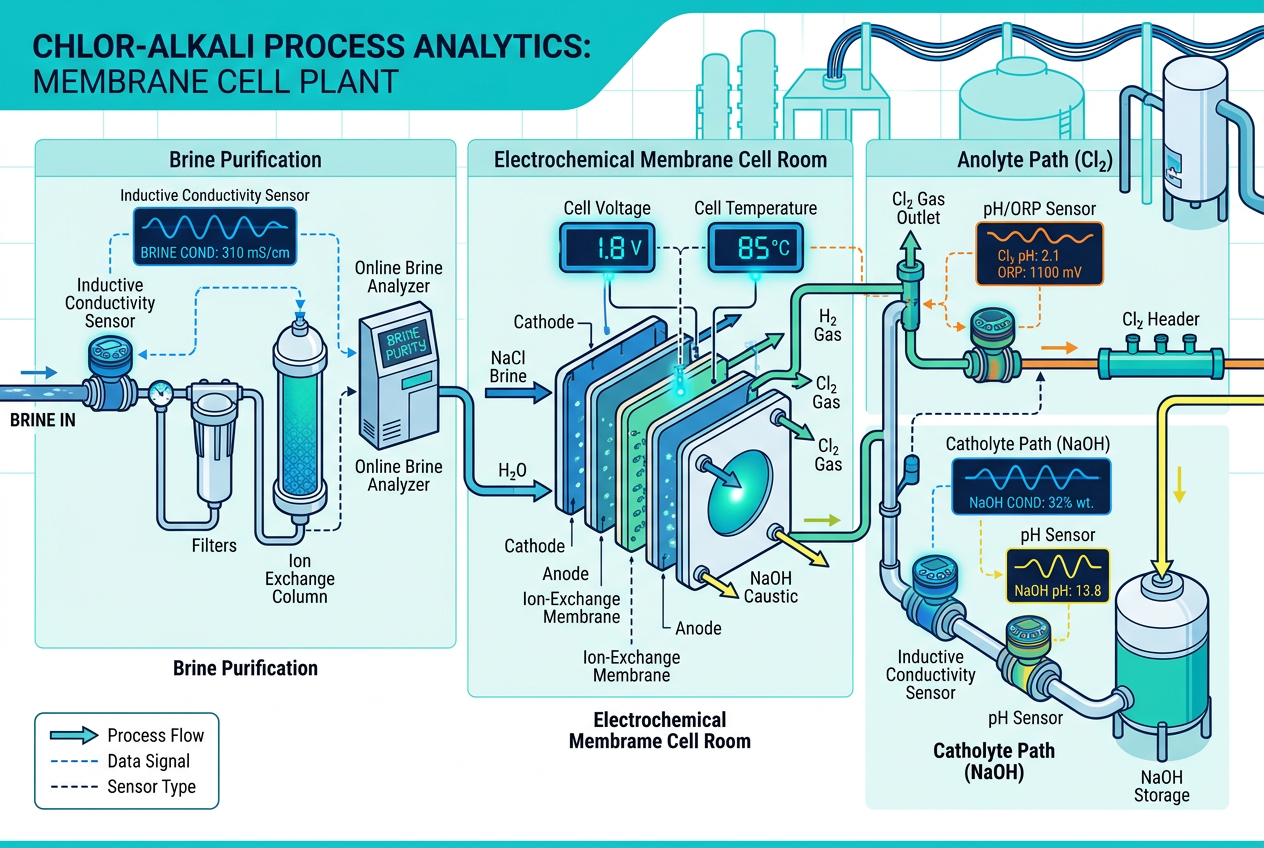
Chlor-alkali production supplies foundational feedstocks to modern industry, predominantly high-purity chlorine gas, caustic soda (NaOH), and hydrogen. In modern membrane electrolysis cells, ion-exchange membranes are exceptionally sensitive to operating conditions and feed impurities.
Even trace hardness (calcium, magnesium) or chemical imbalances in feed brine can foul membranes, spike cell voltage, and cause premature membrane failure costing tens of thousands of dollars per downtime incident. Three key electrochemical analytical parameters govern stream health throughout the plant: pH, oxidation-reduction potential (ORP), and electrical conductivity.
By coupling continuous online analytics with rigorous DCS feedback strategies, plant engineers detect process drift hours before irreversible membrane scaling or hazardous chemical excursions occur.
How Does Precise pH Control Optimize Primary and Secondary Brine Purification?
Raw saturated brine carries elevated calcium and magnesium salts that must be precipitated and removed before reaching membrane electrolyzers. Plants dose sodium hydroxide and soda ash into reaction tanks to precipitate carbonates and hydroxides.
Is pH critical here? Absolutely. If precipitation pH drops below tight setpoints, magnesium and calcium ions remain soluble and pass through primary clarifiers. Conversely, over-alkalization consumes excessive chemicals and triggers severe downstream scaling on filters and ion-exchange polishing resin beds.
Because saturated brine exhibits high ionic strength and elevated temperatures (typically 50°C–65°C), standard lab electrodes fail rapidly. Rugged wide-body sensors like the Yokogawa FU20-VP-T1-FTS pH/ORP Sensor or heavy-duty Yokogawa glass pH electrode assemblies maintain stable liquid junction potentials and resist salt bridging in concentrated NaCl media.
Why Is Toroidal Conductivity Monitoring Preferred for Concentrated Brine Circuits?
Electrical conductivity reflects total dissolved ionic content and is the primary indicator of brine saturation (typically 300–310 g/L NaCl feed vs. ~200 g/L depleted brine). However, contacting electrodes frequently foul due to crystallization, scaling, or polarization in heavy chemical slurries.
What sensor technology solves this challenge? Electrodeless, inductive (toroidal) conductivity sensors. Because the measuring coils are completely encapsulated in chemically inert fluoropolymers (such as PEEK or PVDF), there are no exposed metal pins to corrode or foul.
Pairing toroidal sensors with dedicated analyzers like the ABB ACA592-TC toroidal conductivity transmitter ensures non-contact measurement integrity across severe brine concentration swings. In clean water polish loops or dilute condensate lines where high sensitivity is required, a precision Yokogawa SC42-SP24 contacting conductivity sensor provides high-accuracy cell constant tracking.
How Does ORP Monitoring Prevent Residual Chlorine from Poisoning Recycling Loops?
Depleted brine exiting electrolysis contains dissolved active chlorine and chlorate species. Before this depleted brine can be recycled to primary salt dissolvers, residual free chlorine must be stripped and reduced—often using vacuum dechlorination followed by sodium bisulfite (NaHSO3) dosing.
Why is ORP the measurement of choice here? While ORP does not provide a direct parts-per-million reading of a single species, it provides an instantaneous, millivolt-level reflection of solution oxidation-reduction state. A sudden climb in ORP signals breakthrough of active chlorine, warning operators that dechlorination reagent dosing is insufficient.
To avoid false trips caused by poisoned reference junctions, plants utilize dedicated redox instrumentation like the ABB AX460 single input pH/Redox analyzer. Correlating ORP millivolt targets with scheduled lab colorimetric checks establishes a fail-safe barrier against chlorine carryover.
Which Sensor Wetted Materials and Junction Designs Survive Corrosive Chlor-Alkali Media?
Wet chlorine gas, chlorinated brine, and hot 32%–50% caustic soda attack standard process instruments. Selecting inappropriate wetted parts results in rapid diaphragmatic failure, reference electrolyte contamination, or outright body dissolution.
When specifying analytical hardware for chlor-alkali skids, prioritize:
- Body and Seal Materials: Titanium, Hastelloy C-276, PVDF, and PTFE wetted bodies that resist both active chlorine gas and hot caustic attack.
- Double-Junction Reference Systems: Pressurized gel or solid-electrolyte references prevent process brine from back-diffusing into the internal Ag/AgCl reference cell.
- Retractable Insertion Assemblies: Ball-valve retractable housings allow technician extraction and routine buffer calibration without isolating main process headers or interrupting cell flow.
How Do Field Engineers Architect an End-to-End Analytical Control Loop in DCS?
Connecting raw sensor signals into plant automation requires clean signal conditioning and deterministic I/O processing:
- Step 1: Strategically Position Sample Conditioners: Take measurement samples from turbulent process zones while mitigating gas entrainment from chlorine and hydrogen microbubbles.
- Step 2: Isolate and Digitize Field Signals: Connect 4–20 mA HART transmitters into isolated analog input cards, such as the Emerson Fisher-Rosemount KJ3002X1-BC1 AI module, to eliminate high-ground-potential common mode interference in electrochemical cell rooms.
- Step 3: Configure Temperature-Compensated Logic: Implement automatic temperature compensation (ATC) algorithms in the controller to account for thermal dissociation shifts in hot brine.
- Step 4: Implement Dosing Ratio Feedforward: Combine online pH and ORP feedback with feed flow rates to drive variable-speed metering pumps with anti-windup protection.
How Can DCS Trend Analysis Differentiate Sensor Drift from Upstream Dosing Upsets?
When an operator sees an alarm, how do they know whether a sensor is fouled or the chemical process is failing? Correlated DCS multi-variable trending provides immediate clarity.
A true process upset exhibits correlated shifts across related variables: for example, a drop in pH coincides with rising dosing pump output or a rapid change in upstream raw salt dissolution rates. In contrast, gradual baseline drift with sluggish response to sudden load changes points toward electrode junction coating or electrolyte depletion.
By evaluating pH, ORP, conductivity, and metering pump stroke feedback on a single DCS trend display, operators identify fouling trends early and schedule proactive sensor cleaning during routine shift rotations.
Summary & Key Takeaways for Plant Reliability Engineers
Optimized pH, ORP, and conductivity control forms the first line of defense for chlor-alkali plant safety and membrane longevity. Selecting robust toroidal conductivity sensors, fouling-resistant double-junction pH/ORP electrodes, and isolated DCS analog input modules ensures dependable chemical visibility across round-the-clock production.
Regular preventive calibration schedules, paired with comprehensive multi-variable DCS trending, empower engineering teams to maintain high chemical yields, minimize reagent waste, and extend membrane cell service life.


