

Remote IO System Failure Modes: Diagnosing Network Loss, Power Faults, and Module Drop-Outs in Bachmann M1 and ABB 800xA
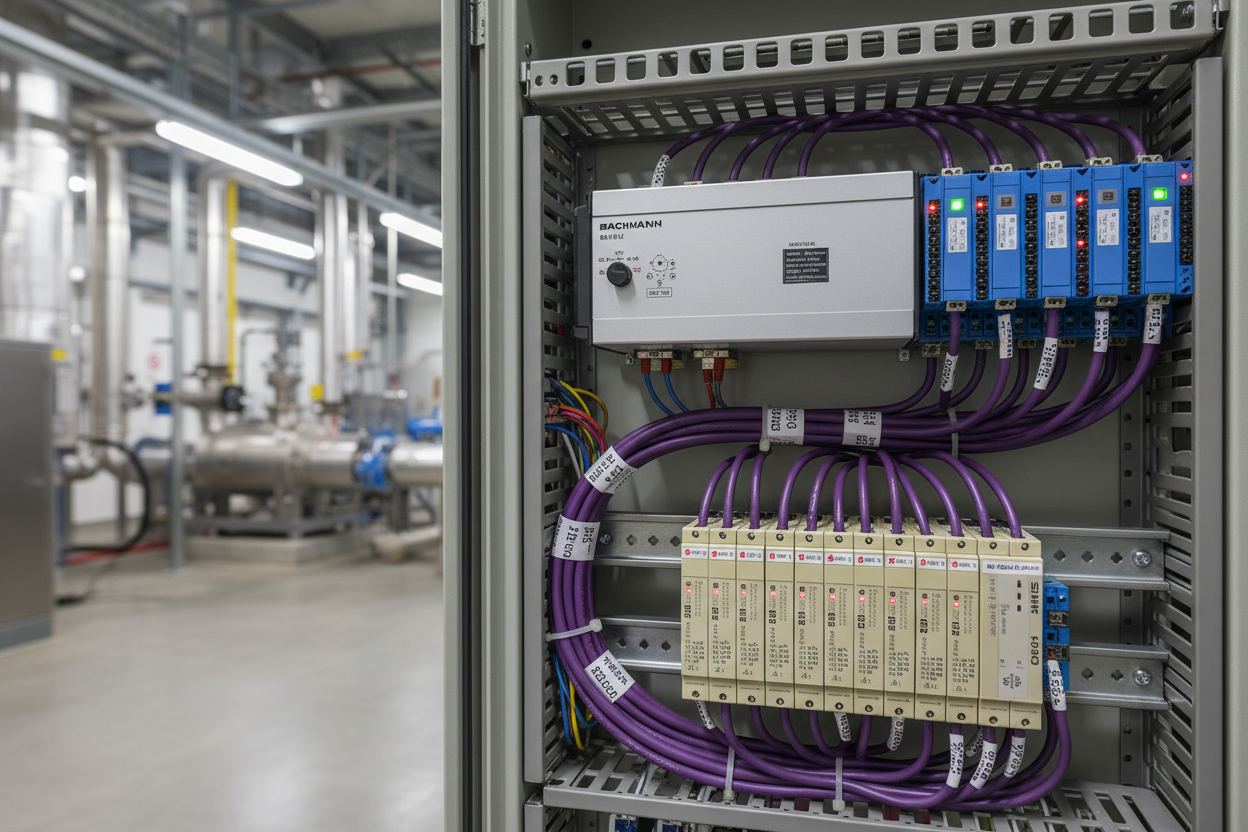
Failure Mode 1: Profibus DP Communication Loss to Bachmann M1 Remote Station
The Bachmann M1 MX207 Profibus DP master connects to remote MX200 IO stations over shielded twisted pair at 1.5 Mbit/s. Communication loss is one of the most disruptive failures in this architecture. The master marks the remote station OFFLINE and substitutes last valid input values on all AI and DI channels. AO and DO channels fall to their configured fail-safe state — typically 4 mA or de-energized.
First, distinguish between intermittent and permanent loss. Intermittent dropouts under 200 ms indicate noise or marginal termination. Permanent loss points to a cable break, node power failure, or address conflict. The Bachmann DPM200 PROFIBUS DP Communication Module provides the master interface for this architecture and supports real-time diagnostic byte readout via SolutionCenter.
- Step 1: Check bus termination at both ends — 220 Ω line resistors and 390 Ω pull-up/pull-down pairs. Target impedance A-to-B: 110 Ω ± 5 Ω with cable disconnected.
- Step 2: Measure shield continuity from panel to field junction box. Connect shield to PE at one end only — no double grounding.
- Step 3: Use ProfiCore Ultra tester. Valid eye diagram requires minimum 200 mV amplitude. Below 150 mV indicates cable damage or excessive stub length.
- Step 4: Check node address switches on the MX200 rear panel. Duplicate addresses cause master confusion. Bachmann SolutionCenter PROFIBUS Monitor shows all detected nodes in real time.
- Step 5: Verify 24 VDC at the MX200 power connector. Minimum 21.6 VDC under load. Low voltage causes watchdog instability and false OFFLINE status.
- Step 6: Read the MX207 master DPV1 diagnostic bytes 0–5 via SolutionCenter — these decode the exact fault: node absent, configuration mismatch, or parameter error.
Failure Mode 2: ABB 800xA S800 IO Cluster Module Drop-Out
ABB 800xA uses S800 IO modules on the AC800M Modulebus. Each cluster supports up to 12 modules. Module drop-out recurs in plants with unstable 24 VDC or high ambient vibration. The AC800M logs a Module Communication Fault in the 800xA Event List with cluster address and slot number. Systematic faults (same slot always) indicate hardware defect. Rotating faults suggest power rail noise or backplane contact problems.
The S800 backplane polls at 2 Mbit/s. If a module misses three consecutive polls, the controller substitutes the configured fallback. For AI820 analog input modules, the fallback is –32768 raw count — visible in the historian as a spike to –10 V EU equivalent. Configure a dedicated alarm for raw value = –32768 on all AI820 channel tags to alert operators immediately. The ABB CI840A-EA PROFIBUS DP-V1 Communication Interface Module and the ABB CI871AK01 Profinet IO Interface Module are available for AC800M cluster communication builds.
- Step 1: Remove and reseat the suspect module. Clean the backplane connector with isopropyl alcohol.
- Step 2: Check the +24 VDC rail at cluster power unit SD821. Minimum 19.2 VDC at full load. Replace SD821 if voltage drops below 20 VDC.
- Step 3: Inspect DIN-rail mounting screws. Loose mounting allows vibration to flex the backplane connector.
- Step 4: Swap the suspect module with a known-good unit. If the fault follows the module, replace it. If the fault stays in the slot, the backplane connector is damaged.
Failure Mode 3: Network Faults Causing Multi-Node Loss
In brownfield plants, Bachmann M1 and ABB 800xA controllers share managed switch infrastructure. A VLAN misconfiguration or spanning-tree topology change can drop multiple remote IO nodes simultaneously, mimicking mass hardware failure. The distinguishing symptom is the fault pattern — hardware faults affect one node at a time, while network faults drop all nodes on the same VLAN at the same second. Check the managed switch event log first. If multiple nodes disappear at the same timestamp, the root cause is always network.
Furthermore, verify NTP synchronization between Bachmann SolutionCenter, ABB 800xA Event Server, and the switch. Target offset: less than 50 ms for DCS event correlation. Verify EtherNet/IP RPI settings — Bachmann MX-EIP nodes default to 10 ms RPI. If switch QoS does not prioritize EtherNet/IP traffic (DSCP 46), packet loss under load triggers false communication faults. Assign EtherNet/IP to a dedicated VLAN and apply DSCP marking on switch port profiles. The ABB CM582-DP PROFIBUS Slave Communication Module supports network diagnostic readback for multi-node fault correlation.
Conclusion and Action Advice
Remote IO failures in Bachmann M1 and ABB 800xA systems follow predictable patterns. Physical-layer cable and termination faults cause Profibus DP dropouts. Power rail instability causes S800 module disappearance. Network VLAN and RPI mismatches cause simultaneous multi-node loss. Each failure type has a distinct diagnostic path.
Invest in a Profibus tester, configure –32768 fallback alarms on all AI820 channels, enforce NTP synchronization, and audit VLAN and RSTP configurations after every network change. These steps reduce mean-time-to-restore from hours to minutes. Schedule a remote IO infrastructure review this quarter before the next unplanned trip.
Author: Liang Bo is an industrial automation engineer with over 10 years of experience in PLC, DCS, and control systems.


