

PTP, IRIG-B, and SNTP Time Sync: Fixing Timestamp Drift in GE and Bently Nevada Systems
Why Timestamps Must Agree
Time synchronization decides whether your data is trustworthy. If devices hold different clocks, events land out of order and engineers cannot determine which record is correct. Root-cause analysis fails, a turbine trip looks random, and the actual sequence — which is intact — becomes impossible to read. In GE PACSystems and Bently Nevada machinery protection environments, clock drift causes the most confusion during post-trip investigations. Choose the protocol by required accuracy, then verify it with measurements.
Q: Which Time Sync Protocol Should You Use?
Four methods dominate the plant floor. Match the method to the accuracy requirement:
- SNTP: ~50 ms accuracy. Skips delay math entirely. Reserve for small, non-critical applications only.
- NTP: ~10 ms accuracy. Suitable for reporting, historian logging, and HMI displays.
- PTP (IEEE 1588): <1 ms accuracy. Suitable for control systems and event ordering on GE PACSystems RX3i Ethernet modules.
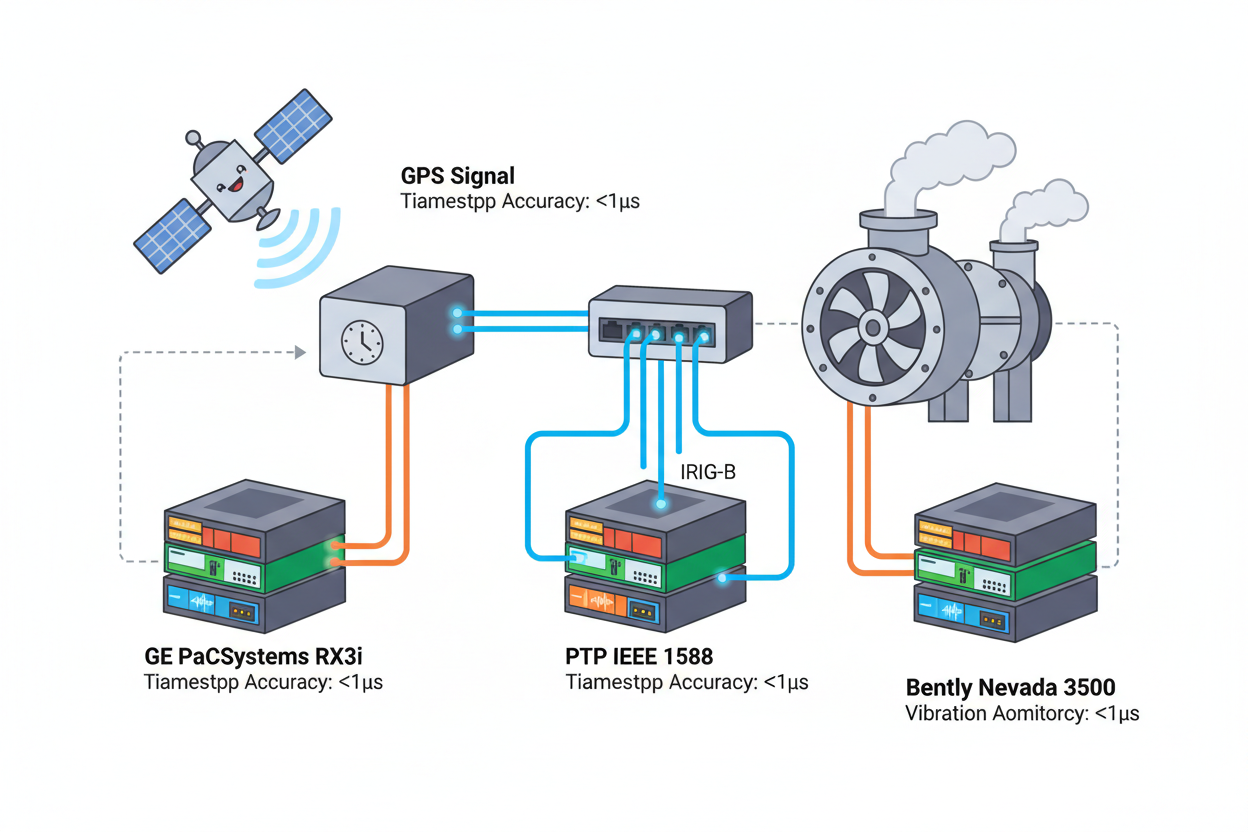
- IRIG-B: Microsecond-range accuracy. The reference standard for phasor measurements and vibration data on Bently Nevada racks.
Q: How Does the Master-Slave Time Distribution Model Work?
All time sync methods use a master and slaves. The master holds the reference — typically a GPS-disciplined time server. Slaves align to it. Distribution depth is expressed as stratum level, ranging from stratum 0 at the GPS source to stratum 3 at end-client devices.
In a typical plant architecture, the SCADA server is stratum 1, pulling UTC from GPS. PLCs and HMIs query it at set intervals. The critical difference: SNTP trusts the master blindly, while NTP and PTP correct for network delay. That correction is what separates sub-millisecond sync from tens-of-milliseconds drift.
Q: How Do You Make PTP Actually Deliver Sub-Millisecond Accuracy?
PTP is the fastest Ethernet-based option. The grandmaster pushes timestamps continuously without waiting for slaves to request them. However, ordinary unmanaged switches ruin PTP by adding variable, asymmetric delay. To achieve and hold accuracy:
- Use PTP-capable managed switches configured as boundary clocks.
- Deploy transparent clocks or hardware-timestamping NICs where boundary clock switches are not available.
- Set the GE RX3i controller PTP domain and profile (default or power profile) to match the grandmaster configuration.
- Configure sync intervals near 2 seconds and announce intervals near 8 seconds for network stability.
Q: Why Is Time Sync Especially Critical for Bently Nevada Vibration Data?
Bently Nevada 3500 racks require tight timing. Phase relationships and vibration trend data depend entirely on synchronized timestamps. Without accurate sync, vibration events misalign with process trip records from the DCS — a shaft surge that preceded a trip looks unrelated when the timestamps disagree by even tens of milliseconds.
- Feed IRIG-B or PTP to the rack for accurate event time-stamping.
- Set SOE resolution to the millisecond class to match trip records from the safety system.
- Verify every module in the 3500 chassis reports the same grandmaster source.
- Cross-check Bently Nevada timestamps against the historian after any trip event.
Conclusion & Action Advice
Time synchronization is infrastructure, not an afterthought. Choose by accuracy requirement: reporting uses NTP, control uses PTP, phasor and vibration protection use IRIG-B. Then protect the entire chain.
- Use a GPS grandmaster as the stratum 0 reference.
- Deploy hardware-timestamped switches as PTP boundary clocks.
- Configure PTP-capable endpoints on all GE PACSystems RX3i I/O modules and Bently Nevada racks.
- Audit clock drift weekly on trip-critical systems.
- Log stratum level and grandmaster source per device — this habit keeps event order honest and post-trip analysis fast.
Author: Zhao Mengqi is an industrial automation engineer with over 10 years of experience in PLC, DCS, and control systems.


