

Pressure Switch Calibration and Setpoint Verification in Safety Instrumented Systems
Why Calibration Matters in SIS Applications
Pressure switches in safety instrumented systems are classified as final elements or initiating elements. Their setpoints determine whether a process demand triggers a protective action. A snap-action switch with a ±2% span tolerance at a 100 barg setpoint has an allowable error band of ±2 barg. The IEC 61511 proof test requirement demands verification that the switch trips within this band at the defined test interval.
ICS Triplex TMR logic solvers use a 2oo3 voting architecture. A single switch channel reading a spurious high signal does not trip the process — two simultaneous channels within 50 ms are required to activate the safety function. This architecture reduces spurious trips but demands all three channels are calibrated consistently. Inconsistent setpoints create asymmetric voting behavior that invalidates the SIL 2 assessment.
Equipment and Commissioning Procedure
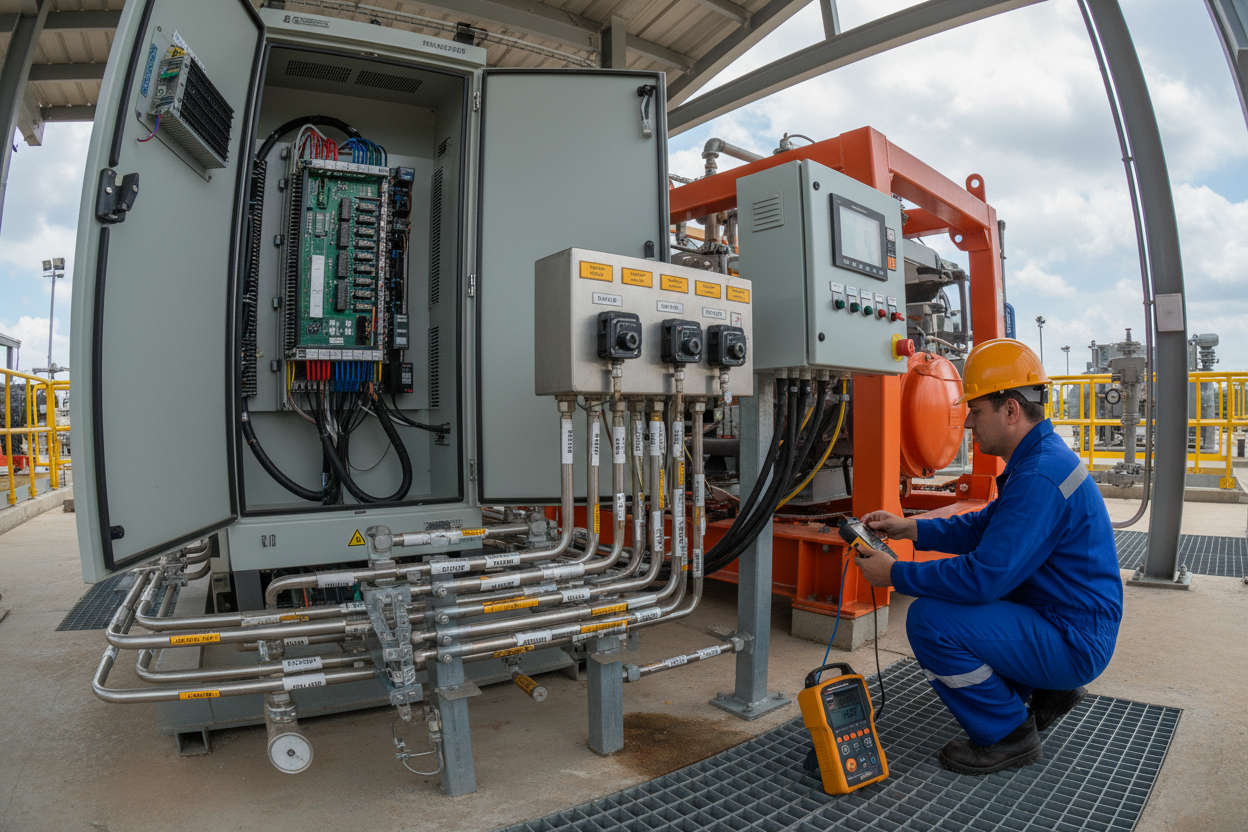
Assemble the following before starting: portable deadweight tester or pneumatic calibrator (Beamex MC6 or Fluke 729), digital multimeter for 24 VDC loop circuits, loop isolation permit, ICS Triplex bypass key and channel inhibit procedure, IEC 61511-1 Clause 16.2.5 compliance checklist, and Woodward ProAct configuration printout.
- Step 1: Issue a work permit and request ICS Triplex channel inhibit for the target switch. Confirm the inhibit is active in the Triplexer system display. Never calibrate a live SIS input without confirmed inhibit.
- Step 2: Isolate the impulse line using the double block-and-bleed valve arrangement. Bleed residual pressure to zero. Connect the Beamex MC6 to the switch sense port. Confirm zero reading is within 0.05% of full scale.
- Step 3: Ramp pressure upward at not exceeding 1 barg per second. Record the exact pressure at which the contact changes state. Continue ramping to 125 barg (104.2% of setpoint), then reduce slowly and record the reset point. Deadband is the difference between trip and reset pressure.
- Step 4: Acceptable trip setpoint tolerance is ±2% of span (±3.2 barg for 160 barg range). Acceptable deadband is 1.5–5% of span (2.4–8.0 barg). If outside tolerance, adjust the setpoint screw. Retest after each adjustment.
- Step 5: Perform three consecutive ramp cycles. All three trip points must fall within tolerance. A standard deviation greater than 0.5 barg indicates switch degradation — replace the switch if exceeded.
Woodward ProAct Governor Integration
In gas turbine compressor trains, the pressure switch feeds both the ICS Triplex SIS and the Woodward ProAct speed governor. The ProAct receives a digital input that reduces fuel demand when process pressure exceeds 90% of the separator limit. If the switch setpoint drifts above this threshold, the control-layer protection loses its margin.
Check the ProAct configuration parameter P_LIMIT_DI. This defines the digital input channel number and response action (speed reduction rate in RPM/s). Confirm this parameter matches the current switch setpoint. Woodward ProAct 3.3 firmware (and later) supports Modbus RTU diagnostic registers. Register 40201 reports the last digital input transition timestamp. Compare this against the ICS Triplex event log for the same pressure event. A difference exceeding 200 ms indicates a communication timing issue. Reduce the ProAct input scan interval from the default 100 ms to 50 ms to close this gap.
Common Fault Patterns
- Fault 1 — Setpoint Drift Above Tolerance: Common in steam service above 120°C. Bourdon tube fatigue under thermal cycling. Replace with an electronic switch rated to 150°C and set a 12-month calibration interval.
- Fault 2 — High Deadband Causing Reset Delay: Worn snap-action cam increases deadband beyond 8% of span. The switch trips correctly but resets at 110 barg instead of the design 116 barg. Measure deadband during each proof test. Replace any switch with deadband above 6% of span.
- Fault 3 — Contact Weld at High Inrush Current: Long cable runs (above 300 m) create high cable capacitance. Use a current-limiting resistor (100 Ω, 2 W) in series with the switch output to limit inrush current. Confirm this does not conflict with the ICS Triplex AI module 10 kΩ internal pull-up.
Conclusion and Action Advice
Pressure switch calibration in SIS applications is a structured, documented process. First, always work within the IEC 61511 proof test framework — verify setpoint tolerance, deadband, and repeatability across three cycles. Second, use the ICS Triplex channel inhibit procedure correctly and never bypass process isolation simultaneously. Cross-check Woodward ProAct digital input configuration after any setpoint change to maintain the control-to-safety margin. Finally, treat any switch with setpoint drift above 2% of span or deadband above 6% of span as a replacement candidate, not a recalibration candidate.
Author: Liang Zhihao is an industrial automation engineer with over 10 years of experience in PLC, DCS, and control systems.


