

OPC Server Connected but Tags Frozen: A Honeywell and Emerson Ovation Field Guide
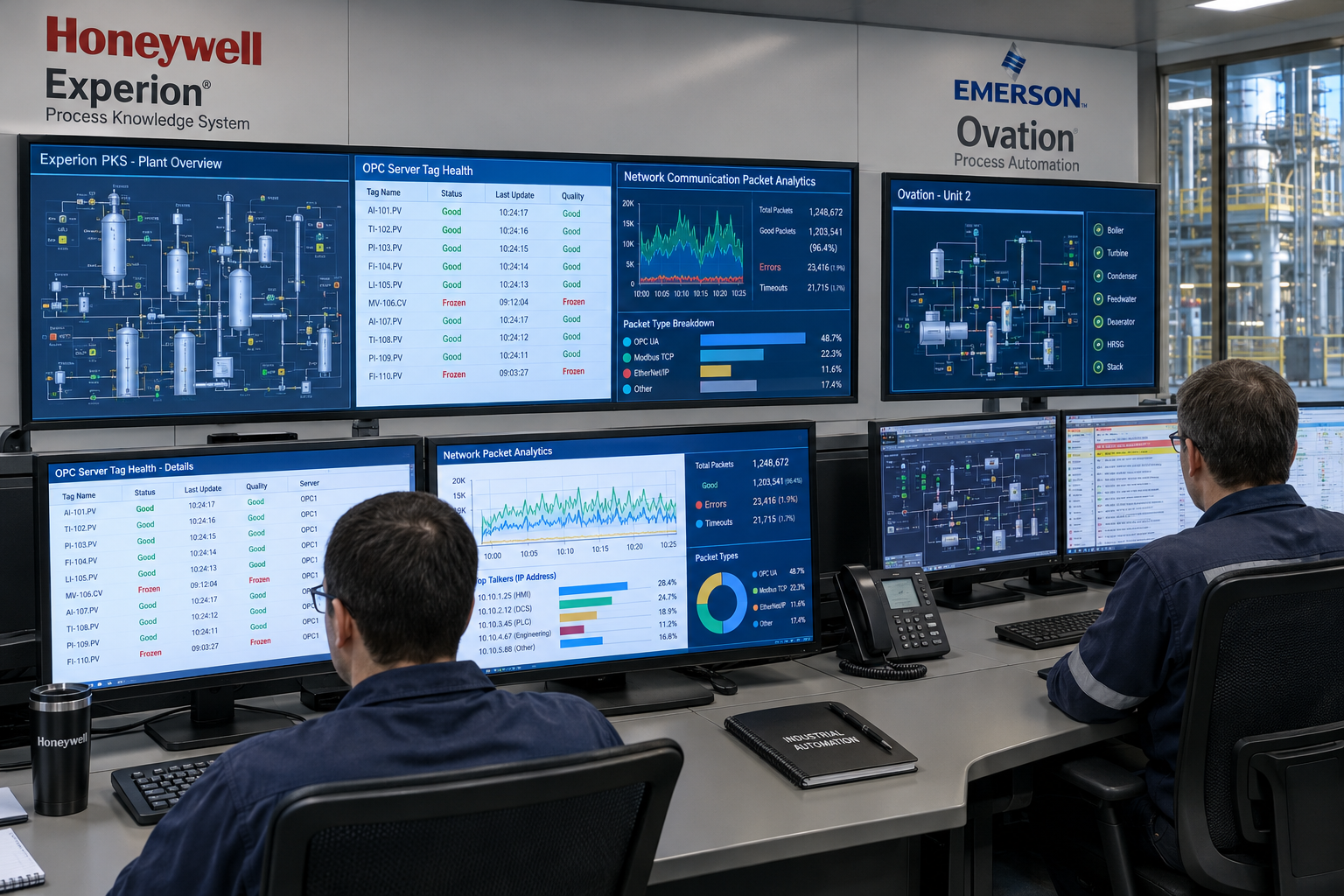
An OPC connection icon displaying a solid green status is one of the most deceptive indicators in industrial automation. Maintenance technicians and control engineers frequently discover that while the OPC client reports "Connected," live process variables remain entirely frozen. Before power cycling the server or rebooting the network switch, it is critical to recognize that this symptom is rarely a physical cable fault—it is almost invariably a configuration, polling, or data-quality issue.
This troubleshooting guide translates field experience into measurable checks for engineers managing OPC DA and OPC UA interfaces across Honeywell Experion (LOPC/ROPC) and Emerson Ovation distributed control architectures.
Why Do OPC Tags Freeze While the Server Connection Status Remains Green?
The short answer lies in the distinction between link status and data quality. An OPC server can maintain a perfectly healthy socket connection to an engineering client, but if the underlying PLC or DCS tag address has changed, the server merely reports the last known value with stale quality.
During plant turnarounds and commissioning phases, PLC logic files are continually recompiled: memory data blocks reorganize, symbol names change, and array boundaries shift. If the OPC item namespace is not synchronized with the controller's symbol database, the driver continues reading an orphaned address. When diagnosing analog loops wired through hardware like the Emerson Ovation 5X00605G01 Analog Input Module or termination assemblies like the Honeywell 8C-TAID61 Analog Input Termination Assembly, always export the OPC tag list to CSV and cross-check tag syntax against the live controller database.
How Do Subscription Rates and Scan Classes Overload Communication Drivers?
Can an overly aggressive update rate freeze your tags? Absolutely. When an OPC client requests a 100 ms update interval for thousands of tags, but the controller CPU or communication gateway requires 250 ms to service the request cycle, the communication queue overflows. The driver drops incoming frames, causing some tag groups to update erratically while others lock up completely.
On Emerson Ovation data servers and Honeywell Experion ROPC nodes, the solution is rigorous scan class segregation:
- Fast Group (100–250 ms): Reserve exclusively for critical safety loops and high-speed closed-loop control interlocks.
- Standard Group (500 ms – 1 s): Assign general digital inputs, such as those monitored by the Emerson Ovation 5X00846G01 Digital Input Module.
- Slow Group (2–5 s): Move slow-changing process parameters like temperature RTD channels, ambient values, and non-critical tank levels.
Monitoring request queue depth on your communication driver will immediately reveal whether an overloaded polling rate is choking data throughput.
Could Deadband and Exception Filtering Be Silently Hiding Live Value Changes?
Another common cause of perceived "freezing" is aggressive deadband filtering. OPC DA and UA servers use deadband thresholds to prevent network congestion caused by electrical noise. However, if an analog channel has a deadband set to 0.5% on a 0–5000 kPa transmitter, a process fluctuation of less than 25 kPa will never trigger an OPC data change event. The client screen shows a stationary flatline, mimicking a communication loss.
Check whether the deadband is configured as absolute or percent. On sensitive inputs—such as temperature elements wired to an Emerson Ovation RTD Input Module (5X00119G02)—set the deadband to zero or match it strictly to the sensor's physical resolution. Retain modest deadbands only on naturally noisy analog loops where raw fluctuations would otherwise overwhelm database historians.
When Do Device Group Timeouts, Stale Cache, and Ethernet Fragmentation Cause Freezes?
When an entire group of tags freezes while others continue updating normally, the failure typically isolates to one of three architectural bottlenecks:
- Group Target Mismatch: An incorrect slot number, rack ID, or IP address halts communication to an entire sub-rack, leaving other controller groups untouched.
- Stale Internal Driver Cache: If client applications read directly from the OPC server cache rather than the physical device, and the background poll thread experiences an unhandled exception, clients will continuously read stale cached data without reporting a disconnect. Dedicated communication bridges, such as the Honeywell FC-USI-0002 Universal Safety Interface, require active diagnostic monitoring to ensure driver cache integrity.
- Ethernet Packet Fragmentation: Large bulk read requests can split across multiple TCP/IP frames. On congested plant control networks, a single dropped fragment forces the driver to discard the entire data block, resulting in periodic or sustained tag freeze-outs. Limit the maximum items per read transaction and isolate control traffic on dedicated VLANs.
What Is the Recommended Best Practice for Restoring Live Data Quality?
To eliminate frozen tags and ensure robust plant historian data:
- Never treat a green connection status as proof of live data; always verify individual tag timestamp progression and quality bits (Good / Bad / Uncertain).
- Audit deadband settings and ensure scan classes respect controller processing bandwidth.
- Implement an automated watchdog script or heartbeat tag that compares server-side timestamps against client-side system clocks.
- When reconfiguring tags, restore live polling group by group and observe trends across a full operating shift before signing off.
About the Author: Lu Jianhong is an industrial automation engineer with over 10 years of hands-on experience in PLC, DCS, SCADA, and control system integration.


