

Industrial Data Historian Architecture: Local vs Server-Based Collection
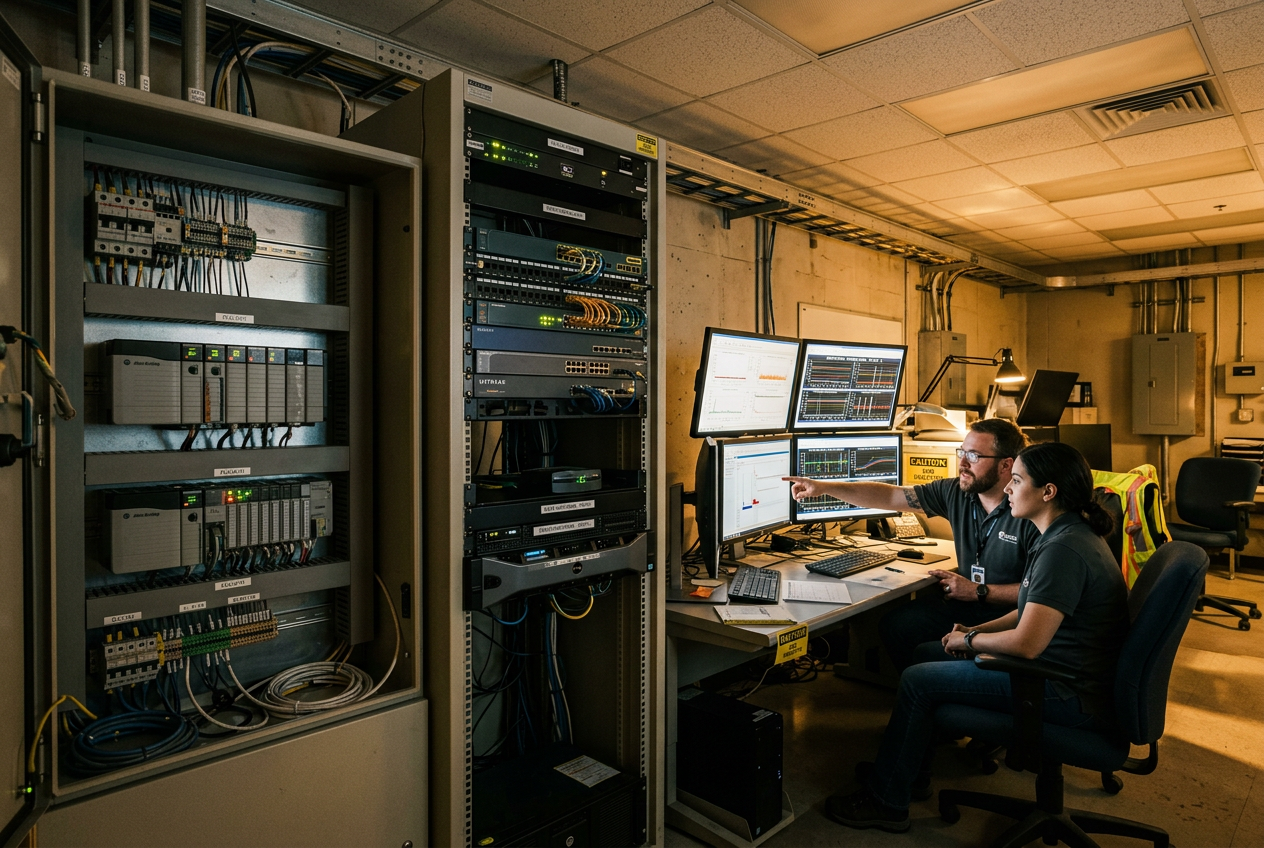
Why Does Historian Architecture Matter?
Industrial automation systems generate continuous streams of measurements, operating states, alarms, and production events. These records help engineers investigate failures, verify process conditions, and understand equipment performance.
However, collecting data does not automatically guarantee a complete or useful historical record. Network interruptions, server maintenance, limited storage, and unsuitable collection settings can create gaps.
The choice between a machine-level historian and a server-based historian should begin with the intended application. Each architecture addresses different collection, retention, and analysis requirements.
A machine-level historian captures detailed information close to production equipment. A server-based historian consolidates records from multiple sources and supports broader analysis.
What Is a Machine-Level Historian?
A machine-level historian collects and stores time-series data near an individual machine, production cell, or control system. Depending on the implementation, it can obtain data from PLCs and supported industrial networks. Common data sources include controllers such as the Allen-Bradley 1756-L1 ControlLogix PLC controller and the Siemens 6ES7214 PLC controller module.
This arrangement is useful when engineers need detailed records surrounding a shutdown, equipment fault, or unexpected sequence of events.
- Machine diagnostics: Preserve selected controller values around faults and production interruptions.
- Traceability: Associate process measurements with production cycles, batches, or individual products.
- Process verification: Retain records used to review whether operating conditions met defined requirements.
- Local data collection: Reduce dependence on continuous communication with a remote historian server.
Local collection can improve resilience when an upstream server or network connection becomes unavailable. However, this benefit depends on the historian's actual architecture and available storage.
Engineers must verify retention capacity, data export methods, collection performance, and recovery behavior. Local storage does not eliminate every possible failure mode.
What Is a Server-Based Historian?
A server-based historian collects historical information from multiple production assets and other supported data sources. It typically offers broader reporting, trending, storage, and analysis capabilities.
Plant engineers can compare equipment performance, investigate recurring production losses, and correlate process measurements across different machines.
Centralized historians also support applications that combine operational records with manufacturing or business information. This can help connect process behavior with production schedules, batches, and quality results.
However, the collection path introduces additional dependencies. Network failures, server maintenance, interface problems, and storage limitations can interrupt data collection. Field-side connectivity often relies on Ethernet communication modules such as the Yokogawa ALE111-S51, the Schneider 140NOE21100, or the Foxboro FBM232, so their configuration and health matter to the record.
Do not assume that every historian automatically buffers data during an outage. Confirm whether the specific collector supports buffering, how long it retains pending records, and how it handles recovery.
How Do the Two Architectures Compare?
| Selection factor | Machine-level historian | Server-based historian |
|---|---|---|
| Primary scope | Individual machine or production cell | Multiple machines or plant systems |
| Typical priority | Detailed local records and diagnostics | Centralized analysis and reporting |
| Storage considerations | Limited by local hardware and configuration | Depends on server resources and archive design |
| Network dependency | Can retain local data during upstream outages | Depends on source connectivity and collection architecture |
| Enterprise integration | May require an additional transfer mechanism | Often suited to multi-source integration |
| Maintenance concerns | Local device health and retention capacity | Server availability, interfaces, backups, and security |
These are architectural tendencies rather than universal product guarantees. Verify the behavior of the selected platform before finalizing a design.
How Do You Select a Suitable Historian?
What engineering question must the data answer?
Start by identifying the decisions that historical data must support. Fault investigation may require high-resolution records around a short event. Production analysis may need longer retention and consistent data from several assets.
Document the required tags, collection intervals, event triggers, timestamp quality, retention period, and reporting needs.
Where can data be lost along the collection path?
Map the collection path from each controller to its storage destination. Identify network switches, gateways, collection services, servers, and other components that can interrupt recording.
Ask what happens during a network outage, a server reboot, or scheduled maintenance. Confirm whether data remains buffered locally and whether the system can reconcile missing intervals after recovery.
How much storage is required?
Estimate storage from the number of points, collection frequency, record size, compression behavior, and required retention period. Include operational overhead and a suitable capacity margin.
Do not size storage using tag count alone. Two systems with identical tag counts can generate different data volumes because their collection settings and process behavior differ.
Are timestamps consistent and well understood?
Historical analysis becomes less reliable when related records use inconsistent clocks or poorly understood timestamp sources. Review time synchronization across controllers, data collectors, and servers.
Determine whether timestamps represent source acquisition, collection, or server receipt. This distinction matters when reconstructing the order of closely spaced events.
Are cybersecurity and recovery covered?
Review authentication, access controls, network segmentation, patch management, backup procedures, and restoration testing. A historian can contain valuable operational information and should receive appropriate protection.
Test the actual recovery process. A backup is useful only when the required data and configuration can be restored within acceptable operational limits.
When Should You Combine Local and Centralized Collection?
Some applications benefit from both architectures. A machine-level historian can preserve detailed records near the equipment, while a server-based historian consolidates selected information for plant-wide analysis.
For example, a production line built around controllers such as the GE Mark VIe IS400AEBMH3A PLC controller module may need detailed event records for fault diagnosis and centralized batch histories for quality review. Local storage and central aggregation can serve these requirements together.
Design the transfer mechanism carefully. Define which records move upstream, how timestamps are preserved, how duplicate records are handled, and what happens when communication is interrupted.
Also consider whether local and central systems retain the same level of detail. Aggregation or compression can change the information available for later investigations.
What Should a Commissioning and Maintenance Checklist Include?
- Verify that required controller tags are being collected.
- Compare historian values against trusted source values.
- Confirm collection intervals and event-trigger behavior.
- Check time synchronization across relevant devices.
- Test network interruption and recovery behavior.
- Review storage capacity, retention policies, and archive rotation.
- Verify access controls, backups, and restoration procedures.
- Document collection paths and ownership of each component.
Record the test results and acceptance criteria. Repeat critical checks after significant network, controller, or historian configuration changes.
Conclusion: Turning Historical Data into a Dependable Engineering Resource
Choose an industrial data historian according to the evidence your operation must preserve and the decisions that evidence must support. Local collection is valuable for detailed machine diagnostics, while server-based collection supports broader reporting and cross-asset analysis. Combining both can provide complementary benefits when transfer, retention, and recovery are engineered carefully. Before implementation, document data requirements, test outage behavior, verify timestamp quality, and prove that backups can be restored. These steps help turn historical data into a dependable engineering resource.


