

HIMA Safety Controller: PROFIsafe Configuration for Process Safety Applications
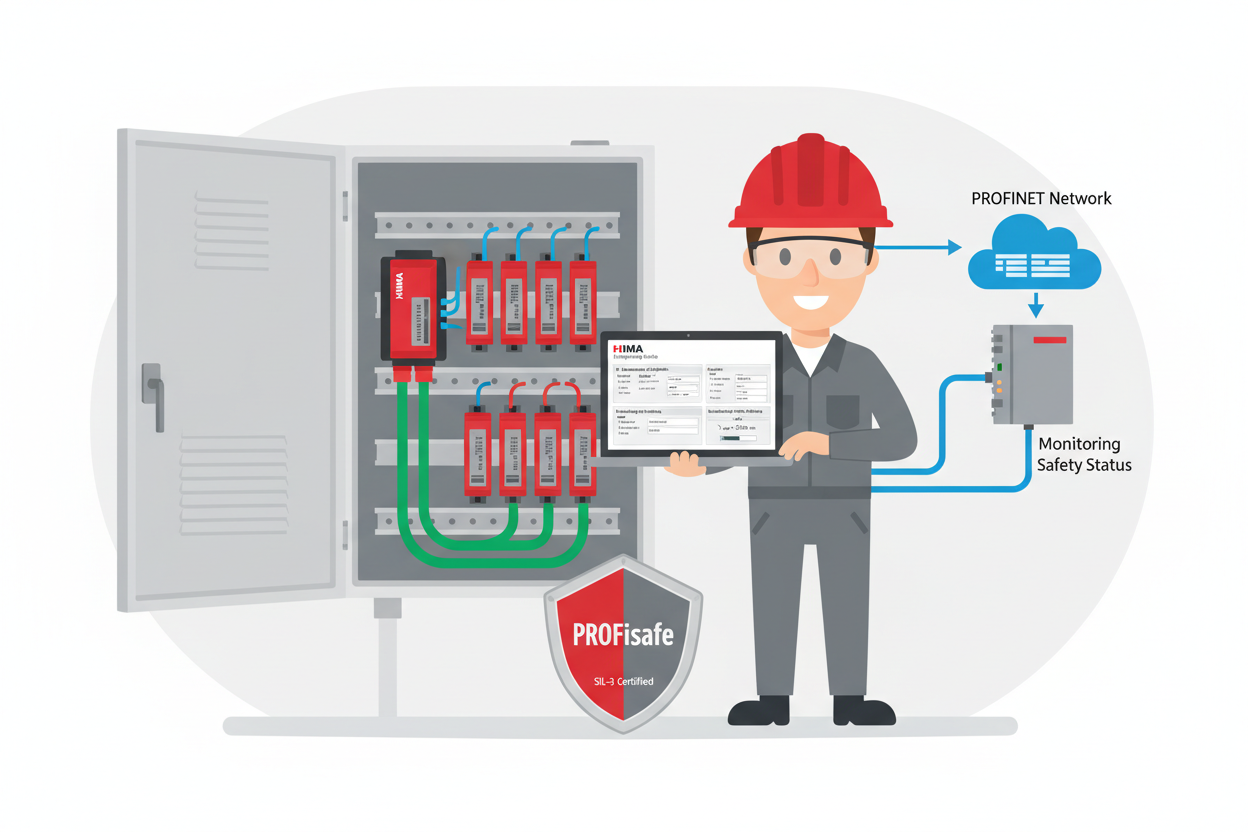
Q: What Makes HIMA Safety Controllers Suitable for Process Safety Applications?
HIMA provides high-integrity safety solutions for process industries. The HIMatrix and Px series controllers support PROFIsafe protocol, enabling seamless integration with standard PROFINET networks while safety functions operate independently from standard automation. The system achieves SIL 3 certification per IEC 61508.
The HIMA F3 DIO 20/8 01 HIMatrix Digital Input/Output Module provides the SIL-rated field I/O channels for safety instrumented functions, while the HIMA Z7136 Safety Related HIQuad Digital Output Module provides the hardwired discrete output channels for final control elements in HIQuad-based safety systems.
Q: How Do I Set Up the Hardware and Network Architecture?
- Step 1: Install the HIMA controller in the cabinet and verify power supply voltage and current margins.
- Step 2: Connect the PROFINET cable to the safety interface module.
- Step 3: Configure the PROFINET interface using HIMA Engineering Studio. Assign a unique IP address for the safety network.
- Step 4: Set the F-destination address (safety address) for each safety device. This address uniquely identifies each device in the PROFIsafe communication.
Verify the watchdog time parameter — this defines the timeout for safety communication. The typical value is 100 ms for standard applications. Adjust based on network latency and application requirements. Shorter times increase safety response speed but may cause nuisance trips on congested networks.
Q: How Do I Configure PROFIsafe Communication in HIMA Engineering Studio?
- Step 1: Create a new safety project in HIMA Engineering Studio. Define the safety network topology and import device descriptions from the hardware catalog.
- Step 2: Configure the F-parameters for each device: watchdog time, data length, and operating mode. Set the F-source address to match the controller configuration.
- Step 3: Program the safety logic using function block diagrams. Use certified safety function blocks from the HIMA library — never use uncertified custom logic for SIL-rated functions.
- Step 4: Verify the logic in simulation mode before commissioning. Confirm all safety functions respond correctly to test inputs.
Q: How Does HIMA Integrate with the Process Control System?
HIMA controllers communicate with standard PLCs via PROFIsafe over the PROFINET network. Configure the standard PLC project to read safety status using standard read/write functions to access safety variables. This enables a unified operator interface for both safety and process control.
However, never route safety control through standard PLC logic. Safety functions must execute in the safety controller independently. Standard PLCs can only monitor safety status — actual trip decisions remain with the safety controller. This architecture maintains safety integrity levels per IEC 61511.
Q: How Do I Diagnose and Troubleshoot PROFIsafe Communication Faults?
- Step 1: Access the diagnostic view in HIMA Engineering Studio. Monitor the safety network status and check the green LED on each safety device.
- Step 2: Check the F-runtime status for each safety module. Verify the F-communication indicator shows proper operation.
- Step 3: Review communication quality indicators and the diagnostic buffer for any communication faults.
- Step 4: Analyze the fault history for patterns. Recurring faults at specific intervals indicate network congestion or cable integrity issues.
Regular diagnostic checks prevent unexpected failures. Document all safety device replacements and parameter changes. Maintain a backup of safety projects in a secure location. Train maintenance personnel on PROFIsafe troubleshooting to ensure reliable safety system operation.
What Is the Key Action Advice?
Always maintain separation between safety and standard automation — this is the fundamental architectural requirement of IEC 61511. Conduct regular proof tests per SIL requirements and document all changes using management of change (MOC) procedures. Train operators on safety system response during alarms. For complex applications, partner with certified HIMA integrators. Consider redundant architecture for critical safety functions where a single controller failure would be unacceptable. This approach maximizes plant safety and operational efficiency.
Author: Liu Yang is an industrial automation engineer with over 10 years of experience in PLC, DCS, and control systems.


