

Thermocouple Cold Junction Compensation Failure: Diagnosis and Fix on Allen-Bradley and Foxboro Systems
What Cold Junction Compensation Does — and Why It Fails
A thermocouple generates a voltage proportional to the temperature difference between its hot junction (process) and cold junction (module terminals). CJC corrects for this terminal temperature in real time. Without accurate CJC, every degree of ambient rise at the module terminals adds a direct error to the measured temperature.
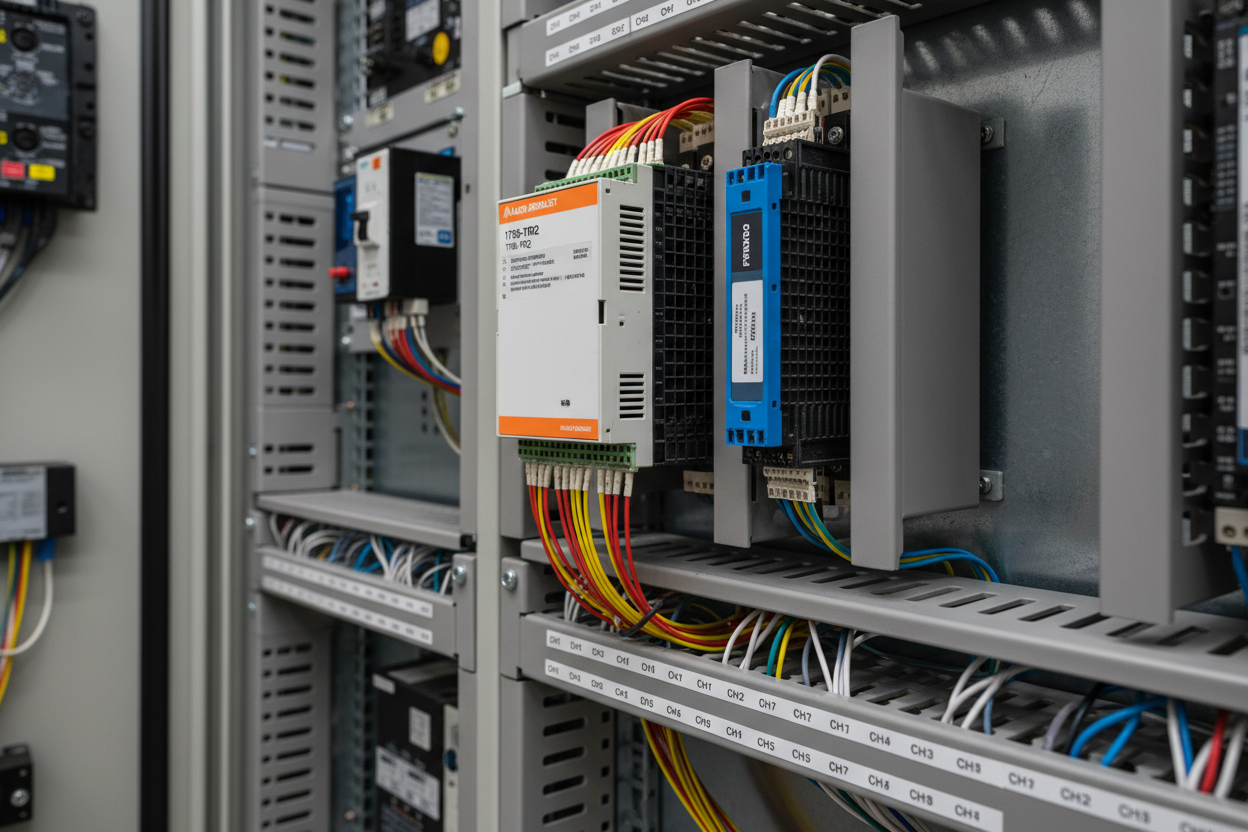
On the Allen-Bradley 1756-IT6I2 thermocouple input module, CJC uses an onboard isothermal block with two embedded RTD sensors. The module firmware reads these sensors every 60 ms and applies the correction polynomial defined in IEC 60584-1 for Type K, J, T, E, R, S, and B thermocouples. The correction formula is straightforward:
T_process = T_EMF_lookup(V_input) + T_CJC_RTD
If T_CJC_RTD reads incorrectly, the error transfers directly to T_process. A 5°C CJC offset produces a 5°C temperature reading error — independent of loop wiring, transmitter calibration, or PLC scaling.
On Foxboro I/A Series FBM04, the CJC approach differs. The FBM04 uses a single thermistor per sub-board (4 channels share one CJC). A thermistor drift or solder joint failure affects all four channels on that sub-board simultaneously. This is a key diagnostic clue in the field.
Recognizing CJC Failure Patterns in the Field
First, note that CJC errors are not constant — they track ambient temperature. A reading that is correct at 20°C but reads 6–8°C high at 35°C is a classic CJC signature.
Second, check whether multiple channels drift together. On the 1756-IT6I2, the two onboard RTDs cover channels 1–4 and channels 5–6 independently. If channels 1–4 all show the same positive offset while channel 5–6 are correct, the RTD for the first group is suspect. On the FBM04, four channels on one sub-board shifting together confirms a thermistor fault.
Third, compare the live CJC reading to an independent reference. The 1756-IT6I2 exposes the CJC temperature in Studio 5000 tag Local:Slot:I.Ch0CJTemp. Place a calibrated PT100 probe at the module terminals. If the tag reads 28.5°C while the PT100 reads 23.2°C, the RTD or its reference resistor has failed.
Moreover, seasonal patterns confirm CJC involvement. Operators often report "transmitter drift" that appears every summer. Review historian trends against ambient temperature logs. A correlation coefficient above 0.85 between reading error and ambient temperature strongly indicates CJC origin.
Six-Step Diagnosis Procedure
- Step 1: Record the reading error at different times of day. Log process temperature, module CJC tag, and a local thermometer at the panel. Confirm the error tracks ambient temperature, not process changes.
-
Step 2: On Allen-Bradley 1756-IT6I2, open Studio 5000 Controller Tags. Check
Local:n:I.Ch0CJTempthroughCh5CJTemp. Compare each CJC tag to a PT100 probe placed within 50 mm of the module terminal block. Acceptable deviation: ±0.5°C. Deviation above ±2°C confirms RTD failure. -
Step 3: On Foxboro FBM04, use the Foxboro DCS SoftSink diagnostic tool. Navigate to the AI block for the suspect channel. Check the
FIELD_VAL_Dparameter. A Bad or Uncertain quality code with no loop wiring fault points to the thermistor reference circuit. - Step 4: Measure terminal block temperature with an IR thermometer or contact probe. Compare this physical measurement to the CJC reading. A discrepancy above 3°C requires hardware replacement or software offset correction.
-
Step 5: Apply a temporary software offset while awaiting hardware. On the 1756-IT6I2, use the
CJOffsetparameter in the Add-On Instruction (AOI) wrapper. Set the offset to the measured discrepancy. Document the value and timestamp in the calibration record. On Foxboro FBM04, modify theCJ_OFFSETparameter in the AI function block. Note: software offsets are a temporary measure only; IEC 61511 SIS channels must not carry uncorrected hardware faults beyond the next proof test. Consider replacing the Allen-Bradley 1756-CJC Thermistors Kit as the permanent fix. - Step 6: Replace the faulty module or sub-board. After replacement, perform a two-point calibration injection at 0°C (1.020 mV for Type K) and 500°C (20.640 mV). Verify output reads within ±0.5°C of injected reference. Update the calibration database and close the corrective maintenance work order.
RTD Multiplexing Scan-Order Errors on Multi-Channel Cards
RTD multiplexing introduces a subtler fault category. The 1756-IT6I2 scans channels sequentially with a settle time of 16.67 ms per channel at 60 Hz filter setting. If the filter is set to 10 Hz, settle time extends to 100 ms per channel. For a six-channel card, total scan time reaches 600 ms. High-rate temperature transients can cause apparent cross-channel contamination — a fast-changing channel affects the ADC reference before the next channel settles.
Furthermore, incorrect wiring of thermocouple compensation cable introduces another CJC-adjacent problem. Type K compensation cable uses green and white conductors per IEC 60584-3. Using standard copper wire between the thermocouple head and terminal block introduces a second thermocouple junction at the transition point. This junction generates its own EMF, which adds directly to the measured signal and is uncorrected by CJC.
Therefore, always inspect cable transitions at junction boxes. Identify any copper wire segments in the thermocouple signal path. Replace them with matched compensation cable. Verify cable polarity: reversed polarity doubles the CJC error instead of correcting it.
On Foxboro FBM04, the module supports both 2-wire and 3-wire RTD connections for CJC. A missing third wire on a 3-wire configured channel causes a constant 0.3–0.8°C lead resistance error. Check configuration parameter RTD_TYPE: set to 2WIRE or 3WIRE to match physical wiring. For a dedicated thermocouple/mV input solution, see the Foxboro FBM202 Thermocouple/mV Input Module.
Calibration Tolerance and Documentation Requirements
IEC 60584-2 defines accuracy classes for thermocouples. Class 1 Type K requires ±1.5°C or ±0.004×|T|, whichever is greater, from –40°C to +375°C. The Allen-Bradley 1756-IT6I2 specification adds ±0.1% of range module error. Total system accuracy must account for thermocouple tolerance, CJC error, module error, and cable resistance combined.
For a Type K thermocouple measuring 200°C with a 500°C range module:
- Thermocouple tolerance: ±1.5°C (Class 1)
- CJC accuracy: ±1.0°C (1756-IT6I2 specification)
- Module error: ±0.5°C (0.1% × 500°C)
- Total worst-case: ±3.0°C
For SIS applications, IEC 61511 Clause 11.6.3 requires instrument accuracy to be included in the SIL verification calculation. A CJC error above the budgeted tolerance must trigger a deviation report and corrective action within the defined response time.
Finally, all calibration records must include: as-found reading, correction applied, as-left reading, calibration date, technician ID, and reference standard traceability number. Store these records in the instrument management system and link them to the relevant ISA instrument tag sheet. For multi-channel thermocouple applications, the Allen-Bradley 1756-IT16 Thermocouple Analog Input Module offers expanded channel capacity with the same CJC architecture.
Conclusion and Action Advice
Cold junction compensation failures cause insidious, ambient-dependent temperature errors that drift with seasons rather than failing outright. Technicians who overlook the CJC circuit waste hours chasing loop wiring and transmitter faults. The diagnostic key is correlating the reading error with ambient temperature, then comparing the module's CJC tag to a physical reference probe. On Allen-Bradley 1756-IT6I2, check the CJTemp tags per channel group. On Foxboro FBM04, inspect the sub-board thermistor and verify the RTD wiring mode. Apply software offsets only as temporary measures. Always close out with a two-point mV injection calibration and proper documentation. Catch CJC faults before they propagate into SIL calculations or cause process control deviations that trigger unplanned shutdowns.
Author: Chen Hao is an industrial automation engineer with over 10 years of experience in PLC, DCS, and control systems.


