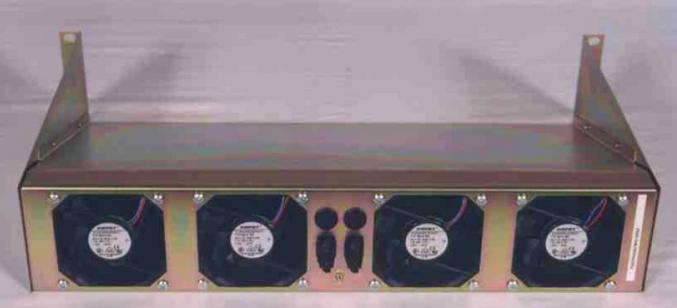
T8270 Trusted 24 Vdc Fan Assembly Rack Mounted

T8270 Trusted 24 Vdc Fan Assembly Rack Mounted

Features:
• Simple installation and connection.
• Capable of moving 69 m3/h (40.6 ft3/min).
• 24 Vdc operation.
• Low noise (32 dB per fan)


The Trusted Fan Tray 24 Vdc Rack Mounted comprises four fans mounted vertically at the rear of a 2U high chassis. The chassis containing the fans incorporates a baffle to prevent air drawn by the fans flowing through the module chassis immediately above the Fan Tray. Air exhausted by the fans into the rear of the system cabinet is drawn upwards and out of the cabinet by roof-mounted fans.


The Fan Tray is powered from dual 24 Vdc supplies arranged such that the fans are supplied in pairs via 250 mA anti-surge fuses. The 0 V supply is connected via terminal block TB1.


We have many ICS Triplex modules, click for seeing.


Item Description
T8270 RACK FANS TRUSTED PART NUMBER:T8270 FAB: ROCKWELL
T8153 TRUSTED CCOAT WITH INT ADP T8153 ROCKWELL
T8122 TRUSTED CCOAT MODBUS MASTER T8122 ROCKWELL
T8231C SOURCE 24 VDC TMR SIS - PART NUMBER: T8231C - FAB: ROCKWELL
T8311 EXPANSION MODULE CONTROLLER TRUSTED PART NUMBER: T8311 FAB: ROCKWELL
T8310 EXPAND PROCESSOR CONTROLLER TRUSTED PART NUMBER:T8310 FAB: ROCKWELL
T8100 TRUSTED PART NUMBER:T8100 CONTROLLER RACK FAB: ROCKWELL
T8300 EXPANSION RACK CONTROLLER TRUSTED PART NUMBER:T8300 FAB: ROCKWELL
T8290 TRUSTED OUTPUT POWER DISTRIBUTION UNIT PART NUMBER:T8290 FAB: ROCKWELL
TC-001-02-1M5 TC-001-02-1M5
TC-011-02-1M5 TC-011-02-1M5 - TRUSTED FAN POWERCABLE
TC-003-02-2M5 TC-003-02-2M5 - TRUSTED PWR CABLE (T8293 AND INPUT FTA
TC-306-02 TC-306-02 - TRUSTED I/P SMART SLOT JUMPER CABLE
TC-308-02 TC-308-02 - TRUSTED O/P SMART SLOT JUMPER CABLE
TC-201-02-4M5 TC-201-02-4M5 TRUSTED I/P FTA CABLE INT/40CH/COMPSLOT
TC-205-02-4M5 TC-205-02-4M5 TRUSTED O/P FTA CABLE INT/40CH/COMPSLOT
Show All
Blog posts
Show All
Software-Defined Manufacturing: A New Era of Industrial Automation

Software-Defined Manufacturing: A New Era of Industrial Automation

In the aerospace sector, SDM has proven invaluable for improving production efficiency and reducing costs. One manufacturer implemented an SDM solution to optimize the production of aircraft components. By integrating AI and machine learning into their manufacturing systems, the company could adjust production schedules and allocate resources based on real-time demand, minimizing waste and delays. As a result, the manufacturer was able to reduce lead times, lower costs, and increase production flexibility, allowing them to meet customer demands with greater efficiency.

Rockwell Automation: Advancing Towards Autonomous Operations with AI and Industrial Data Integration
plcdcspro

Rockwell Automation: Advancing Towards Autonomous Operations with AI and Industrial Data Integration

In practice, predictive maintenance has revolutionized manufacturing operations. For example, a large automotive manufacturer implemented AI-powered predictive maintenance across its global production lines. By analyzing real-time sensor data, the system predicted when machines were likely to fail, allowing maintenance teams to intervene before breakdowns occurred. This proactive strategy significantly reduced downtime and saved the company millions in repair costs, while also extending the operational life of the machines. The success of this program highlighted the potential for AI and automation to transform maintenance practices across industries.

ABB Strengthens Grid Automation with Netcontrol Acquisition to Meet Growing Demand for Digitalized Power Grids
plcdcspro

ABB Strengthens Grid Automation with Netcontrol Acquisition to Meet Growing Demand for Digitalized Power Grids

In real-world applications, ABB's grid automation solutions, combined with Netcontrol's technologies, can significantly improve the management of complex power grids. For instance, utilities facing the challenge of integrating increasing amounts of renewable energy can utilize predictive analytics to better forecast demand and optimize power flow. In regions prone to extreme weather, such as hurricanes or heatwaves, automation can enhance grid resilience by enabling rapid recovery and minimizing downtime during disruptions.