

Motor Bearing Temperature Monitoring and Vibration Protection Settings
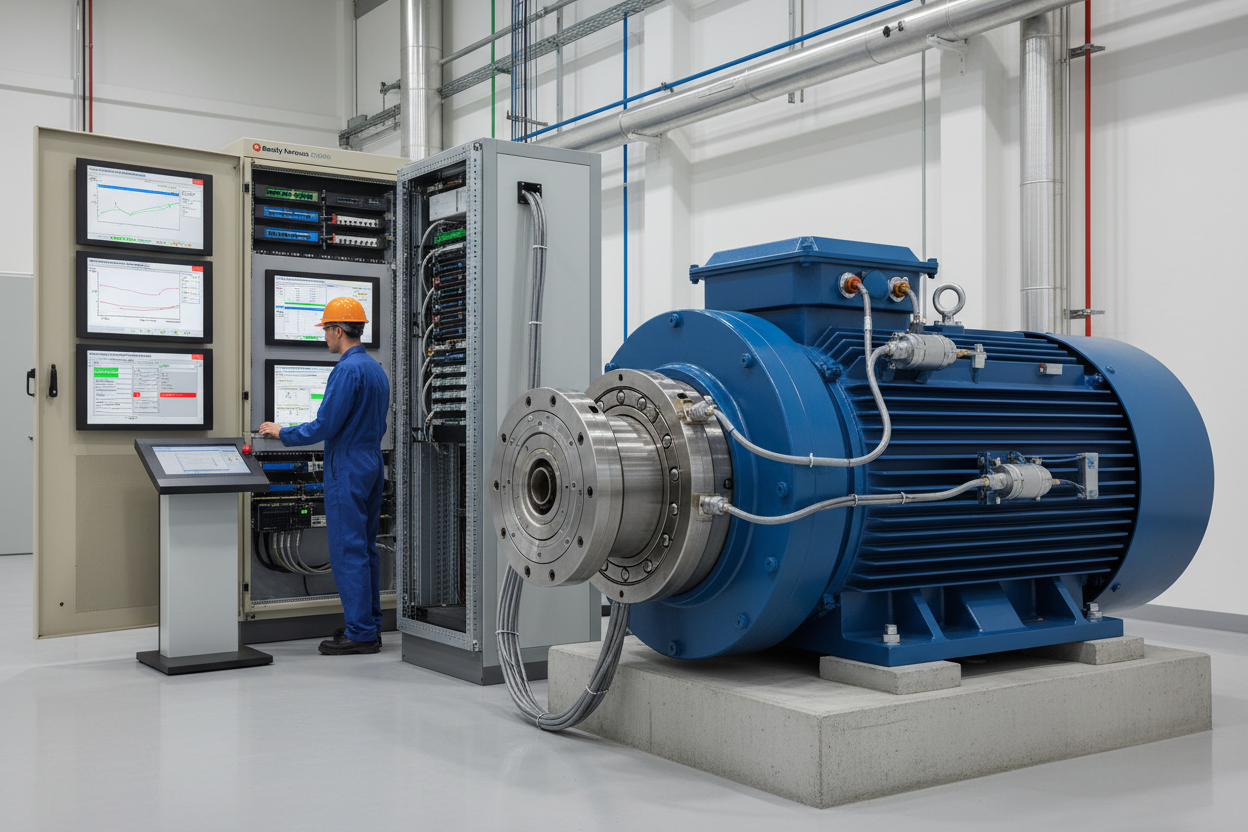
Why Bearing Temperature Alone Is Not Enough
Motor bearing failures account for approximately 50% of all rotating equipment breakdowns in process plants. Temperature monitoring catches bearing degradation — but only after mechanical damage has already begun. Vibration monitoring detects incipient faults weeks or months before temperature rises become measurable. For critical motors driving centrifugal compressors and boiler feed pumps, the best practice is to monitor both channels simultaneously and use cross-referencing logic to validate trip decisions.
API 670 (Machinery Protection Systems) defines separate alarm and trip thresholds for temperature and vibration. A bearing temperature alarm at 85°C and trip at 105°C combined with a vibration alarm at 5.0 mils peak-to-peak and trip at 8.0 mils provides comprehensive protection. The Foxboro I/A Series handles the temperature inputs through FBM224 (8-channel RTD module). The Bently Nevada 3500 system handles vibration monitoring and communicates trip status to the I/A Series via Modbus TCP.
Foxboro I/A Series RTD Configuration
Each motor bearing typically carries one PT100 RTD embedded in the bearing housing — one for the drive-end (DE) bearing and one for the non-drive-end (NDE) bearing. Wire these RTDs to separate FBM224 channels. Never share a channel between two bearings.
- Step 1: Wire each PT100 to the FBM224 using three-wire configuration (one lead common, two leads for resistance measurement). This eliminates lead-wire resistance error up to 15 ohms — critical for field cables longer than 50 meters.
- Step 2: Configure the FBM224 channel in the Foxboro I/A Series Control Builder. Set sensor type to PT100 (IEC 60751 Class B, ±0.3°C at 0°C). Set range to 0–150°C for motor bearing service.
- Step 3: Set the low-alarm threshold to 70°C. Set the high-alarm at 85°C per API 670 guidelines. Set the high-high-alarm (trip) at 105°C.
- Step 4: Configure a 3-second alarm delay on all three thresholds. Temperature alarms without delay produce nuisance trips during motor startup when bearing temperature rises from ambient to steady-state within 15 to 30 minutes.
- Step 5: Map the FBM224 channel output to an I/A Series AIM (Analog Input Module) block. Configure the AIM block with a 0.5% deadband to suppress noise on long RTD cable runs.
Bently Nevada 3500 Modbus TCP Integration
The Bently Nevada 3500 rack monitors vibration, axial displacement, and bearing temperature. It communicates with the Foxboro I/A Series over Modbus TCP. The 3500/20 rack interface module acts as the Modbus TCP server at the configured IP address and port 502.
On the Foxboro I/A Series side, configure a Modbus TCP client block in the Control Builder. Set the server IP to the 3500/20 IP address. Set the poll rate to 500 ms. Map the following holding registers from the 3500 Modbus map:
- Register 3301 — Vibration Overall Amplitude, DE bearing (16-bit signed integer, mils × 100). Divide by 100 to obtain mils.
- Register 3302 — Vibration Overall Amplitude, NDE bearing (same scaling).
- Register 3305 — Alarm Status Word (bit-mapped: bit 0 = DE alarm, bit 1 = DE trip, bit 2 = NDE alarm, bit 3 = NDE trip).
- Register 3310 — Bearing Temperature, DE (16-bit signed integer, °C × 10). Divide by 10.
Configure a communication timeout of 2 seconds in the I/A Series Modbus client. If the Bently Nevada 3500/42 vibration monitor fails to respond within 2 seconds, the I/A Series marks all registers as BAD quality and triggers a "Communication Loss" diagnostic alarm. Never auto-assign a default value on communication failure — a stale value can mask a genuine vibration trip.
Cross-Reference Diagnostics: Temperature vs Vibration
A healthy motor shows stable bearing temperature at steady-state load and vibration below 2.0 mils. When bearing degradation begins, vibration increases first — typically rising from 2.0 mils to 4.0 mils over several weeks. Temperature remains stable during this early phase. Only when mechanical wear accelerates does temperature begin to rise above the 70°C low-alarm threshold.
Implement a cross-reference diagnostic in the I/A Series using a CALC block with the following logic:
- IF (DE_Vibration > 4.0 mils AND DE_Temperature < 70°C) THEN alarm “DE Bearing Wear Detected — Vibration High, Temperature Normal. Schedule bearing inspection within 72 hours.” This early-warning logic catches bearing problems during the vibration-only degradation phase — weeks before temperature alarms activate.
- IF (DE_Temperature > 85°C AND DE_Vibration < 2.0 mils) THEN alarm “DE Bearing Temperature High, Vibration Normal — Check lubrication system and cooling fan.” This condition often indicates a lubrication failure rather than mechanical wear, requiring a different maintenance response.
Conclusion and Action Advice
Motor bearing protection requires both temperature and vibration monitoring to detect faults at the earliest stage. Configure Foxboro I/A Series FBM224 RTD channels with API 670 alarm thresholds (85°C alarm, 105°C trip) and a 3-second startup delay. Integrate Bently Nevada 3500 vibration data via Modbus TCP with 500 ms polling and a 2-second communication timeout. Implement cross-reference diagnostics to generate early warnings during the vibration-only degradation phase.
Review the Bently Nevada 3500/40 proximitor trend data monthly — a vibration increase of 0.5 mils per week on a centrifugal compressor DE bearing warrants immediate grease replenishment and a 30-day vibration monitoring increase to daily checks. These practices extend bearing life by 40% to 60% and prevent the catastrophic motor failures that shut down production lines for days.
Author: Li Wei is an industrial automation engineer with over 10 years of experience in PLC, DCS, and control systems.


