

Improving Industrial Emissions Monitoring with Analyzer Diagnostics
Improving Industrial Emissions Monitoring with Analyzer Diagnostics
How instrument health information can help maintenance teams distinguish measurement problems from actual process changes.
Why Does Instrument Health Information Matter in Industrial Emissions Monitoring?
Continuous emissions monitoring systems (CEMS) and industrial process gas analyzers provide the regulatory and operational baseline for power generation, refining, petrochemical, and chemical plants. These critical instruments safeguard environmental compliance, trigger plant abatement controls, and protect operating licenses.
When an emissions reading spikes or drifts unexpectedly, plant personnel face an immediate dilemma: is the boiler or combustion process genuinely deviating, or has an analytical measurement component failed? A clogged filter, unheated sample transport line, depleted optical light source, or calibration drift can easily trigger false environmental exceedance alarms. Comprehensive analyzer diagnostics supply instrument health telemetry that enables maintenance engineers to isolate hardware faults from real combustion events within minutes.
How Do You Diagnose Faults Across the Entire Sampling and Measurement Chain?
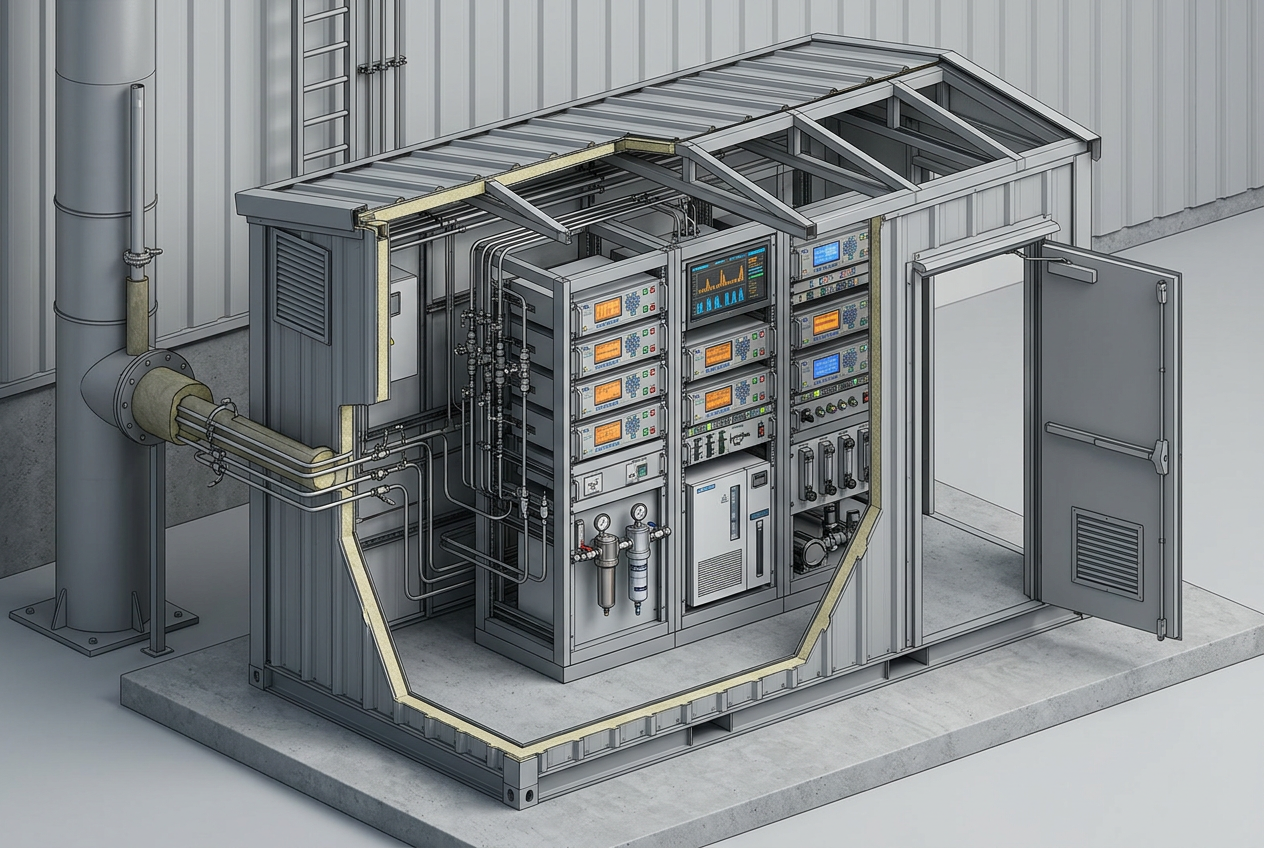
An optical, paramagentic, or electrochemical gas analyzer is only the final detector in an extensive sampling train. A complete extractive system includes the stack probe, coarse sintered filter, heated Teflon transport bundle, sample gas cooler, peristaltic condensate pump, fine coalescing filters, and regulated rotameters.
Over 80% of reported analytical measurement failures originate in the sample conditioning train rather than the analytical detector itself. For instance, cooler failure allows liquid moisture into the measurement cell, quenching infrared absorption bands or damaging sensor optics. In complex multi-stream installations, integrating dedicated field multiplexers such as the Yokogawa AMM42 2-Wire Transmitter Input Multiplexer Module helps capture auxiliary field sample parameters (line pressures, sample flow rates, and enclosure temperatures) alongside core gas concentrations.
What Critical Diagnostic Parameters Can Modern Gas Analyzers Reveal?
Modern continuous analyzers generate rich diagnostic arrays that reflect internal operating conditions well beyond raw 4–20 mA current outputs. Key diagnostic vectors include:
Optical bench health: Optical chopper motor speeds, optical source emission currents, detector reference voltages, and beam intensity attenuation percentages (revealing cell window dirt accumulation).
Sample flow and cell pressure: Differential pressure transducers across sample filters and internal flow sensors detect sample starvation or backpressure fluctuations before measurement readings flatline.
Thermal stability: Temperature sensors on detector blocks, ovens, and chillers ensure gas density and absorption cross-sections remain within precise factory calibration curves.
How Can Maintenance Teams Use Trend Data and Predictive Baselines to Prioritize Repairs?
While discrete threshold alarms alert technicians to outright hardware failure, trending diagnostic parameters reveals gradual mechanical and optical degradation weeks in advance. A steady climb in sample pump vacuum indicates coalescing filter saturation; gradual attenuation in infrared reference channels flags optical window fouling.
By capturing high-frequency analog diagnostic channels into dedicated industrial logging and recording hardware—such as the Yokogawa S9950DD-01 Data Acquisition Module—maintenance teams can establish baseline performance profiles across weather seasons and plan preventative filter changes and optical cleanings during scheduled turnaround windows.
How Should Analyzer Health Telemetry Be Integrated into Plant DCS and Historians?
Historically, analyzer shelters were isolated "black boxes" transmitting only single analog values back to the control room. Today, modern industrial architectures leverage intelligent digital communication protocols to transmit status flags, maintenance mode interlocks, and detailed diagnostic registers directly to the plant Distributed Control System (DCS).
Deploying digital bus modules like the Yokogawa ALF111-S50 FOUNDATION Fieldbus Communication Module enables seamless bi-directional communication between field instruments and CENTUM DCS architectures. Similarly, for legacy analog systems, specialized smart interface cards like the Honeywell MU-GAIH13 Smart Transmitter Interface Board superimpose digital HART communication onto standard 4–20 mA loops, allowing operations to extract device health metadata without re-running physical field cabling.
What Key Items Belong on Your Analyzer Maintenance and Validation Checklist?
- Sample Line Integrity: Confirm heated sample lines maintain target temperature (>120°C for acid gases like SO2 and NOx) across the entire stack-to-shelter run to prevent cold spots and acid dew point condensation.
- Filter & Condensate Inspection: Inspect glass-bowl coalescing filters for particulate loading and ensure automatic peristaltic drain pumps clear condensate continuously.
- Daily Calibration Drift Check: Verify automatic zero and span calibration gas sequences; log daily drift percentages against EPA / EN 14181 QA/QC limits.
- Diagnostic Warning Audit: Investigate low-level diagnostic warnings (e.g., source attenuation >15%, flow drop >10%) before they escalate into invalid measurement flags.
- Fieldbus Communication Watchdog: Verify that DCS alarms clearly distinguish between instrument hardware failure, maintenance calibration hold, and true process emission spikes.
- Calibration Gas Quality & Tracing: Validate calibration gas cylinder expiry dates, balance gas certificates, and regulator delivery pressures.
Why Must Remote Diagnostics Never Be Confused with Regulatory Compliance Validation?
Advanced diagnostic dashboards and predictive AI summaries dramatically reduce troubleshooting hours, but they do not substitute for formal statutory validation. Environmental agencies (such as US EPA 40 CFR Part 60/75 or European QAL1/QAL2/QAL3 standards) mandate physical cylinder gas audits (CGA), relative accuracy test audits (RATA), and rigorous zero/span logs.
Diagnostic telemetry guides technicians to which mechanical subsystem requires attention; regulatory validation verifies that the final recorded number stands up in court. Maintain clear separation between operational predictive tools and certified compliance documentation.
Summary & Practical Next Steps: How Should Environmental Engineering Teams Proceed?
Harnessing analyzer diagnostics transforms emissions monitoring from reactive crisis management into proactive condition-based maintenance. By monitoring the entire sampling train, capturing digital diagnostic parameters into the DCS, and systematically trending health baselines, facilities ensure continuous regulatory compliance while slashing unbudgeted downtime.
Article contributed by Lin Wei, Senior Process Analytical & Environmental Instrumentation Specialist at PLC DCS Pro Ltd.


