

Dragon Boat Festival: China's Ancient Festival of Loyalty, Tradition and Summer Rituals
🐉 🚣 🍙
Dragon Boat Festival · 端午节
China's Ancient Festival of Loyalty, Tradition and Summer Rituals
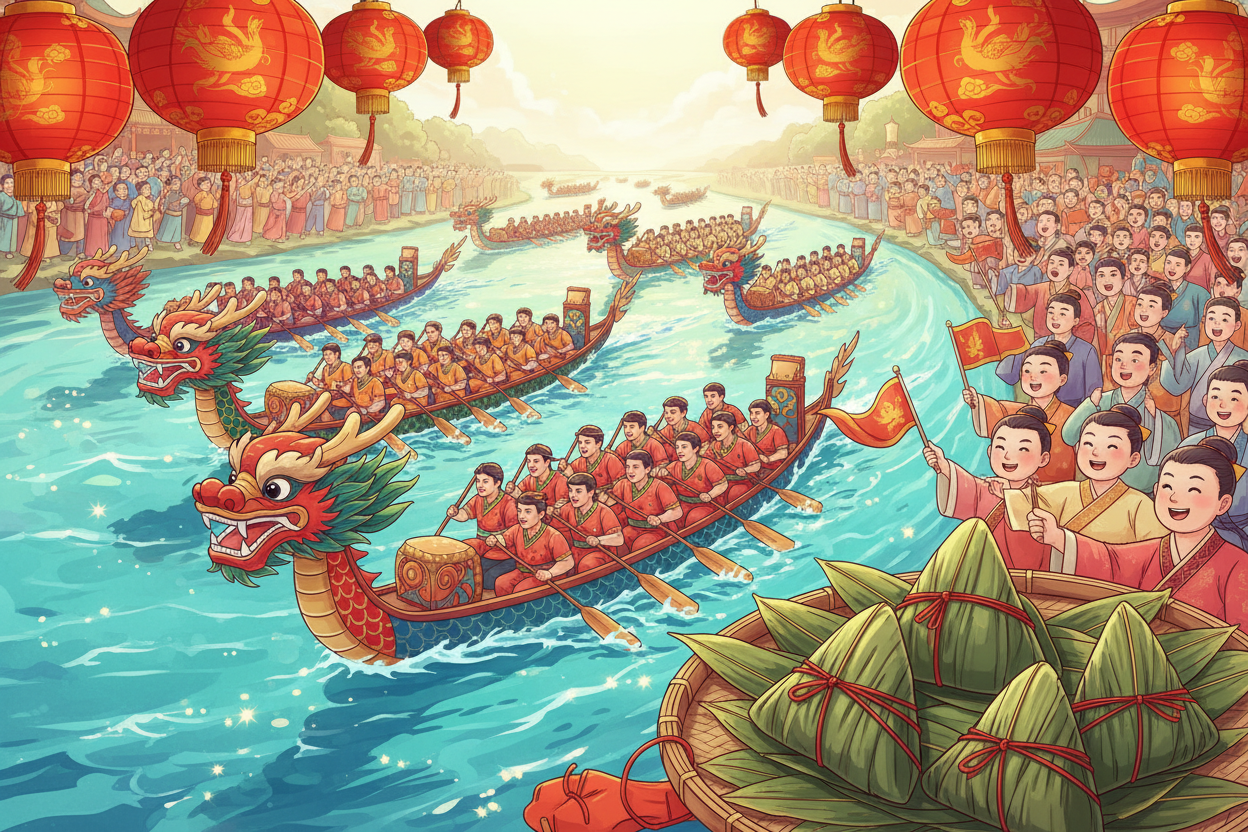
Every year, on the fifth day of the fifth lunar month, the rhythmic beat of drums echoes across rivers throughout China. Long dragon-shaped boats slice through the water as crowds cheer from the shore. Families gather around kitchen tables wrapping bamboo leaves around sticky rice, while children wear colorful silk bracelets believed to bring protection and good fortune.
This is the Dragon Boat Festival, known in Chinese as Duanwu Festival (端午节). With a history stretching back more than two millennia, it is one of China's oldest and most widely celebrated traditional holidays. Yet behind the excitement of boat races and the aroma of freshly made zongzi lies a fascinating story of ancient beliefs, political loyalty, seasonal health practices, and cultural identity.
Today, the Dragon Boat Festival remains a powerful symbol of Chinese heritage, connecting modern society with traditions that have survived dynasties, wars, revolutions, and globalization.
🏛️ Before Qu Yuan: Ancient Summer Rituals Along China's Rivers
While many people associate the Dragon Boat Festival exclusively with the poet Qu Yuan, historians believe the holiday's origins are actually much older. Long before written records connected the festival to patriotic sacrifice, communities living along the Yangtze River practiced seasonal rituals during early summer. The fifth lunar month was traditionally considered dangerous — rising temperatures, increased insect activity, and seasonal diseases threatened both crops and human health.
Ancient villagers responded with ceremonies intended to ward off evil spirits and protect their communities. Boats decorated with animal symbols were launched onto rivers, herbal plants were hung outside homes, and offerings were made to local water deities. Many scholars believe dragon boat races evolved from these early river rituals. The dragon itself was revered as a powerful symbol associated with rain, rivers, fertility, and agricultural prosperity.
📜 The Legend of Qu Yuan: How a Poet Became a National Symbol
No figure is more closely connected to the Dragon Boat Festival than Qu Yuan, one of China's most respected historical poets. Born during the Warring States Period more than 2,300 years ago, Qu Yuan served as an advisor to the King of Chu. He advocated political reform, opposed corruption, and warned against growing foreign threats. However, rival officials eventually succeeded in removing him from power.
Forced into exile, Qu Yuan spent years traveling through the countryside while watching his beloved kingdom descend into political decline. When news arrived that the capital of Chu had fallen to enemy forces, he reportedly walked to the banks of the Miluo River and threw himself into the water. Local villagers rushed out in boats to search for him, beating drums to scare away fish and throwing rice into the river to protect his body.
Whether entirely historical or partly legendary, the story transformed Qu Yuan into a lasting symbol of patriotism, integrity, and devotion to public service. More than two thousand years later, his name remains inseparable from the Dragon Boat Festival.
🚣 Dragon Boat Racing: The World's Oldest Team Sport?
The most dramatic expression of the Dragon Boat Festival is undoubtedly dragon boat racing. Teams of paddlers sit shoulder-to-shoulder in long, narrow boats decorated with brightly painted dragon heads and tails. A drummer positioned at the front maintains rhythm while a steersperson guides the vessel through the water. Success depends not on individual strength but on perfect synchronization — a crew of twenty paddlers must move as a single unit.
Modern dragon boat races combine ancient tradition with competitive sport. International federations organize championships attended by teams from dozens of countries, while major cities around the world host annual dragon boat festivals. What began as a local folk custom along Chinese rivers has evolved into a global sporting phenomenon.
- Traditional boats often measure over 20 meters in length.
- Race crews typically include paddlers, a drummer, and a steersperson.
- International events are now held across North America, Europe, Oceania, and Southeast Asia.
- Cultural festivals frequently combine racing with food markets, performances, and heritage exhibitions.
🍙 Zongzi: The Taste of Tradition
No Dragon Boat Festival is complete without zongzi (粽子) — glutinous rice dumplings wrapped in bamboo or reed leaves and tied with string. The fillings vary by region: savory versions may contain pork belly, salted egg yolk, or mushrooms, while sweet versions are filled with red bean paste, dates, or chestnuts.
Making zongzi is a family activity passed down through generations. The process of soaking rice, preparing fillings, folding leaves, and tying the bundles is as much about togetherness as it is about food. The finished dumplings are boiled or steamed, filling the home with a distinctive earthy, grassy aroma that many Chinese people associate with childhood memories of the festival.
🌏 A Festival That Belongs to the World
In 2009, UNESCO inscribed the Dragon Boat Festival on the Representative List of the Intangible Cultural Heritage of Humanity — recognition of its deep cultural significance and global reach. Today, dragon boat festivals are held in cities from London to Sydney, from Toronto to Singapore, bringing together communities of all backgrounds in celebration of teamwork, heritage, and the enduring human spirit.
Whether you are watching a race from the riverbank, sharing a plate of zongzi with family, or simply pausing to reflect on a story of loyalty told for two thousand years — the Dragon Boat Festival invites everyone to connect with something ancient, meaningful, and alive.
端午节快乐 — Happy Dragon Boat Festival! 🐉


