

Cold Loop and Hot Loop Testing: Yokogawa CENTUM VP and ABB 800xA Commissioning Procedures
Why These Two Tests Define Commissioning Quality
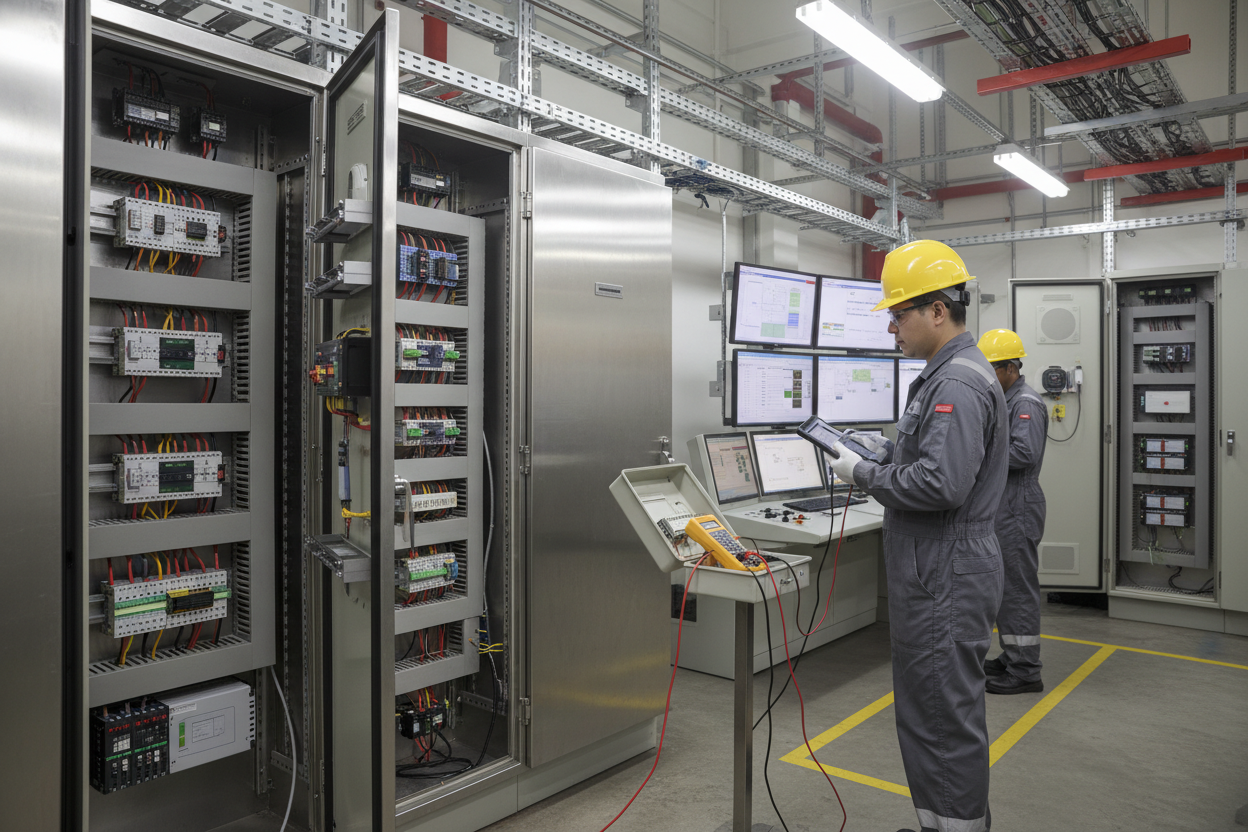
Every instrumentation engineer encounters the same startup pressure: operations wants the plant running, but control loops are not verified. First, skipping or rushing cold loop testing creates wiring faults that only appear during hot commissioning — under live process conditions where corrections are expensive and risky. Second, hot loop testing without a clean cold loop baseline produces misleading PID tuning results. However, engineers who execute both tests systematically on Yokogawa CENTUM VP and ABB 800xA systems cut commissioning cycle time by 30–40% compared to those who troubleshoot reactively. Therefore, understanding the exact procedure for each platform is a direct productivity and safety investment.
Cold Loop Test: Wiring Verification Before Power-Up
Cold loop testing happens before the DCS powers the field instruments. First, confirm the loop isolation — verify that the 24 VDC loop supply at the AI terminal strip is de-energized. Use a LOTO (Lock-Out Tag-Out) procedure on the AI marshaling cabinet power feeds. Second, use a digital multimeter on continuity mode to verify the signal cable from the field junction box to the AI card terminal. Resistance between the positive and negative terminals should read open circuit (no continuity) for an unterminated 2-wire transmitter loop — the transmitter itself provides the load. Any reading below 50 ohms indicates a cable short.
On Yokogawa CENTUM VP, the AI card used most frequently is the AAI141-S (16-channel 4-20mA). Each channel connects at the terminal unit (TU). During cold loop testing, use the Yokogawa FN310 HART communicator or Beamex MC6 in simulate mode to inject a 4 mA signal at the field JB. Read the raw count at the AI terminal strip using a multimeter — expect 24 VDC loop supply plus 4 mA load. Verify the signal reaches the TU terminal with less than 0.5% deviation from the injected value.
- Step 1: Confirm LOTO on loop supply. Measure voltage at AI terminal — must read 0 VDC before proceeding.
- Step 2: Use multimeter continuity mode — verify signal cable continuity from field JB to AI terminal strip. Resistance ≤ 50 ohms for cable run ≤ 300 m (typical 1.5mm² cable).
- Step 3: Check cable screen (shield) connection — connect at one end only (DCS marshaling cabinet earth bar). Verify shield is floating at the field JB. Dual-end shield connection causes ground loop noise.
- Step 4: Verify AI channel assignment in Yokogawa CENTUM VP Builder — tag number must match the physical terminal strip position and CENTUM database point tag.
- Step 5: Document continuity test results in the loop test record sheet — include cable resistance, shield verification result, and technician sign-off.
On ABB 800xA, the AI card is typically the S800 AI810 or AI830A (HART). Before energizing, verify the wiring in ABB Engineering Workplace — the S800 I/O channel list must match the field cable schedule. Moreover, check that the AI810 termination board (TB820 or TB830) DIP switch SW1 is set to "4-20mA" position (not "0-10V"). An incorrect DIP switch setting on the ABB AI810 is the most common cold loop failure cause found during audits.
Hot Loop Test: Signal Scaling and PID Verification Under Power
Hot loop testing begins after cold loop records show zero defects. First, energize the DCS AI card and loop supply in the marshaling cabinet. Second, confirm the transmitter powers up correctly — a HART transmitter should show device status "Good" within 15 seconds of energizing. Third, verify the DCS engineering unit readout against the calibrator injected current at three points: 4 mA (0% span), 12 mA (50% span), and 20 mA (100% span). The DCS reading must be within ±0.5% of span at each test point.
On Yokogawa CENTUM VP, access the AI channel calibration screen in CENTUM Builder under "Field Device" tab. Verify the "4mA Eng Value" and "20mA Eng Value" match the transmitter datasheet range — for example, 0 mmH2O and 2500 mmH2O for a DP level transmitter. Inject 12 mA from the calibrator (50% of 4-20mA span). The CENTUM VP Faceplate should display 1250 mmH2O ± 12.5 mmH2O. If it deviates, correct the 4mA and 20mA engineering unit values in the CENTUM VP database and re-download the tag configuration.
- Step 1: Energize loop supply and confirm transmitter HART device status "Good" on HART communicator within 15 seconds.
- Step 2: Inject 4 mA — read DCS engineering unit value. Verify it equals 0% process range (e.g., 0 mmH2O). Tolerance: ±0.25% of span.
- Step 3: Inject 12 mA — verify DCS reads 50% of span. Tolerance: ±0.5% of span.
- Step 4: Inject 20 mA — verify DCS reads 100% of span. Tolerance: ±0.25% of span.
- Step 5: Inject 3.6 mA — verify DCS generates "Under Range" alarm within 2 seconds. This confirms the alarm limit configuration is active.
- Step 6: Inject 20.8 mA — verify DCS generates "Over Range" alarm within 2 seconds.
On ABB 800xA, use ABB Operate IT Control Builder to check the AI function block "OUT" value during calibrator injection. The AI830A HART card reads HART primary variable independently and compares it to the analog input — a discrepancy greater than 2% triggers a HART diagnostic alarm in ABB 800xA Asset Optimization. Therefore, enable HART monitoring in the AI830A channel configuration to use this built-in cross-check as an additional hot loop verification step.
Control Loop Validation: PID Response Check on CENTUM VP and ABB 800xA
After verifying AI scaling, validate the complete control loop response. First, place the controller in Manual mode. Second, step the AO output from 0% to 25% and observe the process variable response time. Third, verify the control valve or actuator moves to the commanded position — use a positioner feedback reading where available. Fourth, place the controller in Auto mode with PID parameters set to proportional-only (P=1.0, I=0 repeats/minute, D=0 seconds) for initial testing. Step the setpoint by 5% and observe the process response.
On Yokogawa CENTUM VP, use the CENTUM VP Test Function in Control Drawing to force AO output values in Manual mode without modifying the running control strategy. This avoids the need to switch to engineering mode during hot loop testing — a significant safety advantage on operating plants. The AO output resolution on the Yokogawa AO card (AAT141) is 0.025% of span (0.004 mA), so verify the final control element responds to small step changes — a valve that does not respond to steps below 2% indicates stiction or positioner calibration issues.
On ABB 800xA, use the "Override" function in Control Builder ONLINE mode to force the PID output. Set AO to 4.0 mA (0% stroke), then 12.0 mA (50% stroke), then 20.0 mA (100% stroke). Record actuator position at each point. Moreover, use the ABB 800xA Fieldbus Builder to read positioner HART variables — for a Fisher FIELDVUE DVC6200, read "travel" and "set point deviation" directly from the positioner to confirm valve response independent of the analog signal path. The ABB AC 800M processor handles this communication natively.
Common Failures and Quick Fixes
First, the most common cold loop failure: DCS reads a fixed value regardless of calibrator input. This indicates the AI channel is configured for a different range (e.g., 0-5V instead of 4-20mA). On Yokogawa CENTUM VP, check the AAI141-S card hardware range jumper JP1. On ABB AI810, check DIP switch SW1. Second, the most common hot loop failure: DCS engineering unit value does not match process range at 50% input. This indicates the 4mA or 20mA engineering unit parameters are wrong in the DCS database — correct them and re-download the tag. Third, AI Over Range alarm fires immediately at 20 mA injection — this means the over-range alarm limit is set below 100% span. Set the Over Range limit to 20.8 mA (103% of span) as per ISA-5.4 recommendations.
Conclusion and Action Advice
Cold loop and hot loop testing are not optional checkbox exercises — they are the primary quality gate for every instrumentation loop on Yokogawa CENTUM VP and ABB 800xA systems. First, always complete cold loop verification before energizing any field device — cable shorts and miswiring found cold cost 10 minutes to fix. Hot, they cost hours. Second, verify AI scaling at three calibrated points (0%, 50%, 100%) on every loop without exception. Third, enable HART polling on ABB AI830A and Yokogawa CENTUM VP AAI141-S HART cards to provide continuous loop health monitoring after commissioning. Fourth, document every hot loop test result with time stamp, calibrator serial number, as-found and as-left values, and technician sign-off. Finally, perform a 24-hour continuous monitoring check on all critical process control loops before declaring commissioning complete — this catches intermittent wiring faults that appear only under thermal cycling conditions.


