

Clamp-On Ultrasonic Flow Meter Installation and Commissioning: Field Guide Using GE PT878 and Yokogawa ADMAG Series
Why Pipe Data Accuracy Determines Meter Performance
Clamp-on ultrasonic meters measure the transit-time difference between upstream and downstream pulses. This difference is proportional to fluid velocity. The meter converts velocity to volumetric flow using the pipe cross-sectional area. A 1 mm error in wall thickness shifts transducer spacing and introduces a 2 to 3% systematic error. The GE PT878 requires four inputs: outside diameter, wall thickness, pipe material, and lining material.
First, measure outside diameter with a Pi tape — not a caliper. Pi tapes account for out-of-round pipe and provide accuracy to 0.1 mm. Second, measure wall thickness with an ultrasonic gauge. Corrosion causes actual wall thickness to deviate 1 to 3 mm from schedule data. Third, select the correct pipe material. GE PT878 stores reference values for steel (5900 m/s), PVC (2340 m/s), cast iron (4500 m/s), and stainless steel (5800 m/s). Wrong material entry shifts acoustic path geometry and produces incorrect spacing. For inline electromagnetic flow measurement as an alternative, the ABB FSM4000 Electromagnetic Flowmeter provides high-accuracy wetted measurement for conductive fluids where clamp-on accuracy is insufficient.
Transducer Configuration: V-Method, W-Method, and Z-Method
V-method suits pipe diameters from 25 to 300 mm. The acoustic signal reflects once off the far pipe wall. This configuration is the default for most clean-fluid applications. Transducer spacing on a 150 mm steel pipe (10 mm wall, water service) typically falls between 110 and 140 mm. W-method uses two reflections and suits small pipes from 13 to 50 mm. However, W-method requires minimum signal strength of 60% on the GE PT878 display — below 50%, the reading becomes unreliable.
Z-method places transducers directly opposite each other with no reflections. Use Z-method on large pipes above 300 mm, on liquids with particle loading above 3% solids, or on pipes with internal scale or lining. Yokogawa ADMAG RSF series specifies Z-method for all pipes above DN300. For horizontal installations, mount transducers at the 3 o’clock and 9 o’clock positions. Never mount at 12 o’clock where gas pockets accumulate.
Coupling Compound Application and Surface Preparation
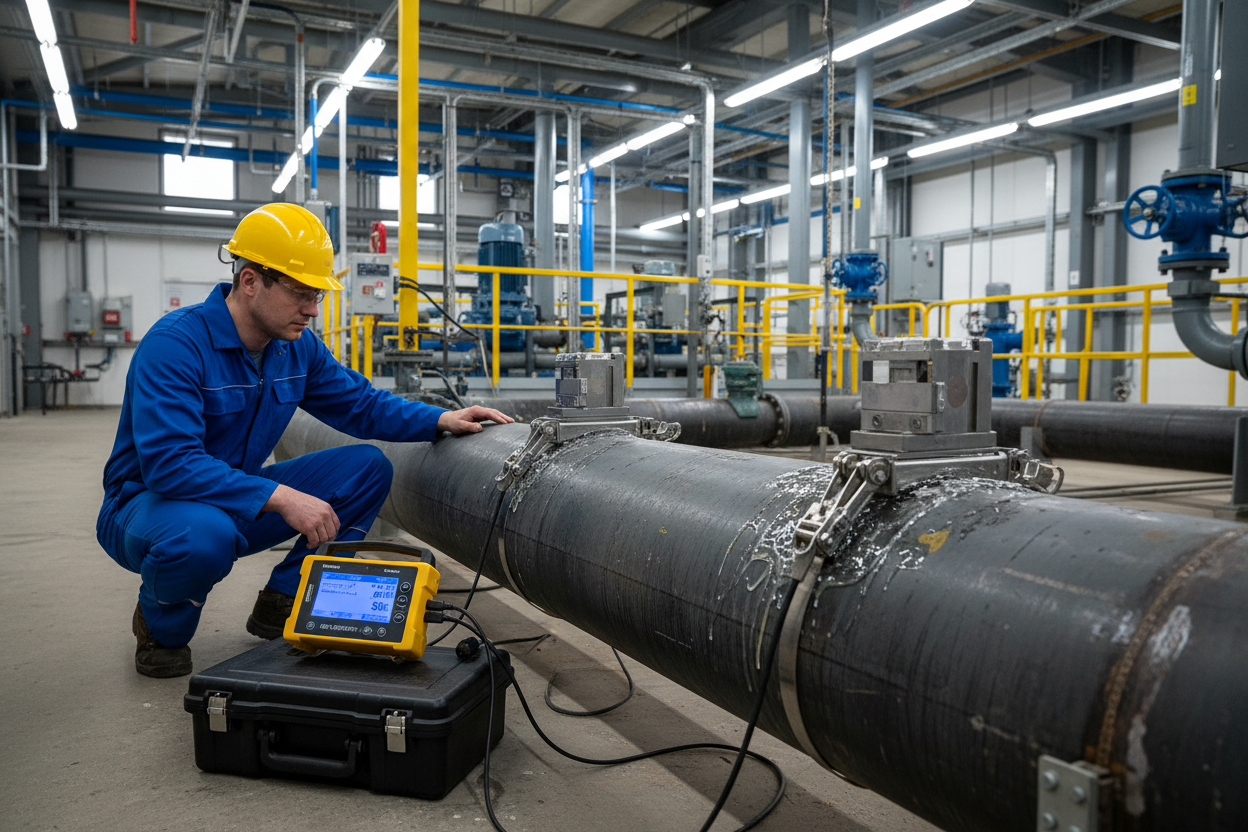
Poor coupling between transducer and pipe surface is the most common cause of low signal quality. GE supplies high-temperature Soundout gel for service up to 90°C and viscous Couplant D for temperatures up to 175°C. Do not substitute plumber’s silicone grease — its acoustic impedance mismatch with steel reduces signal transmission by 15 to 25 dB.
- Step 1: Remove loose scale, paint, and corrosion from the measurement zone using a wire brush or angle grinder. The pipe surface must be bare metal, clean, and smooth.
- Step 2: Apply coupling compound in a circular bead 5 to 8 mm in diameter to the centre of the transducer face.
- Step 3: Press the transducer firmly and rotate it 10 degrees before fixing the clamp strap. This breaks up air bubbles in the compound layer and improves contact uniformity.
Signal Quality Verification and Six-Step Fault Isolation
GE PT878 displays signal strength as a percentage. Above 75% indicates good coupling. Between 50% and 75% is marginal. Below 50% produces unreliable data. Yokogawa ADMAG displays a correlation factor — above 0.98 indicates reliable measurement, below 0.95 requires repositioning.
- Step 1: Recheck pipe outside diameter and wall thickness input values. A 2 mm wall thickness error shifts transducer spacing by 5 to 8 mm on a 150 mm pipe.
- Step 2: Clean the transducer face and pipe surface. Dried coupling compound or rust particles cause acoustic scattering that reduces signal by 20 dB.
- Step 3: Check for gas entrainment or heavy aeration in the liquid. Gas bubbles scatter ultrasonic signals completely. Relocate the measurement point further downstream.
- Step 4: Switch from V-method to Z-method on pipes with internal scale or lining above 3 mm. Z-method reduces acoustic path crossings and maintains signal strength on degraded pipe interiors.
- Step 5: Check the velocity of sound reading. Water at 20°C reads 1484 m/s. Light crude oil reads 1300 to 1400 m/s. Deviation more than 5% from the reference value indicates the transducers are coupling to a gas pocket or scale layer rather than bulk fluid.
- Step 6: Verify Reynolds number. GE PT878 accuracy specification of ±1% of reading requires Re above 10,000. Calculate Re = (ρ × v × D) / µ. Below Re = 4,000, accuracy degrades to ±2 to 5%. Install the meter further downstream or select an insertion meter for low-velocity applications.
Conclusion and Action Advice
Clamp-on ultrasonic meters provide reliable non-invasive measurement when correctly installed. Most commissioning failures trace to incorrect pipe data entry and inadequate surface preparation. Always measure wall thickness with an ultrasonic gauge rather than relying on nominal schedule values. Use Z-method for large pipes, scaled interiors, and high-solids fluids. Verify signal quality above 75% on GE PT878 and correlation factor above 0.98 on Yokogawa ADMAG before handing data to the DCS. These checks take 30 minutes and prevent months of unexplained flow errors.
Author: Liu Yang is an industrial automation engineer with over 10 years of experience in PLC, DCS, and control systems.


