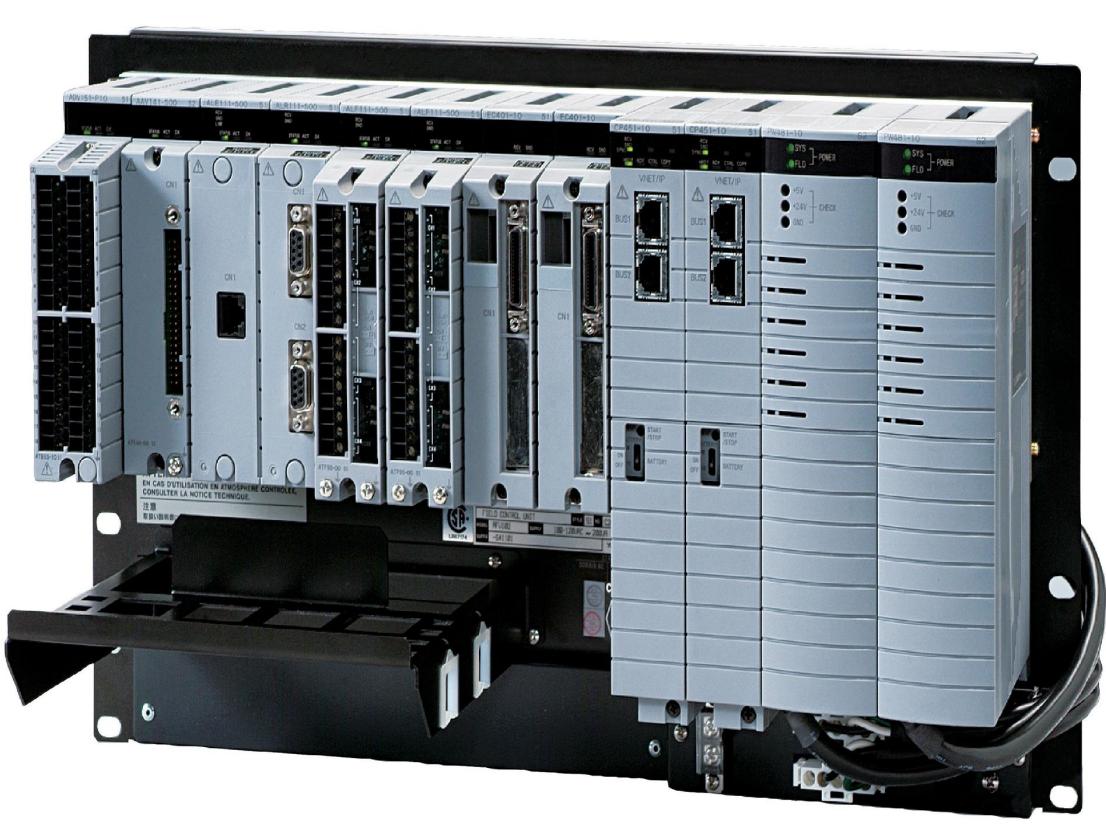
Yokogawa DCS CENTUM CS3000 Products

Yokogawa DCS CENTUM CS3000 Products

Among Yokogawa DCS products, the CENTUM CS3000 series is the most widely used. Here are some key points about this series in English:

Wide Application: The CENTUM CS3000 system has been implemented in various process plants by numerous manufacturers in China and is familiar to many users.
Technical Features:
It inherits the high reliability of the CENTUM series DCS, which was released in 1975, and incorporates the latest information technology, including the Windows operating system.
It has an open architecture, flexibility, and compatibility with existing systems.
It provides basic control functions including continuous control and sequence control blocks and advanced sequence control blocks such as unit instruments and Sequential Function Chart (SFC) blocks.
Over 200 types of function blocks are available to meet the needs of different process control applications for continuous and batch-processing control systems.
Network Structure: The CENTUM CS3000 system offers two types of network configurations: V-net type network and Vnet/IP type network structure.
Application Cases: In the paper industry, the CENTUM CS3000 system has gained widespread application. For example, in the Golden Bright Paper project, the system realizes the control of paper making processes.


AAI141-H00 S2 ANALOG INPUT MODULE
ADV151-P00 S2 DIGITAL INPUT MODULE
VI701 NETWORK DESKTOP CARD INTERFACE
ADV551-P00 DIGITAL OUTPUT MODULE
PW482-10 S2 POWER SUPPLY MODULE
Fan unit AIP601
I/O module ProSafe-RS SAI143-S03
I/O module AAI543-S00
D/O Module SDV531-S23
ALR121 SERIAL COMMUNICATION MODULE
CP451-10 S2 PROCESSOR MODULE
AIP827-2 USB OPERATION KEYBOARD
EB501-10 BUS INTERFACE MODULE
ANR10D-420 NODE INTERFACE UNIT
AAI841-H00 S2 ANALOG I/O MOULE
Battery Pack S9185FA
Analog Input Module AAI543-H50/K4A00
Analog Input Module AAI143-H50/A4S00
Network Control System Stardom
Optical transceiver AIP571
Terminal Boards SBA4D-06
Bus Interface Slave Module EB501-10

Show All
Blog posts
Show All
The Rise of the Smart Factory: Revolutionizing Industrial Automation in 2026
plcdcspro

The Rise of the Smart Factory: Revolutionizing Industrial Automation in 2026

  • Automotive Industry: Using AI-driven predictive maintenance and quality control systems, automotive manufacturers can achieve up to 12% reductions in unplanned downtime and ensure 100% defect-free products.

  • Aerospace: By integrating additive manufacturing with in-process quality inspection, companies can reduce production cycle times by 68% while ensuring high-quality, reliable aerospace components.

Japan's Compressed Air Filter and Dryer Market: Advancements and Key Players
plcdcspro

Japan's Compressed Air Filter and Dryer Market: Advancements and Key Players

In recent years, Japan has seen significant growth in its compressed air filter and dryer market, driven by the increasing demand for clean, dry air in various industrial operations. As automation continues to expand, industries require highly reliable air systems that meet strict air quality standards. From food packaging to metal fabrication, compressed air systems are playing a crucial role in maintaining operational efficiency and product quality. This article explores key developments in the market and highlights leading companies making strides in air filtration and drying technology.

Advancing Industrial Automation with Reflective Automation and Situated Intelligence
plcdcspro

Advancing Industrial Automation with Reflective Automation and Situated Intelligence

Industrial automation has historically been centered on the principle of control—ensuring efficiency by regulating systems within predetermined boundaries. However, with the rise of digitalization and connectivity, the next phase of industrial evolution emphasizes not just control, but awareness and interpretation. The focus is now on creating systems that not only observe their environments but understand them. This shift, from functional automation to reflective automation and situated intelligence, marks a significant transformation in how factories operate.