

The Evolution of Programmable Logic Controllers: 2026 Global Market Insights and Strategic Trends
The industrial landscape is undergoing a profound transformation. At the heart of this change lies the Programmable Logic Controller (PLC). As we move into 2026, these ruggedized computers are no longer just simple relay replacers. They have become the sophisticated brains of industrial automation. This report explores the market trajectory, emerging technologies, and the human capital challenges defining the next decade of factory automation.
Market Valuation and Growth Projections through 2031
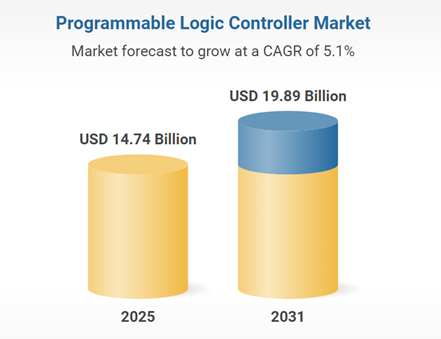
The global PLC market demonstrates robust financial health. Experts project the market will grow from USD 14.74 billion in 2025 to USD 19.89 billion by 2031. This represents a steady Compound Annual Growth Rate (CAGR) of 5.12%. While these figures are impressive, they reflect a deeper structural shift in manufacturing. Companies are moving away from legacy hardware toward interconnected control systems. This investment is no longer optional for firms seeking to remain competitive in a high-cost global economy.
Industry 4.0 and the Smart Manufacturing Revolution
Industry 4.0 is the primary engine driving modern hardware adoption. Manufacturers now require controllers that do more than execute local logic. Today's PLCs must manage massive data streams for edge analytics. Furthermore, they must facilitate seamless cloud integration. According to Rockwell Automation, nearly 95% of manufacturers are now evaluating smart technologies. This transition forces a continuous cycle of upgrades. Consequently, we see a growing demand for hardware that supports open protocols and rigorous cybersecurity standards.
Electrification: Driving Demand in the Automotive Sector
The shift toward Electric Vehicles (EVs) has revitalized the automotive automation segment. Legacy assembly lines require aggressive retooling to handle battery assembly and electric drivetrains. High-performance modular controllers are essential for this precision-heavy work. With global EV sales hitting record highs, the need for scalable factory automation is urgent. Leading players like Siemens AG have already reported significant revenue gains. These gains stem directly from increased capital expenditure in these specialized production environments.
The Skilled Labor Shortage: A Barrier to Expansion
Despite technological progress, a significant hurdle remains: the human element. There is a persistent shortage of technicians qualified to program complex control systems. Data from the National Association of Manufacturers shows that 65% of leaders struggle to find quality talent. In developing regions, this gap is even more pronounced. If a company cannot maintain a system, they will likely delay its implementation. Therefore, the talent gap acts as a direct brake on market expansion and hardware procurement.
AI Integration and the Rise of Autonomous Logic
Artificial Intelligence is moving from the laboratory to the factory floor. Modern PLCs now utilize Machine Learning (ML) to optimize process loops in real-time. Unlike static, rule-based instructions, AI-enabled controllers can predict anomalies before they cause downtime. I believe this shift toward "Self-Healing" systems is the most significant trend of the decade. Recent data shows a 12% year-over-year increase in manufacturers investing in generative and causal AI. This transition marks the end of passive automation and the beginning of truly autonomous control.
Software-Defined and Virtual PLC Architectures
The industry is currently witnessing the "decoupling" of software from proprietary hardware. Virtual PLCs allow control workloads to run on general-purpose edge servers. This architectural shift follows the standards set by IEC 61499, promoting greater interoperability. By virtualizing the controller, managers can update logic remotely. Moreover, this approach reduces dependency on specific hardware supply chains. Siemens’ recent financial success underscores the viability of this digital-first strategy. It allows for a more agile, IT-based approach to operational technology.
Analysis: The Future of Industrial Control
In my view, the convergence of AI and Software-Defined Automation will redefine the competitive landscape. Hardware will eventually become a commodity. The real value will lie in the sophisticated algorithms and data integration capabilities of the software layer. Companies that fail to adopt flexible, virtualized architectures may find themselves locked into expensive, rigid legacy ecosystems.


