

AI-Enabled Robotics Reshaping Food Manufacturing Automation
Why Industrial Automation Is Becoming Critical in Food Manufacturing
The food manufacturing sector faces persistent labor shortages, rising costs, and quality instability.Therefore, industrial automation has shifted from an efficiency option to a survival strategy.Factory automation, control systems, and AI-driven robotics now play a central operational role.
The U.S. Food Manufacturing Labor Crisis
According to U.S. labor statistics, food preparation recorded over one million unfilled positions in 2023.Moreover, annual turnover rates often exceed 150 percent across processing plants.As a result, manufacturers struggle to maintain stable production capacity and trained teams.
Operational Risks Caused by Labor Shortages
When labor availability declines, several operational risks appear simultaneously.First, manual portioning causes inconsistent meal quality.Second, overfilling increases food giveaway and erodes margins.Third, absenteeism forces reliance on temporary workers with limited training.Therefore, consistency and throughput suffer across the entire production line.
Why Traditional Factory Automation Fell Short
Many processors invested in depositors, dispensers, and fixed PLC-based equipment.However, traditional automation lacks flexibility for high-mix food production.Food ingredients vary daily based on preparation, cooking, and storage conditions.As a result, rigid mechatronic systems cannot adapt without costly downtime.
The Limits of Fixed Control Systems
Conventional PLC and DCS architectures perform well in stable environments.However, they struggle with variable food textures, shapes, and densities.Moreover, cleaning and changeover times often eliminate expected productivity gains.Therefore, many automation projects fail to scale beyond limited SKUs.
The Breakthrough of AI-Enabled Robotic Systems
AI-enabled robotics introduces adaptability missing from traditional control systems.Chef Robotics applies computer vision and machine learning to meal assembly tasks.These robots analyze ingredient properties in real time before each pick-and-place action.As a result, production lines achieve higher accuracy without sacrificing flexibility.
How AI Improves Factory Automation Performance
Unlike fixed automation, AI models learn from every production cycle.ChefOS collects operational data directly from live factory environments.Therefore, robots continuously improve portion accuracy, placement consistency, and speed.This learning loop creates compounding value over time.
Flexible Automation Designed for High-Mix Production
Chef robots handle frequent SKU changes without mechanical reconfiguration.Moreover, operators switch between recipes with minimal downtime.This flexibility mirrors human labor while maintaining machine-level consistency.As a result, manufacturers can automate previously manual assembly tasks.
Integration with Existing Control Systems
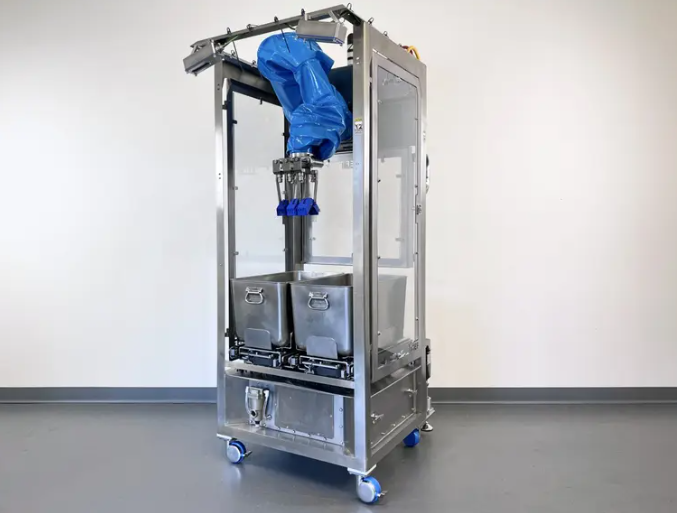
Chef’s robotic modules integrate smoothly into existing factory automation layouts.They require only standard power, compressed air, and wireless connectivity.Importantly, manufacturers avoid major PLC or conveyor retrofits.Therefore, deployment risk and installation time remain low.
Human-Centered and Food-Safe Robotic Design
Food safety and worker safety remain critical in processing environments.Chef’s robotic module holds NSF certification for food contact compliance.Additionally, collaborative design follows ISO/TS 15066 safety standards.As a result, robots and operators can work side by side safely.
Mobility and Line-Level Scalability
Each robot occupies the same footprint as a human worker.Moreover, casters allow operators to reposition robots between lines during shifts.This mobility maximizes utilization and supports dynamic production planning.Therefore, automation scales without locking equipment to a single process.
Measurable Results from Real Production Environments
Manufacturers using AI-enabled robotics report measurable performance improvements.Output often increases two to three times compared to manual assembly.Food waste reductions can reach up to 88 percent.Portion consistency improves by as much as 30 percent.These results come from live factory deployments, not lab simulations.
Robotics-as-a-Service Lowers Automation Barriers
Capital investment remains a major obstacle to factory automation adoption.Chef’s robotics-as-a-service model reduces upfront financial risk.Manufacturers pay for performance rather than ownership.Therefore, automation becomes accessible to mid-sized and growing processors.
My Perspective on the Future of Food Automation
Based on industry trends, manual meal assembly has limited long-term viability.Younger workers avoid repetitive tasks in cold production environments.Meanwhile, AI, vision systems, and adaptive control software mature rapidly.Therefore, early adopters gain long-term operational and data advantages.
Why Waiting Increases Competitive Risk
Automation systems improve through accumulated production data.Manufacturers who delay adoption lose this learning curve advantage.Moreover, competitors using AI-enabled robotics achieve superior consistency and cost control.As a result, late adopters face shrinking margins and customer dissatisfaction.
Application Scenario: Ready-to-Eat Meal Assembly
In ready-to-eat meal production, ingredient variability remains constant.AI-enabled robots pick proteins, vegetables, and grains from shared pans.They adjust placement and weight dynamically per tray compartment.Therefore, manufacturers achieve compliance, speed, and repeatable quality simultaneously.
Conclusion: Lead the Shift in Industrial Automation
AI-enabled robotics represents a practical evolution of factory automation.It bridges the gap between human flexibility and machine reliability.For food manufacturers, the technology already delivers proven results.The strategic choice now is whether to lead automation transformation or follow competitors later.


